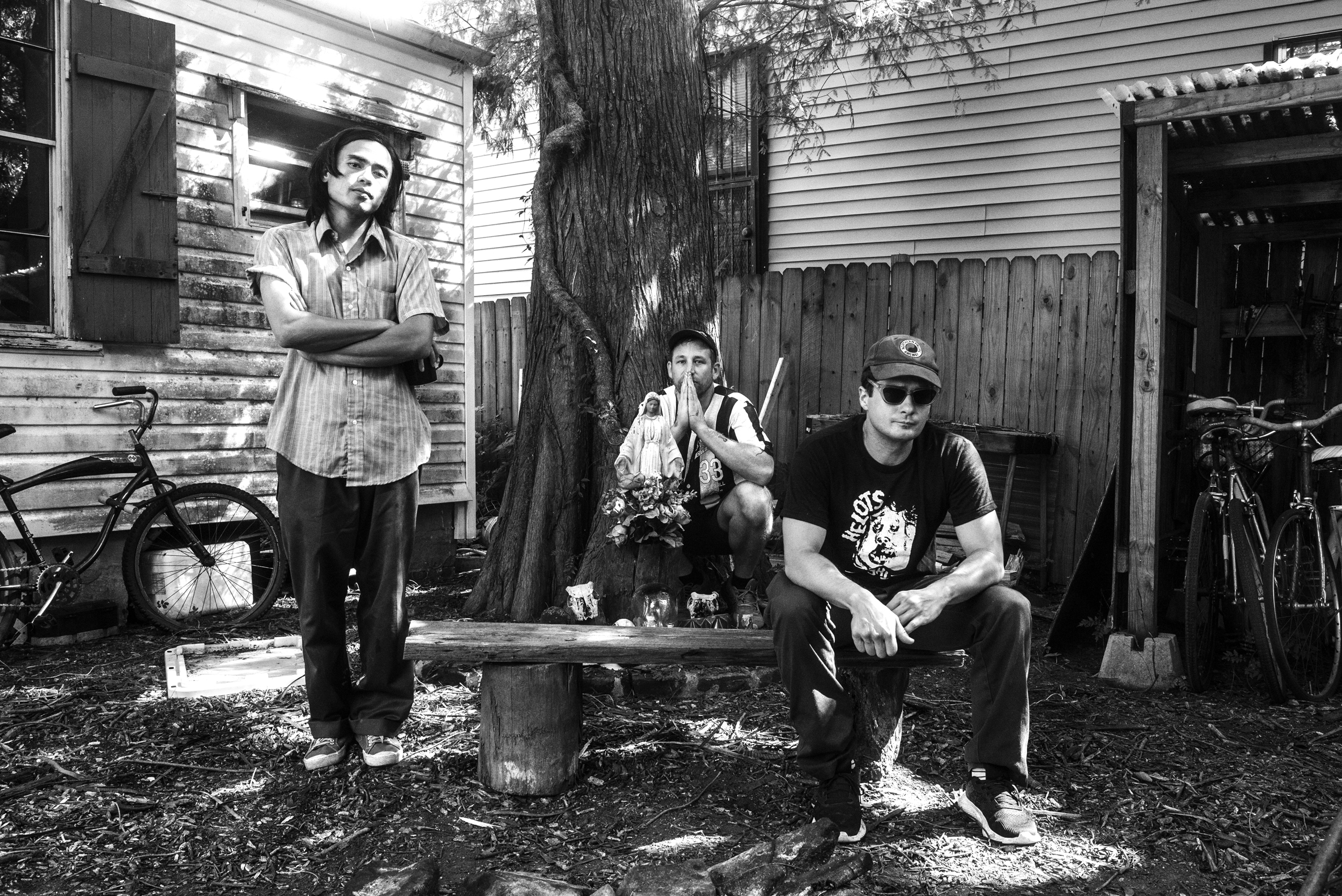
Twisted Teens don’t sit still for very long. They’ve learned they’re better in motion. The local band released their debut in April 2024 and hit the road later that year, doing a few runs around the United States before touring the summer of 2025 in Europe and recording an EP there. They then returned to the States to play Gonerfest in Memphis and record what would become their three 2026 releases, Blame the Clown, Florida Water Blues, and The Holy Cross Tigers. This year, they’ve continued touring the U.S. and achieved some major milestones, like signing with Sub Pop and opening for The Breeders. And they’re not slowing down. On November 6, Sub Pop will release The Holy Cross Tigers. Then on November 18, Twisted Teens opens for Kurt Vile at the Joy Theater as part of a three-week tour together.
To understand this New Orleans band—who seemingly sprung up overnight—I wanted to meet with the core duo and get to know their unique background as artists. Prior to Twisted Teens’ ascension, Caspian Hollywell (vocals and guitar) was perhaps best known for being in Santa Cruz folk punk band Blackbird Raum but has also performed in many other projects, including Cinder Well, Scissorbills, Chardonnay, Bellringer, and with Sonya Badigian and Nick Shoulders. The other half of the band, “Razor” Ramon Joseph Santos (steel guitar), began gigging in New Orleans in the late 2010s, performing with various country and Cajun bar bands such as NBD and The Big Deals, Noah Trahan, and the Sister Street Aces. Each year, he’d live about six months in New Orleans playing music before returning to Canada (due to his immigration status) to paint for the rest of the year. He’d make a living there as a sign painter in Dawson City, Yukon.
We meet at Caspian’s home in Holy Cross, which is especially restless. The front yard is overgrown, chickens are running around, and I hear cats yelping and neighbors hollering in the distance. Adding to the noise is the muffled sound of Atlanta punk band Sir & Sol recording in the front room of the home. I enter through a side gate to meet them in the backyard, past an old school bus. It’s a huge yard. There’s a shed full of bikes, a cookshack, a campfire, and an old delivery truck—and the lot extends further beyond that. I find Ramon (who goes by “RJ”) and the band’s live guitarist, Melrose “Mel” Billiard, out back. They pull up some chairs and offer me a drink. I sit down with Mel and RJ as Caspian dips in and out of the scene.
Caspian himself is equally as restless as his environment. He was absent at the start of the interview and would leave the conversation multiple times throughout the hour and a half I spent recording, while Mel and RJ, who felt they were unable to answer some questions without Caspian, sat with me. I assumed Caspian was attending to his guests up front but learned he was also taking care of t-shirt designs and press inquiries, so much so that he was doing a second interview on the phone with Mojo magazine. The band had just announced The Holy Cross Tigers a couple of days prior, and today was Monday, so the few remaining music publications in existence all seemed to want the scoop as they entered their work week—a testament to how hot this group’s brand of transplanted-New Orleanian rock’n’roll is at the moment.
Thanks again for meeting with me. What have y’all been up to today so far?
RJ Santos: What did I get up to today? I literally was just throwing a guy out of my house. He was squatting in my place and I didn’t want him there, and he kept refusing, so I just spent all morning throwing his shit out onto the curb.
Oh, that fucking sucks.
RS: No, it’s great. Can you put that in the magazine, that I spent my day throwing some guy out?
I can leave that out if you want.
RS: No, I want it in there. [laughs]
I want to ask about the new album, Holy Cross Tigers, and the name coming from an old high school team. Being in the Holy Cross neighborhood, does this place have some sort of influence on y’all musically?
RS: A lot of the content of the songs are [influenced by Holy Cross], and then even a lot of the sound is really coming from the Holy Cross. A lot of the homies that live in the neighboring areas, they play all types of different music, and Twisted Teens is an amalgamation of all that sound that is being produced. Even some of the steel licks in Florida Water Blues are just Cajun licks that I was stealing from playing in Cajun bands. I was playing in Cajun bands a year or two ago.
Where would you play?
RS: Saint Roch, BJ’s, Saturn.
Melrose “Mel” Billiard: The Tigermen Den, [for] Cajun brunch.

Performing at BJ’s Lounge on April 29
Going back a little bit, what was it about New Orleans that drew you?
RS: It was just by happenstance that I ended up here. I met some folks in Canada at a festival, and they were living in New Orleans, and they told me I could visit any time, so I did one year. And I just stayed, and I kept coming back every year. Because as a Canadian, I’m only allowed six months down in the States, so I have to keep coming back. So I would paint signs and pictures for six months and then come down here and practice music and try to play music with people for six months.
[Caspian drops in.]
Caspian, how did you end up finding this place and moving to Holy Cross?
Caspian Hollywell: I was walking past it and the dog ran in the house.
Was it abandoned or something?
CH: No, there was this old Polish guy that owned the whole neighborhood. He was the weed dealer, and he fixed Volkswagens. He had this circus woman in the house, and she refused to pay rent or anything. And eventually, the only way he could think to get rid of her, because he’s not the type to call the cops or anything, was to sell the house from under her. But then he hired this sheisty pseudo real estate agent woman and [she] fucked off to Mexico. She put the listing on. There was no sign outside saying the house was for sale, and then the pictures online were almost designed to where you wouldn’t even want to sell the house. Like one of the main photos was the bathtub with a bunch of skateboards in it. And the house was totally fucked up looking from the outside. Apparently some people came by trying to look at the house anyway. And that circus lady, she was just throwing them out, and she wouldn’t let the real estate agent show it. So there was nothing happening with the house. But then I was running past it one day and the dog ran in the house. And so I had to go in there. I ended up talking to the [circus] lady and she was like, “Yeah, they’re trying to sell the house.” And I was like, “Well, fuck it, I’m gonna buy it.” She’s like, “Well, I want you to buy it because you’re friends of friends.” She knew all those like Krewe du Poux people and all that shit. So we were the only ones allowed to look at the house. I ended up getting it for really cheap. [Pitchfork had a very different account of what happened in their interview published later in October.] That would’ve been a little over 10 years ago when I came back. But I lived here [before]. I was squatting in the Bywater on Rosalie Alley, which, at that point, was called Murder Alley. And I was squatting there in a house before Katrina, and I left a few months before Katrina. So I’ve been in and out of this place for a long time.
You are originally from California though, right?
CH: Yeah, I’m from the East Bay, and my dad’s from West Virginia, mom’s from Kansas. So like half the time I’m talking totally crazy different. That’s why when you listen to the records, I have like nine different accents—I’ve been moving around my whole life. I can’t keep one in my head.
RS: Yeah, when we were in Ireland, I started developing the Irish accent.
CH: After a whole summer of that—where you’re hanging out with Canadian punks and then you’re in Eastern Europe, and then you’re in fucking Ireland, and then you’re in the South—our accent at the end of it… especially me, I’m just like this crazy smattering of redneck-Euro-trash-East-Bay-bro. It doesn’t make any sense.
I feel like I read this somewhere, that y’all used to train hop?
RS: No comment. No comment.
CH: We’re not allowed to talk about that shit. There’s a lot of shit we used to do and some stuff we still do. But that’s really not everyone’s business, you know? Look, what are we gonna be like, “Oh yo, we used to train hop.” Then we look like poseurs to all the people that still train hop. You gotta talk to us about the songs, man. The lore should be implied from the vibes.
Being in New Orleans, and also ANTIGRAVITY being a New Orleans magazine, I wanted to know why you ended up here?
CH: Well, it’s a hub for busker culture, traveler culture, punk subculture, folk music, and also rap music. It’s a cultural hub for a lot of different things that we’ve shared interest in.
I’ve seen y’all post on social media that people accuse y’all of being industry plants or not real teenagers—
CH: [The industry plant claim] was two different people with little comments online that are clearly obviously haters. It was two bad reviews and two shitty comments. But the funny thing is I just amplified it because this is what people do on the internet. They’re like, “People are attacking me in the comments,” and try to act like there’s some controversy… I did some cyber-sleuthing on all the people that were talking mad shit, and it was always just some dude with skinny jeans who’s in some mad wack garage punk band that gets no clout. So I was like, “I don’t know. I’m gonna wait till someone who isn’t in a failed garage rock band wants to say something bad about us.” But really, the support we’ve received is amazing.
When y’all are touring, do you get a lot of questions about New Orleans?
CH: Yeah, it’s like people wear New Orleans shirts. I guess I could have predicted that people would, really. Our album [Florida Water Blues] is very much about this city. [The Holy Cross Tigers] not so much so. A lot of the songs relate to New Orleans. There’s a song about the desert. We mix it up, but there’s a lot of songs about New Orleans on there. I’m not from here. I mean, I’ve been here longer than lots of people that are from here. For example, people that are 11 years old, you know? So in a way, I’m actually more from here than they are, because they’re too young for that shit.
RS: We were getting criticism for not actually being [from] New Orleans. I heard some things.
CH: But we’ve gotten a ton of support from people, literally every day, messages like, “I’m from Louisiana. Fuck yeah. You guys are representing.” And there’s hella locals that are just down as fuck.
RS: We got asked to play somebody’s wedding.
CH: Because we’re fucking chill. We chill in this neighborhood. We’re not only talking to transplants. Our next music video is the next-door neighbor, and he’s just gutting fish. And we chill with him. We know our neighbors. I’ve made beats for rappers [such as Eclaire and Auto32] in this neighborhood. A lot of people move here and then they live in the Pacific Northwest again or something. I don’t feel like that’s what we do, but I’m not gonna sit here and pretend that I was born here, and I also don’t care about that at all. I’ve lived here for long enough. I sing songs about the town I live in. When I lived in Santa Cruz, I sang songs about Santa Cruz. When I lived in Oakland, I sang songs about Oakland.
It makes sense. It’s like being here is going to inspire you in some way.
CH: If it didn’t, it’d be questionable—like why are you not absorbing the vibe? Then it’s kinda weird. Music comes from a place. That’s why when these people write like, “Oh, I wanna start a post-shoegaze band,” and you’re like, “OK, well, you know My Bloody Valentine lived in Dublin in a squat? Are you gonna go live in Dublin in a squat?” All the best music comes from some raw-ass situation like that, whether it’s rap music from the hood, punk music from some squat or abandoned building, or something like that. I mean, old-time music from the mountain holler, Cajun music from the swamps, it all has a setting to it. Have you ever played Magic: The Gathering? You have to have your land mana, or else you can’t make music. If you don’t have the support of your land, your music is trash. So that’s what it is.
RS: We also never pretended that we’re from New Orleans, you know? We never repped it super hard.
I asked Mel and Ramon this already, but when y’all were writing Florida Water Blues and Holy Cross Tigers, was there something about this side of the canal that inspired you?
CH: I mean, there’s people that are being referenced in those songs. Hopefully they never find that out. But it’s all New Orleans history because it’s right down Old Good Children. That’s the old name of St. Claude. That’s why there’s a Good Children Gallery. Our next album’s called The Holy Cross Tigers, so yeah, obviously it’s inspired by this bridge.
I assume the high school doesn’t know, right?
CH: Well, they don’t exist no more. Now it’s a fucking development, like housing investment fucked up shit. But actually, some old head texted me. He’s from the neighborhood. Some old man was like, “Yo, I’m from Holy Cross. I went to Holy Cross High School in the ’80s, and you guys are my favorite fucking band.” He’s like, “I’m a Holy Cross Tiger too.” We used to break into that place and get the T-shirts, so we’d all be walking around with Holy Cross Tigers shirts, because it was abandoned after Katrina.
RS: There was dozens of shirts floating around the neighborhood, people ransacked it.
CH: It got utterly murked by Katrina, that building. The roof just caved in and it was rotten. One time I was crawling around in there, and my fucking leg went through the floor, bro. Literally, like ba-boom. And it was like, the first floor of that place is 14 to 16 feet tall because the gymnasium was down there. So I was like gah-goo, and I literally almost went right through a bunch of jagged wood, like down into a pile of rusty trash and shit. Utterly insane.
I’m glad you didn’t get seriously hurt.
CH: That’s the last time I explored a bando. I’ve explored so many abandoned buildings in my life, and I was like, “Damn, I really don’t have health insurance like that.” It was one of those adulting moments where I was like, “Why the fuck? I’m a grown man. Why am I in this building like that?” And then the funny thing is, someone bought it out and did try to do demolition by neglect. It didn’t work. Eventually they were like, “Well, we’re gonna put all this money into revitalizing ‘this building.’” We’re going to build luxury apartments, which is definitely what the Holy Cross neighborhood needs. But the problem is it’s so much money to renovate one of these old buildings that they actually made the rooms the smallest legally allowable size. So they’re luxury apartments in there, but they’re the smallest legally allowable space for you.
Like how they’re trying to turn the abandoned Navy base into apartments and Checkpoint Charlie’s into a luxury hotel.
CH: The people that do this stuff are the least creative people in the world. That’s why their buildings are ugly. They think thinking about beauty is what idiots do. Then they make this shit, and they’re living in a city where people actually care about that, and it doesn’t work. No one moves into their fucking lame-ass buildings. Fuck them. I actually hollered at these developers. They had their clipboards out. There was 30 of them. I was like, “I know you guys. You guys are the fucking investors. You’re the developers.” And they’re like, “Oh, yeah.” And I was like, “Just to be clear, everyone around here hates you, and we would literally prefer tweakers who steal our shit than you as a neighbor.” The people that’ll rob you with a fountain pen are way scarier than the people that’ll rob you with a six-inch knife, man… If this town wasn’t an ecocidal mess, then all of this development would’ve happened 10 years ago, and all of this community would be over by now.
Say more about that. I’m curious.
CH: Well, look, the only thing keeping these people from destroying our fucking town, obviously it’s not us. We’re not resisting them. So why are they not? People don’t want to move into their fucking buildings, and second of all, this town is a fucking disaster and you can’t insure anything. So the fact that this town is already doomed is the only thing keeping it alive. They said that in Zhuangzi, in the Taoist text. They state the crooked tree, that’s the tree that doesn’t get cut down, because it’s not useful. Like Zhuangzi’s sitting on the side of the road, and he’s talking to a woodcutter and the woodcutter’s complaining. He’s like, “Look at this gnarled, old tree. I can’t use it for anything.” And Zhuangzi’s like, “That’s the smartest tree in your whole field, because the other trees try to grow up straight and good, and you cut them all down. And this tree tried to grow up ugly and fucked up, and you left it alone.” So actually, the smartest thing that tree ever did was never know how to grow.
That kind of reminds me of your music and how it can be a little imperfect. It can be mangled.
CH: But we’re perfectionists about mangling it. That’s the duality of Twisted Teens.
How do you play loose with the steel guitar? It seems so precise and technical. Can you even “mangle” it?
RS: It’s both ways. You really still have to be precise, obviously, to be in tune and play really nice melodies. But also, it’s sometimes a chore to even be loose.
It sounded like y’all were playing with electronic effects on it too on the Holy Cross Tigers album, is that true?
RS: Yeah. It’s kind of funny now in the 2020s to see a steel guitar in a punk band or in a rock’n’roll band. I think that part of Teens’ success is people hearing that and they’re like, “Whoa.” But really in the past 50 to 100 years, the steel guitar was a main instrument in American pop music. Like from its inception in Hawaii, it was a main thing up to like the mid-‘50s to late ‘50s.
[Caspian has left us at this point.]
And even then it was still in country music.
RS: Well, it was in country music, but then country music got taken over by rock’n’roll. That was the start of the elimination of steel guitar in popular music.
Y’all have been really blowing up, like you’re on Sub Pop now. How has it been getting all this extra attention?
RS: We were doing pretty well in the underground, but it wasn’t like what it is now. It hasn’t really changed me much and my circumstances. But I feel that it’s happening so quickly that it’s even hard to think about it, and I don’t really spend my days busying myself thinking about it. Otherwise, I might go crazy. And probably the same for Mel here. I think the healthiest thing is just keep on keeping on. It’s kind of like the whole thing with the artist’s life. If you think about it, then you’ll crumble into existential dread. But if you just keep doing it, then those questions aren’t really certain. The point of your life as an artist is to just keep living the artist life. I spent so many years here in New Orleans waking up in the morning being like, “What the fuck am I doing with my life?” Maybe that had a positive impact on me.
Why do y’all think Twisted Teens blew up versus some of the other bands that y’all have been in?
MB: It was the bumper stickers. We got more bumper stickers than anybody.
RS: Yeah, we do. We have dozens of them. But that’s probably why we blew up. No, but to answer your question in an honest way, I think it’s just that we worked on it super fucking hard. I don’t think I’ve ever worked that hard in my life. Well, maybe I have.
Sometimes it doesn’t pay off, you know?
RS: Well, the only way you can succeed is if you work hard. And I knew that because I came from a painting background, and I worked super hard on painting signs to the point where I could just make a living, and I started a business and made a living doing that. I was busy every summer, maybe too busy. So I just applied that theory into the Twisted Teens and so did Caspian and Mel here, and it seemed bulletproof. But you also have to believe in what you’re doing. People see if you believe in what you’re doing.
I think that people do see that Twisted Teens feels real in a way that sets y’all apart from a band like Geese, for example. Especially all the shit Caspian does with Instagram. The other day he posted something like, “Journalists, don’t ask me about indie rock bands. Ask me about Xaviersobased and Dead Moon.”
RS: Yeah, me and Mel don’t really listen to indie rock or even contemporary music that much. And I think that’s part of the strength of Twisted Teens is that we’re really divorced from modern sound. And we listen to really old music, and a lot of that is applied in the music of Twisted Teens.
What have you mostly been listening to this year?
RS: Lately, I’ve been listening to Greek music from the ’30s. A guy who adopted the steel guitar because the Hawaiian craze reached Greece. And he applied it into Rebetiko music and formed a band. His name is Kostas Bezos and his band’s called The White Birds. It’s super fucking weird, and I highly recommend everybody listen to this because it’s really strange but also really beautiful. I certainly haven’t heard anything like that before.
I’ve been seeing a lot of people, myself included, compare y’all to Guided by Voices in terms of output. Do y’all feel like that’s a fair point of comparison?
RS: I don’t even know who that is. And I’ll be honest with you: Once this thing gets published, I’m not even gonna read it. I never read them. That’s why I get texts from random people being like, “Hey, you should not have said that.” Or like, “Hey, that’s not real.” I’m like, “I don’t read them, man.” Like, I just say things when I’m being asked in these interviews.
That’s cool. Sorry this has been such an informal interview.
RS: This is generally how our interviews go. We had an interview with the BBC a few weeks ago, and we just made fun. They hung up on us. They weren’t expecting us to completely make fun of them in front of their faces. Me and Caspian are supposed to fly to New York City to do a New York Times interview. I said, “Why do we gotta fly for that? Why can’t they just call us?”
I think that y’all might be the biggest new punk or rock band to come out of New Orleans in a while. Was there a turning point where y’all started to notice that? I guess I’m just asking, “Why do you think you blew up?” again.
RS: It’s hard to say. A lot of it is like beating the shit out of the road. We were in Europe for three months, four months, you know? And we just kept releasing records. So look, I think if you’re super active like that, people respond to it. While we were recording the two albums, I was also gigging out, having to learn a bunch of new material, and then using that material immediately in the recordings. It was coming from practicing in the bus, just all this new material with this other band, and then coming into the house and having to write and record with the Twisted Teens. So it’s like all of the stuff that I was learning, whether it was Cajun music or R&B music, it was just being funneled back into the recording studio. And same thing with the melody.
[Caspian walks by on the phone listing various bands, pacing around their backyard. He’s been doing another interview for Mojo.]

Performing for a “Rock Out for Gaza” benefit at Okay Bar, April 2024
Photo by Angela Calonder
I’m picturing what your days must have been like living in the bus. Did you just get up, go make eggs in the kitchen, and start playing? Or what was that like?
RS: Yeah, sometimes. Or come back after a gig and then just do some recording. It was weird because my life was literally that bus and this house for six months. And there were days that went by where I didn’t leave Holy Cross. I find that, especially now after all these tours, I don’t want to leave my house so much anymore right now. I’m not a very extroverted person, so it takes a lot out of me, and you could tell with Mel here, it takes a lot out of us to see a lot of people.
Yeah, I feel bad having to pester y’all.
RS: No, man. You’re only one guy. You’re not like 15 people asking questions. I hope you don’t make us look like assholes.
I’m trying not to. Y’all opened for The Breeders last month. Were you into The Breeders at all?
RS: Oh, I love The Breeders. I’ve had such a crush on Kim Deal since I was probably 11, when I first heard the Pixies and then hearing The Breeders shortly after that. She’s one of my heroes. And then to play with The Breeders was something else.
How’d you feel when you found out y’all were signed to Sub Pop?
RS: I don’t even know. I mean, we kind of just signed the contract and went on our merry way.
Did you have a lot of labels trying to sign y’all?
RS: Yeah, there was Third Man who was scratching on us, and there was a few smaller labels. Sub Pop seemed to be the best one. They seemed up our alley. Like, the largest “independent” one.
I know y’all have worked with a few labels in the past but your debut was completely self-released right?
RS: Yeah, so Sunny War, she lives in Chattanooga but out of the goodness of her heart because she believes in us, funded us $2,000 to print out the vinyl for the first record. Shout out to her. That’s how the enterprise really got started.
And your EP, y’all recorded when you were in Europe released through Jazz Life, right? What’s his name again?
RS: Yeah. Steven from Blood Red Shoes. I guess they were pretty famous. But again, really supported us. From the goodness of his heart, he just believed in us, set up three shows in England for us, and we recorded in a studio.
Why did y’all go to Europe so early? Touring Europe is super cool, but it seems harder than touring the United States for the same three or four months.
RS: Because touring the United States sucks. That’s basically the reason. And you’re taken care of in Europe. You got a bed most of the time. You got a free meal, and you got endless amounts of beverages. They really take care of people over there. As opposed to the United States. I mean, we’ve done some dumpy-ass tours here. It’s not bad, but, you know, it’s definitely rougher. Europe seems to have more of a respect for artists.
MB: They get government money over there.
I talk to a lot of New Orleans bands, and the bands who really seem to “do well,” sell a lot of records or whatever, are usually out touring all the time.
RS: You know, I noticed this thing in New Orleans that’s kinda strange. It’s like if you are big in New Orleans, like you’re popular, you gig out all the time in New Orleans as a band—you kinda only remain in New Orleans. But it’s the ones who blow up elsewhere, they’re not really gigging out so much and playing in New Orleans. I don’t think we, as Twisted Teens, really have that big of a following down here. Like I said, I don’t think anybody really gives a fuck.
I think some people care. Y’all were able to get a decent chunk of people at your BJ’s show in April, and you’re opening for Kurt Vile at the Joy Theater later this year.
RS: Well, we’re trying to implement that in our tours now. Every once in a while, we just want to actually [spend] one or two days of the tour playing a punk show. Whether it be a secret punk show or some smaller venue in the city. Like we did that in Olympia at a house show, and then we did that in New York too. It was like a secret show.
Like the Mardi Gras Day show, which was a hotline show, so I remember having to call to find it.
RS: Yeah, that was probably one of the most fun shows I’ve ever played. I remember my amp almost exploding. Like it felt like it was going to explode. I was using that as a seat and I could feel the rumble, and it was just getting so hot. It was so cranked.

Performing on Mardi Gras night at BMike’s StudioBE
Do you remember all the costumes and stuff?
RS: A little bit. I remember looking out into the crowd and seeing an ocean of glitter.
[Caspian comes back and I ask if he has time for a few questions. He tells me I’ve got 5 to 10 minutes and they have to go get lunch and play at 4 p.m. (It’s almost 3 p.m.). He says Pitchfork is flying in a writer from Chicago to interview the band tonight.]
It’s crazy y’all are doing so many interviews.
CH: Bro, you do not even understand. I’m so used to having a camera pointed in my face after the last three months of my life. We were literally playing basements in Germany this time last year. I had a broken foot and we were literally playing squats in Germany. And now we’re talking to Pitchfork and Guitar World and shit like that.
I wanted to ask you specifically about the three-album thing, they seem like they represent different moods or seasons. Is that true?
CH: There is kind of a seasonal thing with it but then the problem is I couldn’t release it at that schedule. Florida Water Blues is more like Mardi Gras season, Blame the Clown‘s springtime. And then this [The Holy Cross Tigers] is like fall. And then the first one, [Twisted Teens’ self-titled] was like summer. So it’s the four seasons. But I couldn’t drop it in that schedule. It would’ve slowed our drop schedule down by like a year and a half. But they actually are seasons. Florida Water Blues is winter, but it’s Louisiana winter. It’s not snow. Blame the Clown really—there’s that song “Little Seed.” That’s why it’s neon green. It’s for the new shoots of spring. But I don’t care. I don’t need people to know that. You don’t have to tell people this shit. You can just know in your head, and then the vibe changes. It’s the colors. It’s literally orange for the summer, brown for the fall, blue for the winter, and green for the spring. It’s obvious.
Did you have that idea before you started recording everything?
CH: I don’t know. It’s hard to say if you notice things happening or if you think of them happening. For me, it’s more about noticing what’s happening rather than pretending that I thought of it all. I did think of it all, but that’s not me that’s— you have a lover named the white goddess, the muse, you know? So you have to have fun with her and not just treat her like an old pony that does the dishes and does all your work and puts the baby to sleep when you want to watch the fucking game. You gotta have fun with her. But I wouldn’t claim, “Oh, yeah, I invented all this.” It’s just more of a receptive process.

RJ and I were talking about the Mardi Gras Day show, the one at BMike’s studio on Royal outside. You remember that show?
CH: Oh yeah. You’re talking about the genny show. We knew the cats that were doing all that. The problem is not that we can’t do this stuff now, it’s just that how much time is there to do it? The other reality is that we just spent all our time and energy and all our resources and all our money for the last two years getting this band out the gate. So now we kind of have to go take some gigs. But we’ll always play generator shows and shit like that. I mean, I’ve been doing that shit since literally the ’90s. Why would I stop now? Just because we’re playing Coachella? I don’t care.
You’re playing Coachella?
CH: Yeah, we’re playing all that shit. Primavera [Sound], Coachella, like all that shit. We’re doing it all. Mosswood [Meltdown].
Coachella’s a good paycheck too.
CH: But the thing is when you start getting these bigger paychecks, then you cut in your employees. Your own pay doesn’t go way through the roof because now you have management, now you have a booking agent. You see what I’m saying? You have to pay taxes on this shit. So if you look at it in the abstract, like our actual money that we’re making has improved, but it’s not by the margins that you would think. Maybe once we keep the energy up, because we literally charted. We’re on the Indie Top 40 right now, as of yesterday. Absolutely insane. Bro, I gotta eat lunch. I’m starving.

Twisted Teens’ fourth full-length The Holy Cross Tigers will be available November 6 and they will be performing at the Joy Theater opening for Kurt Vile on November 18. For more info, check out twistedteens.bandcamp.com and @twistedteensneworleans on Instagram.
Photos by Dalton Spangler (except where otherwise noted)
Top photo: (left to right) RJ Santos, Caspian Hollywell, Mel Billiard
