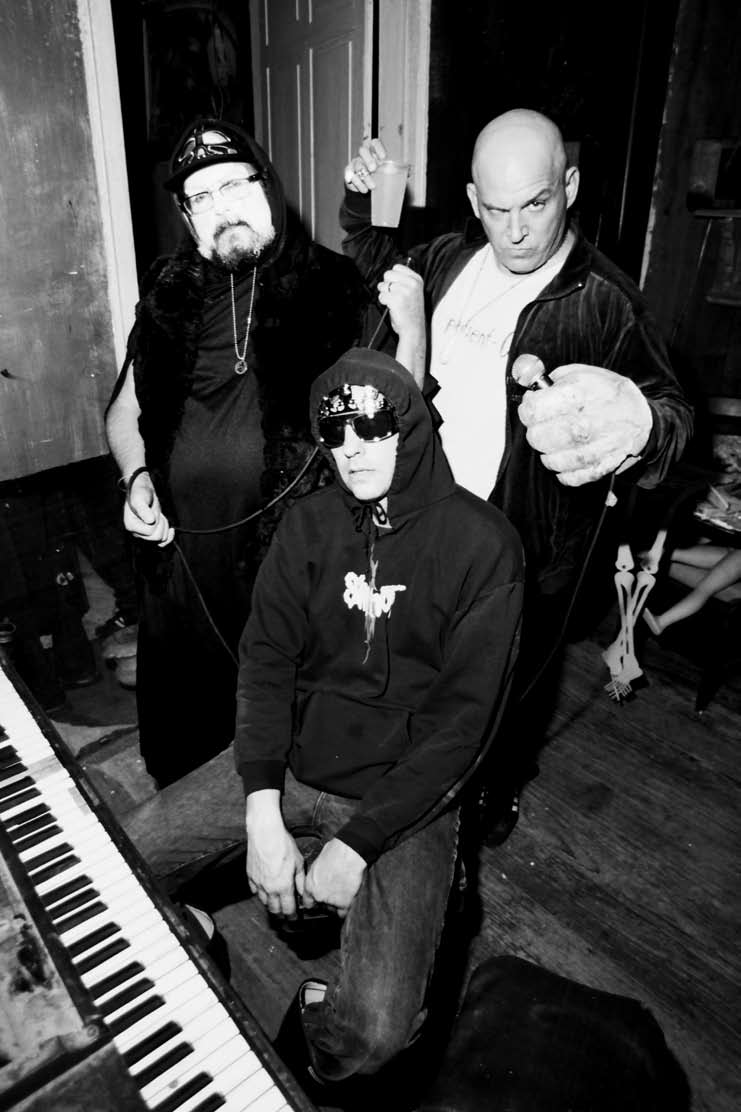
 If you’ve ever been driving down the highway late at night, traveling some far distance, the yellow divider unzipping into the black, an AM radio preacher droning on in a thick twang about the New World Order to come, static crackling and general aural hypnosis tricking you into thinking you’re in a movie with one character and one viewer (both you), then you should meet MC Trachiotomy—or the bag of human meat he steers around, J Poggi.
Like many an artist drawn to this city, J’s route to New Orleans was circuitous to say the least. He first touched down in the early ‘80s as a student at Tulane, where he lasted a semester before discovering New Orleans’ (at the time) lax drinking-age laws. A brief stint in the Coast Guard took him out of the city but he would return soon enough, this time joining another kind of army. The legendary Crash Worship, an ever-evolving confederation of noise musicians, percussionists and exhibitionists famous for visceral, messy live shows, scooped him up during one pass through town and sent him on tour around the world.
Eventually, J settled into the looming 9th Ward compound he dubbed the Pearl (part quaint New Orleans architecture, part industrial hangar), where the free-form party atmosphere of the Crash Worship experience took root and J became a lightning rod, maestro and host for the city’s eccentrics, experimental music makers and true life characters.
MC Trachiotomy was born from this fertile time, a persona developed at the Hi-Ho Lounge years before its makeover, when dropped ceilings, a human-sized bird cage and an environment that J describes as something “David Lynch built intentionally” made it one of the seedier venues in New Orleans.
This atmosphere might explain why Trachiotomy’s penchant for lo-fi party tunes and good time vibes is tempered with a form of media terror, like phone bombing Q93’s 9 o’clock Props with his trademark undecipherable verse, entering battle of the band contests in Metairie or crashing an amateur hip-hop contest in Atlanta (says D. Lefty Parker: “It was like being at 8 Mile with us as the opening act. That did not go well.”) J and crew have even been banned for life from multiple venues, only to find that “life” in New Orleans is a forgivable sentence sometimes. J shrugs it off: “Maybe it’s not good for business, but maybe it’s good for your brain.” Although it’s certainly been good for “business” at times, with Trachiotomy opening for psychedelic heavyweights like Acid Mothers Temple or hosting after-parties for the Butthole Surfers.
Trachiotomy’s first release, Robot Alien or Ghost was forged on two tape decks and a Gemini sampler around 1999; the result was an album of static, muddy madness in the vein of Madvillian, Dälek or Dr. Octagon—raw, hip-hop helmed by an intergalactic hustler (though for the record, the Trach crew is careful to circle the genre without claiming it). The second album, With Love From Tahiti (released on Andrew WK’s Bulb Records) was built in the same way, though has some mellower moments and shows Trachiotomy’s lounge side. Then a handful of ultra-rare and obscure releases preceded Rowdy Life (released on Jonathan Toubin’s New York Night Train Records), the test run for Trachiotomy’s newest tome, Rats Live on No Evil Star, a split release between Houston’s Tourrette Records and Quintron’s Rhinestone Records label.
Rats is finally out after years of threatening and in double CD packaging, no less. It’s the most ambitious release yet for the 9th Ward’s weirdest MC and is a huge leap from the earlier work, sporting crystal-clear production and speaker-testing bass tones like a new suit, though it’s drawn from 12 years of previous, more raw recording sessions.
From the beginning, the cast of a Trachiotomy production has been as varied and endless as the samples on each song and reads like a dream team of noise aficionados, from more well known musicians like Quintron (a fundamental contributor to Trachiotomy’s earliest incarnation), Ratty Scurvics, Missing Monuments’ Julian Freeze and Luke Allen, to more eclectic artists like (Antigravity contributor) E. Willy P. (credited as Zodiak Man), John Henry Kelly (of the Heavy Lids), Bisquittino, Matt Vis, Matt Castille, Tony “El Tonios” Barton and Jayme Kalal of the Microshards. Charged with untying this gordian knot of personnel and sound bites and forging it into something releasable is producer/DJ/early adopter extraordinaire D. Lefty Parker. Since his arrival in New Orleans in the mid ‘90s, Lefty has immersed himself in a myriad of projects, from DJing for bounce pioneers Katey Red and Big Freedia to backing Ernie K-Doe on bass, recording Guitar Lightnin’ Lee and a lot of other yeoman’s work for the New Orleans music community. As J puts it: “Ever hear the expression ‘polishing a turd?’ This guy will buff you up.”
At the risk of mixing a Star Trek reference into what is surely a Star Wars interview, finding a cohesive narrative for this piece had the feel of a Kobayashi Maru exercise, where the outcome was doomed from the start. This mountain of compounding information—endless mixtapes and home-made bar sessions, snippets of life caught on record, friends (and friends of friends), legends in time and in mind—was not easy to climb and at times felt like a battle for sanity itself. Whatever the failures of logic or narrative, time or space, fact or fiction, chalk it up to evolution, mutation or just a melding of realities that might best be described with a term borrowed from our beloved ecology: brackish.
I spoke with J, Lefty and Quintron over the course of two weekends about Trachiotomy’s history, approach and collaborators. We started among the derelict antiques and dusty party favors of the Pearl but ended up across the street (though it might as well have been across the universe) at Ms. Stacy’s immaculate home, where I was fortunate enough to shoot some of the pictures for this piece. It’s a tidy metaphor for the worlds Trachiotomy straddles, where rags can be cast off in a second to reveal royal threads: the frog was a prince all along, or the prince really a frog… Either way, champagne was always close at hand.
J, how did you get involved with Crash Worship?
J Poggi, aka MC Trachiotomy: I met Jeff Mattson in 1993 at a Cafe Brasil show. In the 9th Ward Marching Band, he built the golf cart with the Leslie broadcast speakers [aka the Organ Car]—
D. Lefty Parker: [He’s] sometimes known as Strangebone—
MCT: Often known as Strangebone, with a “Doctor” if you really don’t know… He was definitely one of the original people in San Diego in the ‘80s when [Crash Worship] was fucking around… And after the show, I walked up to Jeff, who’s just standing there with his fingertips and his thumbs pressed together, kind of staring down the street, his one-mile radar melting everything in its path—seemingly (but he was probably having pleasant thoughts). I was like, “Hey. This seems to be over. Want to go to a party?” And he was like “Yes…” We did a procession through the French Quarter, which was monumental: two and a half blocks down Bourbon Street the wrong way. So then we became friends and started going with Doo Rag (Bob Logg III’s old band)… That’s how I met Quintron. He’s from Chicago and he started opening for them.
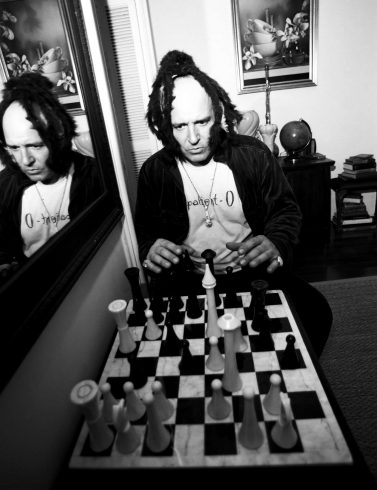 Quintron: They’re the eye at the center of the storm of a lot of us meeting each other and coming together, actually… It’s all tied in together with my first distinct impressions of New Orleans, this neighborhood, this street. It was all like a collective blob of people together that struck an impression. And J seemed like the emperor of it all, in a way, although the entire blob was made up of an amalgamation of emperors and empresses… It’s one of the reasons that I was drawn here permanently, for sure. I’m not a big stickler for reality and it didn’t seem like anybody else here was, either.
DLP: How many years were you in that band?
MCT: Until it was done, if it’s indeed done.
Didn’t Crash Worship shows always have stuff everywhere?
DLP: It was the most interactive show I’ve ever been to in my entire life.
MCT: And as chaotic as it often became, there was a skeleton to follow, a tempo, kind of planned-ish, I guess? But no one ever spoke to anyone about it.
DLP: They had an actual cannon on stage. MCT: You could stuff it full of awesome stuff like grapes and confectioner’s sugar. And so you set it at the right projectile so no one got a grape in the eye; but a shower of grapes is not a shower of tacks. Sometimes, someone might’ve thrown a tack in there, though. You don’t know! No one was guarding the mouth of the thing so sometimes you could get a beer can. Then we went to the catapult… But the point was never to get messy. The cleaner you were, the more veteran you are.
DLP: It’s almost like a Burning Man thing, but not hippy.
MCT: Way before Burning Man.
What makes it not a hippy thing?
MCT: Just because we’re on hippy drugs doesn’t make us hippies. We break shit.
DLP: We knew people like our parents who were hippies and we didn’t like them.
MCT: Nice is not always the answer. Look where nice has gotten us in this country.
DLP: It was part of the DIY culture of the time: tell me I can’t do something. There were so many people not paying attention to the rules that you could get away with a lot more then.
MCT: There were no rules that governed that domain. Because no one expected any of this stuff to happen.
DLP: They were like “Sure, we can rent you a warehouse. What can happen? We’re going to get a hundred dollars for the night? That’s just an empty warehouse to us.” They didn’t know what we were going to do with it. [laughs] Chinese restaurants were really easy to get shows put on during that period. Because the owners would just be like “What? You’re going to pay me money and there will be people in here for my buffet?” And you’d be like “Yeah.” And people would show up with mohawks and they would go “Ummm…” But then you’d hand them a pile of money and they’d be okay.
It seems like back then there was a lot more integration of culture than now, actually.
MCT: It was free. Before The Big Easy coin, before the movie, it was truly a huge neighborhood.
DLP: You know the movie is the reason we call this the Big Easy? I did the research because I heard that and I thought no, that can’t possibly be true! [laughs] It’s a horrible movie.
MCT: Some fucking vulture was listening who got invited to some place like [the Pearl], maybe, and someone was like [in a thick New Orleans drawl] “Baby, you livin in the big easy!”
Q: That’s just ebbs and flows in art and music and I don’t really think that’s true… Everything in life is so subjective, you’re begging to be proven wrong if you say anything like that. And it’s a negative statement towards people that actually are just coming alive and awakening to what’s possible in life and art and music right now because of their age or whatever.
It seems like New Orleans weirdness has a shot at certain points but then it hits a ceiling.
Q: But what more do you want? There’s mass marketed weirdness like Lady Gaga, but anything really weird from anywhere—like how far did grime go? That’s pretty weird shit… It was a flash in the pan and it had some moments and it influenced a lot of other mainstream artists; but of course it didn’t take over the world. Those things are not meant to take over the world. Weirdos are meant to create their own worlds and live in them happily ever after. And then Lady Gaga takes over the world.
 As far as underground culture goes, there’s the adage of “Don’t trust anyone over 30.” Do you guys trust yourselves?
MCT: I trust myself now, absolutely. [laughs] Little kids really love MC Trachiotomy. Imagination Movers move over!
Do you think sometimes it’s important to get out of the way of young people and what they’re trying to do?
Q: Fuck that, no. I’ll stand in the way. It’s just a sieve, man. Some people fall through and you keep going… I love youth culture; I love youth. More young people are going to be making art than old people because it’s way easier… life is easier when you’re 20 years old. And most of those people are going to get caught in the sieve; and they’re not going to live a bad life, but go on to other things. And the ones who fall through the sieve are just as valid and belong on the same street as all those 20 year-old kids that are doing what they’re doing. But the people in this room were small enough to fall through the sieve. If that makes any sense.
It’s open to interpretation… Lefty, you seem like you have a pretty good handle on hip-hop for being a grungy white dude. Where did that come from?
DLP: I was always a record store guy. I’ve worked at record stores for my entire life. And I remember the first time I saw my first Run DMC record in 1983 and was kind of intrigued. But I was living in Ohio and it was not something that was very well received at the time. But I will tell you this: I didn’t really give a fuck about hip- hop… I never thought of it as my music while I was coming up… If we identify with hip-hop for any reason other than the sampling, it’s that J likes a slow groove, a dance beat—
MCT: I like when people dance close. I don’t need to watch you; I can tell if you’re enjoying each other’s company.
DLP: And we both love Funkadelic and the Isleys and obviously Ernie [K-Doe] and Allen Toussaint and all that great stuff… but in the beginning you [J] were really trying to make dance music for the party that was in your head.
MCT: That’s the only party I know about.
DLP: It’s not only in J’s head, but it can be in everyone’s head if you do it right.
MCT: And that’s where it’s a group of people, because if you have a laser pointer it’s hard to make a hologram, but if you have a couple different angles of perspective that are beaming towards the same intent, it starts to take a little bit of shape. Like Soul Train or American Bandstand.
DLP: So my work with a lot of hip- hop artists comes from working with Trachiotomy… That is actually where I got into DJing with Katey and Freedia. I wanted to promote a show for them because I liked them (and I couldn’t afford to pay a DJ when I was booking those gigs). And I thought “I only have to do one song at a time? This is going to be simple.”
Do you ever play Trachiotomy stuff for them?
DLP: Yeah. And I gave Mannie Fresh a copy of Rats… He has not said anything to me about it. [laughs] I gave one to Wild Wayne. Katey’s listened to it and she was like “That’s weird.”
When you do something like this that is a big group of friends, do you wonder about the people outside of that, at least when you’re putting out a CD?
Q: I think people are more interested in other people than they are in the formalities of music. The reason people are so obsessed with certain artists is it makes them wonder what their crew is like or what they’re like. For something to be really specific to you and your group of friends is not necessarily to exclude the rest of the world. Because I think that’s interesting to the rest of the world. And after this article comes out, this record is going to be a million seller!
MCT: Even though there’s only 300 of them.
Is MC Trachiotomy a good guy or a bad guy?
MCT: I don’t know. Who are you? Can I do my favorite quote of all time? [makes funny face, whispers] “I’m nobody… I’m nobody…” Charles Manson.
Q: He’s a good guy. He’s your friend, for sure. He’s like a Teletubby, whatever the nice Teletubby is; he’s that one… He’s like a big, cuddly, weird, hilarious teddy bear that’s joking but completely serious at the same time.
 I wonder because there’s a lot of aggressive elements in Trachiotomy, a lot of dark, evil stuff, too.
MCT: Yeah, I’m pissed off pretty much.
Q: Teletubbies get depressed sometimes. That purple one… he went through that thing in the ‘90s. [laughs]
With all of the samples you use, do you worry about sample rights?
DLP: No, we did… but we don’t. [laughs]
MCT: That was the hold up for Rowdy Life.
DLP: We never got Rowdy Life pressed on vinyl because there was a sample from Night of the Hunter on it and they busted us. It’s the first sample on the record.
MCT: They were listening to the playback [at the pressing plant] and one of the interns was like “I love that movie!”
DLP: The first track [on Rats, “creepy critters”], the one with all the Chewbaccas in it—I purposefully chose stuff from the Holiday Special, which George Lucas has disavowed entirely. There are no copies of it. So I thought he would have to acknowledge that it existed for him to sue us for that. So if it ever does come to a legal issue, we could push the point with Star Wars fans and turn it into a whole different thing.
MCT: If the shit’s gonna hit the fan, I want the fan on high.
Trachiotomy is kind of an assault sometimes. On the new CD, for example, there are minutes of clipping at the end. It makes me wonder if something went wrong with the duplication.
MCT: That’s to symbolize when you think you hang up because you’ve left the bar and you walk home. I went home and called Guitar Center.
DLP: It’s purposefully that way… But I think there should be something wrong. If you think back to the fact that he was doing With Love from Tahiti with two tape decks, it’s not going to sound right. This is the highest fidelity project we’ve done and there are purposeful nods to things going wrong.
Does a set ever go horribly wrong?
MCT: Every night. And no one knows the difference. It’s not the intent, but that’s the whole thing about expectations.
DLP: A Trachiotomy band can be bad at least fifty percent of the time.
MCT: And the bigger it is the worse it can get.
DLP: But when it’s on, it is the best band in town.
MCT: Does everything have to be good? And then what’s the standard of good? Who says what’s good? Did you smile about it; are you still thinking about it? I don’t go into things thinking “I’m gonna get ‘em tonight!” I’m still getting out of the van and walking in, even if I’m just driving from here…
Best review ever?
“Worst thing ever.”
Rats Live on No Evil Star is available from Tourette Records and local record stores. For more information, check out touretterecords.com
Bonus Cutz
THE TRACHIOTOMY NAMESAKE
MCT: There’s a bright yellow bar, Brothers Three, uptown. They used to have a three- for-one happy hour between like 3:30 and 4:15 or something weird. The early news used to come on the television, but it had a vertical hold problem. And if I remember, it used to be carpeted on the floor and kind of midwestern style, like up the bar. You closed the door and it was fucking dark, except for the light from the television. And this gentleman, Clarence, sat at the end of the bar, smoking cigarettes through the hole in his neck. And we were listening to the recap and the advance of “what you’re really going to hear on the news;” but you can’t see anything, just a weird strobe going. But it’s three-for-one Pabst—that’s way before Pabst made stickers—so I would go in there and I could never tell what Clarence was saying as much as I knew whether he agreed with what the guy on the news said or not. And it was his enthusiasm, like [makes different noises of reaction]. And I thought, “Am I on a Disney set? Can I get 9 more Pabsts?”
TIMER OF LOVE
MCT: With Love From Tahiti was designed to be 58 minutes*, because it’s dedicated to the baby-making-music-makers. So if you’re a one-hour variety lover—one hour motel— you got a minute to check in, a minute to check out. But if you’re a stay-at-home style lover, you could push repeat and stay and play all day. Because it loops back in.
INTROS AND OUTROS
MCT: The intro and outro of a song (with the space in between) is its own beast. That’s why the second disc [of Rats…] is arranged the way it is, because there’s a lot of backwards masking on the forward part that you might not have gotten. So if you play it backwards, if you’re patient, it’s like the long bath… though no one should stay in a bath longer than an hour. 20 minutes with epsom salts. If you get the drugs out and you don’t want to lose them, guess what? Stay in epsom salts longer than 20 minutes, they’ll get sucked right back in.
PINK FLOYD = TIME TO GO
DLP: At the end of “08-29-05” we added Nagin talking about how everyone’s going to get their FEMA money. And there’s an interesting joke in there because when we were on tour we came up with this concept… the first two places we played, like the Music Box and some other place in Alabama, they started Pink Floyd at the end of the night, so it became the joke where even if Pink Floyd wasn’t playing, I would turn to J and say “Pink Floyd” so we could get the fuck out. So there are samples of Pink Floyd in the end of that song illustrating it’s time to get out.
CHRISTMAS IN THE JUNKYARD
MCT: “WWWest bank” is inspired by E. Willy P., Imagine “the” Band. He threw himself a surprise birthday party via his girlfriend at the time. It was at a place called the junkyard in Gretna and it was 24/7 Christmas theme inside. Every day was Christmas in the junk yard. So everyone’s getting there and there are some different sized boxes, some big ones, whatever. And we all crouched down and hid behind the presents. The count was four and on two and a half, three, he jumps out of one of the boxes and goes “Surprise mothafuckazzz!!!” “Where you wanna go? Take me to the junkyard!” Take me right to that very moment of absolute brilliance. Fuck, what a wizard.
*Tahiti, however, was released with four extra songs on it.
