
On Ash Wednesday, I received a sweet greeting from Sarah House in my Instagram inbox. We randomly connected in the streets on Mardi Gras Day—Sarah was the queen in blue sitting on a pedicab and I was the photographer capturing portraits of all the Carnival participants. Sarah creates whimsical ceramic sculptures that remind me of plants or something grown on another planet. For the last 15 years, her artwork has been inspired by natural fractals that represent nature’s interconnectivity. This intrigued me as I’ve always paid attention to this phenomenon in nature. Recently, Sarah completed a residency at the Joan Mitchell Center, and I reached out and asked if I could come and photograph her with this new work.
On a Sunday morning, I walked into this large, hot, shared studio space on Mehle Street in Old Arabi. As Sarah walked me to her studio I passed several other artists’ spaces that were covered in organic browns, whites, and cream—the artists here have similar tastes and common ground to share. Sarah had a wall partition set up with her newest creations installed on the wall, staged on podiums, and displayed at the nearby table, including a big droopy slime piece that bloomed, and smaller pieces with root-like textures and curvy branches with subtle purple buds. It felt like standing in a cosmic fairyland.
Can you tell us about your journey into fractal art?
Yeah, it’s just being fascinated by nature at a young age. One of the first things I was drawing as a kid was trees, and I just drew trees all day. I just thought they were so beautiful and cool, and learning that there’s this mathematical pattern behind it blew my mind open. I always struggled in math as a kid, and then to have a different relation with math through nature felt very empowering.
I went through your website and you state that you are creating with fractals because they have a feeling of interconnectedness. With fractals, what resonates with you internally? What are you trying to express with your ceramic art with fractals as an artist?
Looking at a tree, and looking at clouds, they are just visually beautiful. It calms our nervous system down. But then when I started to notice that the same patterns were repeating everywhere—you know the branches of a tree, our lungs branch, a mountain range branches—I started to feel like on a deeper level this was very symbolic of the interconnection that runs through nature. We are all a part of the same stuff, part of the same system, and that comes up visually through these patterns. So making work inspired by this, I’m hoping that I can inject a little bit of that. If I can remind someone of a time they had in nature or make them daydream about being in nature, maybe it makes them feel a little more calm. And then, ideally, in the long run they would start to notice these patterns everywhere and get that same level of feeling, like they are a part of the greater whole.
When people are looking at your artwork, the patterns are shown on the surface of each piece. How do you make these patterns and what are you using to create the fractals?
That is a textured glaze. I found the recipe through Alfred, which is a prominent ceramics university in New York. They share their glaze recipes freely. And I just tweaked it a little bit, adding some ingredients to make it whiter. And the surface tension of the glaze breaks it apart in the kiln, so it shrinks and creates a fractal pattern.
And this naturally happens?
It just naturally happens in the kiln. The thicker it is, the bigger the cracks. So I can control it a little bit, like how thick it might be in certain areas, but I never know what it is going to do in the kiln. And what I had been making previously was kind of structurally more fractal, like it had to be fractal for me to make it. I feel like once I took that boundary off of what I was making and let myself make more organic shapes more freely, I still wanted to have a tie to the fractal-ness, so then I started to use this glaze on the surface. Even if the form itself isn’t as fractal as some earlier works the surface can be a tie back to this original source. A lot of this work is really inspired by mushrooms and slime molds for their weirdness. They are wonderful and weird. I think they are so fun!
Can you tell us a little about slime molds?
Slime molds are ancient beings—they are single cell organisms that come together and kind of act like an animal. They will hunt as a group: It’s an example of emergent behavior, similar to how a flock of birds fly together as a unit or an ant colony forms a society without anyone really in charge. Our brains work this way, cities form this way—emergent behavior is super cool. I learned about that just through learning about fractals and mathematical systems in nature. So slime molds are an example of emergent behavior because no one is in charge. They all come together and act like an animal and hunt. But it’s not an animal, it’s kind of like protozoa. They are super tiny, they live on the forest floor, and they form these structures that are so bizarre and so alien they are almost very Seussian in a way. I decided last year that I was going to make work that was more joyful and more fun to make. It seemed like the perfect muse to make work inspired by these bizarre little colonies of organisms.
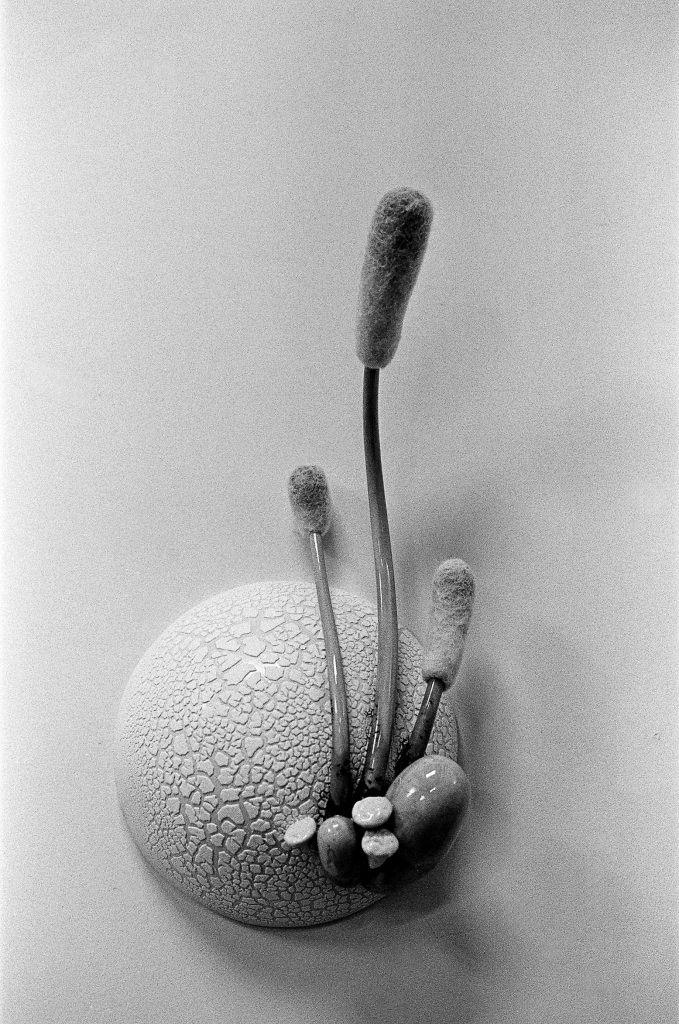
Sprig
What are you using as a reference when you are working on these sculptural pieces?
I follow mushroom and slime mold Instagram hashtags—I feel so nerdy—I watch mushroom documentaries, [read] Wikipedia websites, and articles. I found some great articles on The New York Times about the weirdness of mushrooms. I’m just taking screenshots, and I have a little collection of images that I find online and through documentaries that I reference. What I tend to do is I will look at those images and make drawings and then I just look at my drawings. So I’m not tied to this photograph, I’m tied to my interpretation of it.
Do you create a series and build your ceramics within that series or are you working on pieces individually?
I think I tend to work in series but not in a real intentional way, it just shakes out that way. I would be inspired by a certain form or something and I’ll just make a lot of work inspired by that. And then something will happen a year later and I’ll be inspired by that, and I’ll start making work that way. But really all the work I’ve made in the last couple of years has been geared towards this big dream I have of making an immersive installation that is an alien forest where stuff is growing from the ground and dripping down from the walls and you’re walking through it. So that is what I’m working towards now. I just finished a residency at the Joan Mitchell Center where I started to explore other building materials—which is intimidating and exciting—so that’s letting me scale up.
What type of new building materials were you able to work with?
I’m using wire to make a frame and I’m building that out with paper and going over that with a paper plaster, which is a concoction of toilet paper, glue, and plaster; and then I’m smoothing over that with a thin layer of veneer plaster. Then I’m adding the felted wool if appropriate, but I’m still figuring that out. I mean, this was just a couple of months ago that I started to explore. I don’t want to be hindered by the size of my kiln and I don’t want to be hindered by the limitations of porcelain. Porcelain is awesome but it’s also finicky at best and there are certain things that I can’t do. So if I want to scale up and make work that’s really big and can leave a good impact on people, I have to branch out into other materials.
I love how you have some pieces that are wall installments and some pieces that you have on stands and some that can go on tables. Why do you build with this kind of variety?
That’s just because [I ask]: How many different ways can I occupy a space? If I’m trying to make something that is immersive then I need to have things that can live on the floor, on the table, on the walls, maybe even hanging down from the ceiling.
To me, these all seem like very delicate pieces, so that’s scary if you are making these installations and people are coming into your space to view it.
True, I need to consider that, but I feel like after this last residency I feel limitless in what I can do. It doesn’t have to be fragile porcelain, it can be anything. I’m going to be a little clumsy with it at first but I’m good at learning. I’ll just figure it out. What does it want to be made of? Maybe it’s gonna be fabrics, and maybe it’s gonna be something else.
I enjoy the incorporation of the felt on your sculptures. There’s a lot of textures on your pieces, it gives the eye a lot to read and absorb, and it’s very beautiful. When did you start adding felt to your sculptures?
Thank you, it’s very satisfying. Fiber art was the one that got away while I was in art school. I had to choose a focus and I chose ceramics—no regrets but I’ve always wanted to know how to make sculptures out of fiber. A couple of years ago I was doing a residency in upstate New York, and I thought that I’m just going to use this as an opportunity to learn, and wool felting, you can do it anywhere. You just need a couple of needles, some felt, and some YouTube videos. So that is my first attempt at incorporating some fiber sculpture. You can just make it and it doesn’t have to be fired. How nice is that?
You’re giving yourself permission to open up new doors?
I’m giving myself permission: You don’t just have to do something out of clay, you can do whatever you want. Life is short, so grab some wool.
What inspires how you choose your color palette in your glazes?
That is a hard thing to put into words because sometimes I just like a color. I’m getting a lot of inspiration from the forest so I want to shy away from greens because I feel like that’s too on the nose… but I like blue and purples and golds. There’s not a huge meaning more than that, I just like it. For a long time my work was just white because it was about the form and the shape and the shadows and I didn’t want color to inject unintended meaning. But more recently I started loosening up a little bit like, “No, you like colors, you use colors in your dress and your house and you should put a little more personality into your work.” So I started to play a little more with those colors in subtle ways.
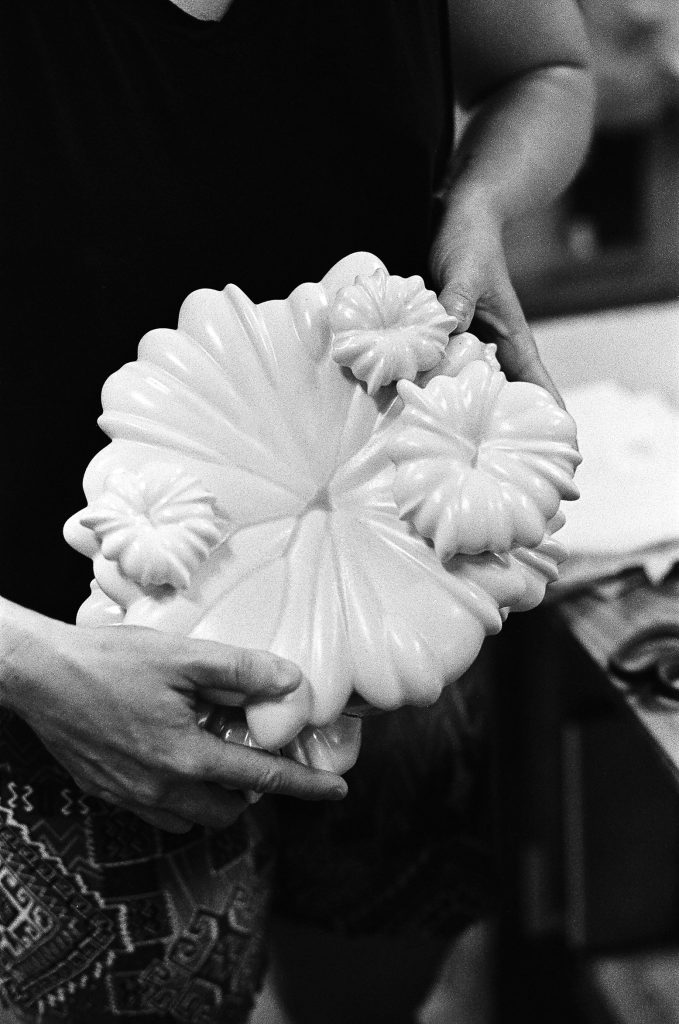
Fruiting Bodies (Detail)
I want to back up to something. You were talking about shadows and while I was looking at your website, I noticed that some of your wall installations do create shadows. Is this something that you make with intention?
No, not really, it’s just something that happens. If you make some cool shapes they tend to cast some cool shadows. I’m just always delighted when I’m surprised by that, when I install something and I light it and I see the shadows that it’s casting, I think that’s so cool. I wasn’t making the work for the shadows but I love when it happens.
You teach at NOCCA—are you teaching ceramic arts there?
I am NOCCA’s ceramics teacher but I also teach a class called critique where every two weeks they have a homework assignment and then they come in and critique. A lot of times that’s a drawing or a painting and it’s just teaching them how to talk about art, how to think about art, how to talk about each other’s art, and how to take constructive criticism. I also work with the level 4 students, and that’s like a mentor-mentee relationship where we work together to come up with their contract on what they will do that year. But most of my time is spent teaching ceramics, so I teach slab and coil which are hand-building techniques, and wheel throwing which is making pottery on the wheel.
If you were to give a young artist advice in pursuing a career in ceramics, what would you tell them?
I would start by telling them, generally with making art, to stay curious and make it weird.
What are your future goals?
My future goals are to have gallery representation in two or three different states. I’m kind of locked into Louisiana but I’m looking to get wrapped up in North Carolina, Houston, Miami, New York, or somewhere. I have a studio assistant now and I’d like to be able to hire her more and be able to have her help me more in the studio. I want to move to North Carolina in the mountains and have a dope studio. Just hike in the forest, make art, and still teach but less, and get eight hours of sleep every night.
What type of spaces are you seeking out for large installations, what do we have close by?
I think there are so many spaces. There are so many DIY spaces in New Orleans, and there’s also formal galleries. As long as they allow me to put holes in the walls then we’re good. I’m really good at patching walls!

You can view Sarah House’s work at her upcoming solo show at Good Children Gallery on September 14, or at Ann Connelly Fine Art in Baton Rouge year-round. You can also find her work at sarahhouseceramics.com or on Instagram: @sarahhouseart.
photos by Tammie Quintana
