
SIMON LOTT
Simon Lott was born and raised in Louisiana, though watching him perform puts his Earthling status into question. By incorporating dozens of genres and unusual hardware and techniques into his live shows, Lott creates a push and pull with organic sounds, giving off a human-robot hybrid essence. The creator of Very Cherry, Context Killer, and We Gon Do Dis pulled up at the first base of Wisner Playground on a stormy late-summer day, in a full body suit and mask. We scrambled to set up and break down his rig for a photoshoot before the clouds broke and made it to (fittingly) Cherry Coffee Roasters just in time. Then we settled onto a comfy couch with our matching blue hair and oat milk beverages for several hours of discussing ear protection and the importance of having boxes to break out of.
How did Very Cherry originate?
I was on tour in 2006 with Charlie Hunter—he plays this hybrid string instrument that has bass strings and guitar strings—and there was a T-shirt at a gas station with that spray paint kind of design that said “very cherry” with sparkly cherries. You know that thing where musicians are always like, “That’d be a great band name?” That’s what happened there, but it actually stuck ‘cause it’s catchy and embodied something I believe in, something that’s done well and refined, like a cherry car.
You’ve already surprised me. I didn’t expect it to be a double-adjective band name. Goes well with being a two-piece though.
It used to be a five piece and we didn’t use Ableton, ‘cause Ableton was fairly new then. David [Polk] might have been using a different DAW at that time, but it was more like we were playing instruments in that old regard. [Very Cherry] was a thing I put together but I didn’t want it to be this top-down band where this is the leader and these are my side people. I wanted everyone to be involved and David was the one who was really speaking about what he wanted from the project. We’ve gone through a lot of different sounds. We used to have vocals but there’s more clarity, in a weird way, without words. Musically, we’re trying to give people a good time but also that dystopian sense of dread. You can either party and dance or have a deep listening experience to our music. We always wanted to combine those two things. Initially, the concept was “iPod on random.” We just feel like, when you do one thing too much, that’s when it begins to lose its luster.
Isn’t performing live to pre-existing tracks in a DAW constricting?
With the looping, each little square embodies a portion but we can do them out of order or we can leave something out or add elements in. You can have a reprise. You can change the bpm. It’s all about playing devil’s advocate with boxes. For the most part, the loops give you this grounded sound, which satisfies that, “I want that thing to happen to me” need in listeners. Sometimes it’s chaotic and chance oriented—that concept came out of doing a lot of free improvisation in the earlier days. David and I have been playing together for 25 years but we always want to be compositional and have intent with this project. The loops sound so formed already, which allows us to have each of those concepts in one. Our joke is, we call it “compisation” (composition and improvisation kinda as one word). It allows us to inhabit the crawlspace of “you know this song” but then it just goes a little different.
So your setup on stage for Very Cherry is a monitor, a mixer, and drums?
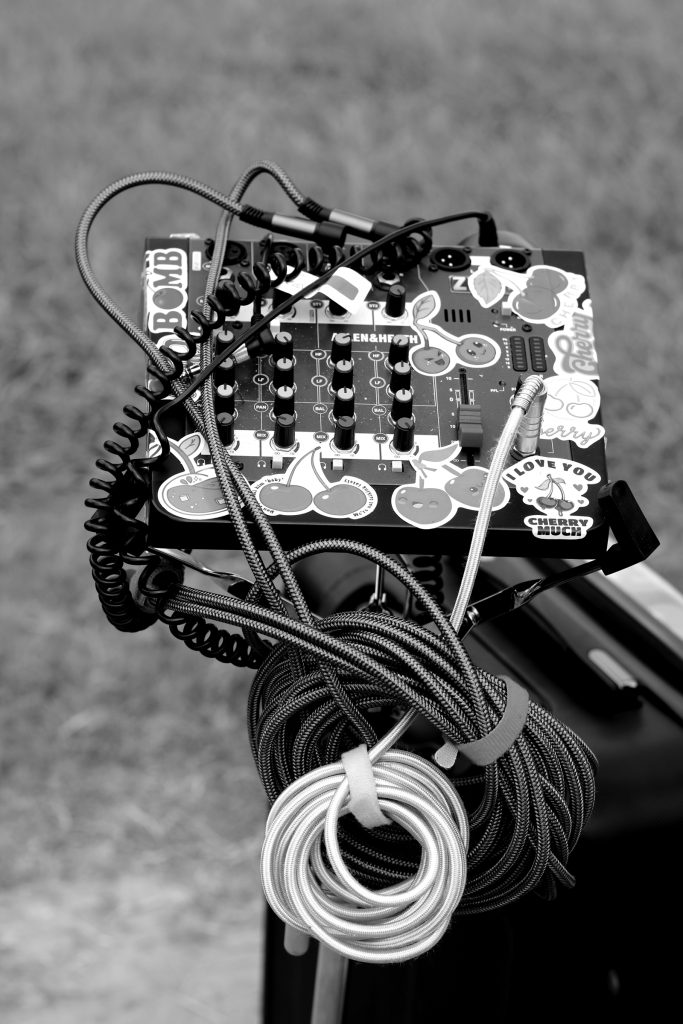
The monitor allows me to see what David’s doing on Ableton, so I know what song we’re on. I know if we’re skipping a song. The more I learn about the individual boxes that represent the sections, the more I can key in on how he’s improvising the form. It clues me in more to what he’s thinking and it also has the added [visual] component of representing where we’re at as people: We’re all in front of screens, they’re a part of our existence. The singularity has already happened.
The [Allen & Heath ZED-6FX 4-channel] mixer has two outs. One gives me the click and the other goes into David’s interface, and what that feeds me is the Ableton loops and all the instruments he’s playing (sax, guitar, synthesizer). He mixes it himself, so all the person at the soundboard has to deal with is two lines and drums. It’s easier for them and then we can present this really complicated thing and it sounds more 3D.
And the drums themselves?
It’s pretty much the setup from our photo. I use multiple snares always, cause that’s more electronic. And I use stacks instead of cymbals because, in my opinion, most of what’s going on in electronic music is bass drums, snares, and high hats—there’s very little need for cymbals. I use this thing on my floor tom called a[n Aquarian] Super Kick II [Clear Drumhead with Tom Hoop 14”]. Somebody at Aquarian was like, “What if we made this Super Kick II head that is actually like a bass drum head but will fit on a snare or a tom and that way people can turn their floor tom into a bass drum, if they want?” The first thing I put it on was the LP [Raw 18] Street Can, which felt way more cyberpunk-y and industrial to me. It’s like a bass drum I can play with my hands but it’s close to what I’m doing with a floor tom. That was a cool way to bring the sonic palette of Cherry into a more specific drum sound. And maybe I’ll change it where I don’t have rack toms, I have rack snares.
A big part of the look, with your mask and suit and monitor is also the oversized headsets you wear. What’s going on there?
That’s for the function. I don’t play drums without earplugs anymore. The overtones are a problem. It doesn’t matter how soft or quiet the music is. We’ve played quiet gigs and we know how to do that, but the main thrust of what we want to say needs a bigger spectrum of volume. We still use a ton of dynamics but if you want to sound punky or metal, which some of our songs do, that’s a bigger threshold of volume going on. That’s why I don’t use in-ears because if the music is that loud, you have to turn your in-ears up louder and you’re not actually saving your hearing at all, so I use molded Audibel earplugs that I got from the hospital on Prytania [Audibel Hearing Health Care]. The added benefit of when you use earplugs is you’re getting to hear it how the audience hears it. Behind a drum set, it sounds terrible. There’s all these overtones that are just not pleasant, but the audience members are getting all the good ones, so that’s why I use them, even on quiet gigs.
Then the Behringer [DH100 Professional] headset goes over the earplugs, and the benefit of that is, I’m hearing a subtler, more clear version of what we’re doing. ‘Cause you’ve gotta think about EDM and hip-hop and dubstep as having all these low-end frequencies, where, at a live show, that can get kinda muddy.
You’ve inspired me to go get a molded pair.
You should! Everyone should. Good ones target all the right frequencies. That’s why they’re expensive. It’s worth it. I’ve been playing drums for 31 years. For the first ten, I didn’t use earplugs and I would be like, “Why am I so annoyed after a show?” And it’s because I’d be beating up my body. We tend to not think of hearing as a muscle or a physical part of our body but it is and if you tax it out you’re gonna be tired and annoyed.
What’s the smallest version of a kit that you think you can get a good sound out of?
We play at Bacchanal sometimes and, at that place, I use the Meinl [Percussion] BASSBOX as my bass drum. It’s this little thing that has these sideways beaters that come down onto the top of the thing. It’s tiny and quieter ‘cause when it’s raining, you have to play indoors, upstairs, where you need something to make that echoey room feel appropriate. That’s a cool, little mini rig and maybe I’ll add a really small snare or these things called “drum tortillas” which I use in conjunction with a clip-on mute. That’s a way to super mute and then you can play with the physical aggressiveness of the punk, metal aesthetic but it ends up sounding really quiet and I like that juxtaposition anyway, of someone wailing but it doesn’t sound loud. I use a Snareweight [M80 leather tone control] dampener for drum muting to sound more electronic and it gives me more sonic space to work with because the loops that David is playing are really dense. There’s a lot going on, so drying up the drums allows space to hear more. When I first heard drum and bass and jungle I thought, “I want to sound like that and not be programming it.” I learned how because of the appreciation I have of technical proficiency but I also just love that music. In the ‘50s, they were playing bebop and that was their “going beyond typical human ability” thing. I’m finding my version.
For more info, including the many, many gigs Simon Lott has lined up, check out simonlottmusic.com.
photos by Sabrina Stone
