When I think of the long history of revolutions whose liberationist intentions ended in authoritarian disaster, I am reminded of the myth of Orpheus and Eurydice. Orpheus, the lute player gifted by the gods, loved Eurydice so much that when tragedy struck he was willing to journey into death itself to get her back. But though he almost succeeded in carrying her spirit from Hades back to life, at the last moment he violated the one rule he was given—to walk straight ahead without turning around until death was well behind them. Like the doomed lovers, those who betray their own utopias learn a hard lesson: You can drag your beautiful dream all the way through hell, but if you look back into the dark even once, you will not be able to emerge into the light.
Not all Americans are as ignorant about Haiti as those currently making headlines for it, thank God, but our educational system has left shamefully large gaps in our knowledge of the second oldest republic in the Western Hemisphere. Thus have so many faulty conclusions come to be so widely held. I wish I could count how many times I’ve expressed my admiration for the Haitian Revolution only to hear a pitying voice reply, “Yes, but look at them now,” implying that the country’s present state of turmoil is the sad result of a failed revolution.
It isn’t.
It is true that not all who fought in the Haitian Revolution defined peace the same way, and that many of its most powerful and courageous leaders could not imagine a world beyond the plantation. In the end, Toussaint Louverture, Jean-Jacques Dessalines, and Henry Christophe all tried to force the population to return to the fields, holding out a few measly carrots alongside the customary stick. They couldn’t keep their eyes trained on the light.
But in Haiti, Eurydice found her own way out. While urban elites continued the game of power politics initiated during the revolution, the people retreated into the mountains—where those fleeing the plantation had always sought refuge—to live the lives they had been dreaming of while they labored in the sugar fields. In spite of the presidential revolving door in Port-au-Prince, ever-changing constitutions, and sky-high payments on the disgraceful indemnity France demanded at gunpoint as compensation for its loss of (human) property, the fertile island was more than capable of feeding all its people. Functioning more or less autonomously, the countryside operated within a maroon economy where time was far more valuable than money, which almost wasn’t needed at all. Haitians avoided taxes and import fees by developing their own systems of currency and banking, and providing for themselves and each other rather than relying on the global economy. During mango and avocado seasons food was so abundant that Haitian villagers could count on paid time off as a gift of nature, and what they did with it was nobody’s business but their own.
In the 19th century, Haiti was the place to be. Freedom was their way of life, and it was beautiful. As war and famine sent the starving population of Europe to Ellis Island in droves, and the tentacles of colonialism increasingly choked the world’s resources, Haiti’s artists, musicians, and Afro-Creole theologians thrived in a post-plantation Golden Age whose creative splendor rivaled ancient Greece, the Italian Renaissance, and the Caliphate of Cádiz.
But in 1915, when the United States Marines invaded Haiti on the orders of President Woodrow Wilson, putting a stop to all that was item one on a very long agenda. Upon arrival they set about seizing all ports they found commercially advantageous, selecting a president they knew to be friendly towards U.S. interests, and rewriting the Haitian constitution to overturn the prohibition against foreign land ownership that had remained unchanged since the first foreign landowners were sent packing back to France in 1803. They declared martial law, took control of the import-export offices, and claimed to be developing Haiti’s infrastructure when they used forced peasant labor to build roads through the previously impenetrable jungles that had always been the seat of Haitian anticapitalist power. The countryside revolted, and guerillas known as the Cacos took on one of the world’s most sophisticated military machines with little more than machetes, succeeding in scaring the living daylights out of the Marines, who were forced to call for backup. When international outcry over the Le Cayes massacre finally pushed the U.S. to withdraw in 1934, they left in place a newly centralized, easily corruptible government system tailor-made for dictators to empower themselves with American-built infrastructure and honeycomb the countryside with secret police.
The calamities that followed the Marines’ departure include a genocidal slaughter of Haitians by General Rafael Trujillo (the racist maniac in charge of the neighboring Dominican Republic for decades), two generations of Duvalier dictatorship, two coup d’états against the democratically elected Haitian President Jean-Bertrand Aristide (organized by leaders of countries such as the U.S. and France shortly after Aristide started bringing up reparations to the international press), and the Clintons.
When Haiti predictably showed no interest in accepting the humiliating assignment by neoliberals to the lowest rung of the North American economic death ladder, Americans smirked at the resulting poverty. And when an earthquake devastated Haitian lives and infrastructure, those who weren’t scamming the disaster victims à la Red Cross scolded that it was their own fault for being so poor. The Wall Street Journal and New York Times urged the island nation to face facts: Haiti has a “voodoo” problem, and if they didn’t want to keep getting buried in rubble, they should develop a less “progress-resistant” culture.
I don’t know what exactly is going on there right now. That the media so consistently fails Haiti gives me pause before drawing too many conclusions from the scraps of information I have. What I do know is that if so many of them are leaving the land they love for this snakepit of a country, where inhabitants hurl crazed, insulting accusations at refugees coming and going from grueling, demeaning jobs, then things at home must be terrible.
I have no idea how much more punishment one group of people can take for setting themselves free, nor do I care to find out. Our country owes Haiti much more than we can realistically afford, but if we ever intend to return to the land of the living with our spirits intact, we’d better start figuring out a payment plan. In the meantime, the very least we can do is to stop perpetuating ignorance, remember our manners, and offer newly arrived Haitians—and all immigrants, for that matter—the most gracious hospitality we can muster. Those of us ready to do more than that can show our solidarity by getting serious about setting up some maroon economics of our own. This way, we’ll prove that Toussaint Louverture was right when he defiantly told his French captors in 1803 that executing him wouldn’t make a difference in the end. “In overthrowing me you have cut down… only the trunk of the tree of liberty,“ Louverture warned. “It will spring up again from the roots, for they are numerous and they are deep.” —Holly Devon
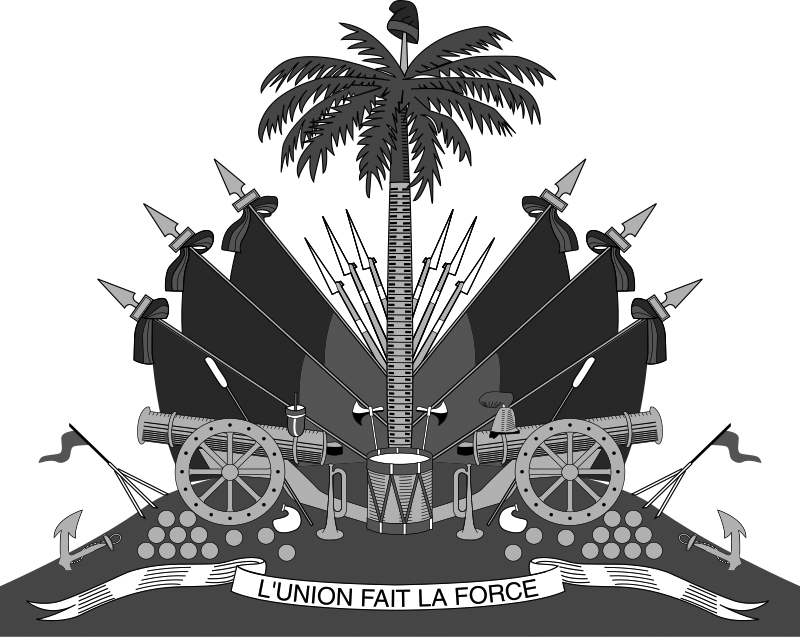
Top image: coat of arms of Haiti

October 2024 cover illustration by Eden Chubb
