
BANANAS ARE BANANAS
Bumps in the night? Inexplicable knocks on your second story window? Shadowy figures looming over your paralyzed body while an overwhelming feeling of dread courses through your veins? Yeah whatever. Move over, Cthulhu. Get a job, Bigfoot. The real fear beyond comprehension—the truest highest strangeness—may well be hiding in plain sight in your backyard. It is the banana, and the more you know about it, the creepier it gets. So let’s get freaked out and learned posthaste, yes?
I reckon I should start with a brief shoutout to the true horrors unfortunately all too within our scope of comprehension, but if I go too far down the deep dark rabbit hole of Banana Republics, United Fruit Company, and the significant role bananas have played in the brutal colonialism of Central America (all of which are directly linked to New Orleans), we will never get to the fun, spooky facts. If you are curious, the literature is vast. Bananas are up there alongside sugar cane, rubber, and cotton as one of the most devastating products to human dignity in modern history. If you need your hard truths peppered with easy comedy and a screen, the Drunk History episode on New Orleans has a bit on United Fruit that is a wonderfully informative gateway drug.
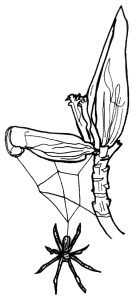
If you’ve ever seen a banana flower, you probably remember the first time you saw a banana flower, because it was weird as hell and it didn’t make any sense to you at all. They look like beautiful, huge upside-down alien egg teardrops dangling from giant spinal umbilical cords. And you know who pollinates these flowers so that they will produce? Bats. Historically, not just any bats, but fruit bats, the big ones. Here in the Southeast, we don’t have fruit bats, so birds, wasps, bees, and regular-sized normal baseline spooky bats do the job instead, but still though.
Once these freaky flowers get pollinated, the fruits that will become bananas you recognize and adore do not grow from the flower, as is the accepted norm for most fruiting bodies, but rather above the flower, while the freaky alien pod stays present and purple and keeps producing male flowers the whole time. What’s more, the banana fruits are called hands. Why did we have to do that? More than that even, they grow upwards, defying gravity and sensibility. If one were to look at the flower pod and imagine a bunch of banana hands growing round it, it would be so easy to imagine them clustering around it in their perfect crescent arch. But no, it is literally the opposite thing for reasons that seem absolutely evolutionarily absurd.
Of significant note, a banana “tree” only produces fruit once, and needs to live through a winter in order to produce. Though magnificent beacons evocative of tropical breeze and ease when happy and fresh, old banana plants that have been through a winter or significant storm look pretty rough, and it can be tempting to chop them down. If you appreciate your banana aesthetics and could take or leave the fruits, then chop away, and bear witness to the banana’s most terrifying feature: It grows back in real time. We are not accustomed to being able to see plants do things with our human brains and eyes limited by space and time. We know they move, we know they grow, but we don’t see them grow. Chop down a banana plant and you will be able to watch it push out new growth from its center in real time. It is surreal to behold, and becomes harder to visually recognize after the first couple of centimeters (that grow in the first few minutes), but I do not exaggerate in the least. Walk away for an hour and you could have a foot or more of fresh new banana plants coming quickly. There will be fresh leaves alive and unfurled within a week or two if your plant is well enough established.
Speaking of establishment, banana plants are extremely hard to kill. The “trees” are actually shoots coming off of a lateral underground rhizomatic root structure, and their incredible rate of growth is a result of the strength of the rhizomatic structure beneath it. Rhizomes contain multitudes and are very difficult to undermine, reaffirming the banana’s well-deserved spooky reputation. It is about what lies beneath, what lies below, what dreams may come, what we do in the shadows. The rhizomes of bananas do not grow in long stretching lines like invasive bamboos and the like, but slowly ooze out in a vague circle underground, becoming large clumps aboveground if left to their own devices, like an oasis of tropical trees in a desert of grass and weeds.
Where one banana ends and another begins is also impossible to define and (depending on how deep in the botanical-rhizomal universe your head already lies) ostensibly mind boggling to consider as well. Humans have been domesticating bananas so long that all of the edible varieties out there are incapable of making their own babies from seed. When you are eating a banana, you are not eating a single monster seed, but a whole bunch of tiny teeny seeds that have been rendered immature and incapable of making babies through countless generations of human manipulation. As a result, every banana of one variety is literally a clone of every other banana of the same variety. We have three or four edible varieties that grow all around New Orleans (and a bunch of ornamentals as well). And yeah, they are all technically the same plant, grown from a rhizomatic cutting of another plant that is also the same plant that was grown from the rhizomatic cutting of the same plant before it, and so on backwards forever until we land in a plant breeder’s Frankensteinish lab of discovery and despair.
You may or may not know that it is this dependency on a single plant’s DNA that led to the death of the Gros Michel banana. Pandemically massacred by a fungus to the point of extinction, all that we have left of it on this planet is the echo of its flavor screaming into the unhearing canyons of our taste buds that it was once a real thing. This is the flavor of banana Runts, Hi-Chews, Laffy Taffy, and the like. Now commercially, we only know Cavendish bananas (though remnants of Gros Michel live on in small tracts across Central America), and are mostly unaware that bananas can be or have been anything else at all.
As is the case with the best scary stories, it is always us ourselves, the humans, who are ultimately most terrifying. And the horror of bananas is no different. The exploitation of a people and the land they have called home over centuries for the sake of profit has led to the veritable extinction of an entire species of banana and we’ve been doing it all over again with the Cavendish for the last 80 years. The banana industry, massive as it is, is just a rhizomatic microcosm exemplary of a worldwide exploitative food system focused not on sustaining humanity or civilization, but on unmitigated profit at the expense of entire species, daily. It’s literally bananas.
If you’ve got questions for the Dirt Nerd, feel free to email ian@hotplantsnursery.com or visit @hotplantsnursery.
illustrations by Rachel Speck
