
This is an extended version of the print interview
It’s January 2018. I’ve just moved into a month-to-month room in a rundown house in the St. Roch neighborhood, and am about to hit the town for my first weekend out with my new roommates (soon-to-be BFFs). Our agenda for the evening: a pun competition at Hi-Ho Lounge followed by jockstrap lube wrestling at the AllWays Lounge & Cabaret. “Welcome to New Orleans, amirite?!” I text my bewildered friends back home.
I was to discover that jockstrap lube wrestling is but one of myriad inventive events—from burlesque bingo to queer witch cabaret to the Rocky Horror Striptease Show—that make AllWays Lounge a unique and vital element of the New Orleans cultural fabric—and particularly the queer cultural fabric. It’s exactly the type of place that deserves a documentary, and with the added drama of the struggle to re-open and stay open following COVID, local filmmaker Stuart Sox (who’s now based in New York) saw his opportunity. With some additional know-how and technical support following the success of his first feature-length documentary, To Decadence with Love, Thanks for Everything!, which won the Jury Award for Best Louisiana Feature at the 2020 New Orleans Film Festival, Sox turned his camera on the drag and burlesque performers of the AllWays Lounge. The still-evolving final product is I Love You, AllWays: a thrilling (and visually sensational) tale of quintessentially New Orleanian vibrance and dedication to community.
This is not your first foray with the New Orleans Film Festival: To Decadence with Love was in the fest in 2020. Do you want to tell us a little about that project first? Brag on it a bit?
Stuart Sox: That film just came about because I had relationships with the two stars already, Laveau [Contraire] and Franky [Canga], and I just knew that I wanted to film a feature, and I knew that they were going to be really busy throughout Decadence, so we were just like, “Let’s do it!” So yeah, we played some really great festivals. New Orleans was our premiere, and then a big highlight was playing Frameline in San Francisco, which is like the biggest queer festival in the country, so that was big. And then we eventually got distribution. It was available to stream on Starz for two years (that just ended). But now it’s on YouTube, Tubi, and a few other things. That was really, really fun. And actually, that film kind of springboarded the start of I Love You, AllWays. ‘Cause if you watch To Decadence with Love, some of the shows and B-roll is in the AllWays Lounge, so I met the owner Zalia [BeVille] a few times through filming that. But then also, throughout the pandemic I was at the AllWays Lounge filming this thing called “Cyber Distancing,” which was like a virtual, online drag show that a few of the regular producers there would produce weekly, because they couldn’t do in-person shows. So I would go there, film the shows, they would put them online or on Zoom. So I was basically there all the time throughout the pandemic, throughout 2020.
And then when To Decadence with Love premiered at New Orleans Film Festival, I invited Zalia to come watch it, and she came and had a good time. She loved the film. And then I think at some point in late 2020 or mid-2020 she had the idea for the AllWays Lounge Peep Show. I don’t know if you heard of that happening throughout 2020 and 2021, but it was like this cool little vaudeville-style, outdoor, one-on-one burlesque show where you would just watch a performer behind glass. And it was one of the windows on the outside of the AllWays Lounge. It was just a really, really cool and inventive sort of thing, and I was just like, “This seems very unique, and there’s nothing else really happening like that right now.”
Yeah, I remember—it was a cool way to play on, like you said, a former, vaudeville way of experiencing things, while respecting the current pandemic restrictions.
Exactly. My documentary filmmaker brain turned on, and I thought, I should just go get some footage of this. And I hopefully wanted to make a film, and talking with Zalia, she told me that because of what I did with To Decadence with Love, she trusted me with this. So that’s kind of how those projects were connected and came about.
How do you feel your filmmaking changed between the two projects? What lessons were you able to take from To Decadence with Love and bring to this?
Truly everything, every possible part of the filmmaking process. I think I became a much better filmmaker by making To Decadence with Love, and then seeing what things I would’ve done differently or wish I could’ve done better, and applying that to I Love You, AllWays. I feel like on a technical level—but also on an emotional and narrative level—I Love You, AllWays is a lot more deep, a lot more introspective, a lot more intimate with the characters.
Was part of that that you had a little bit more experience with them, both in filming the Decadence one and then spending the time with Zalia afterwards?
I think so, but also the personal relationships kind of happened as filming continued. The documentary about the AllWays was supposed to just be about the peep show. But then, you probably remember in 2021, we had the beginning where the vaccines were kind of rolling out, it seemed like everything’s fine, it’s over. But then we had a series of different variants of COVID. That year we also had Hurricane Ida. So it was just one obstacle after another of trying to keep the AllWays Lounge open and keep providing this space for all these artists to express themselves and make money and do what they love. So we thought we were gonna stop filming a few times, and then things kept happening, and I’d be like, “I think we should keep filming.” And all the while I kind of developed relationships with the main subjects of this film, and I ultimately ended up feeling very like a part of the community, very at home there.
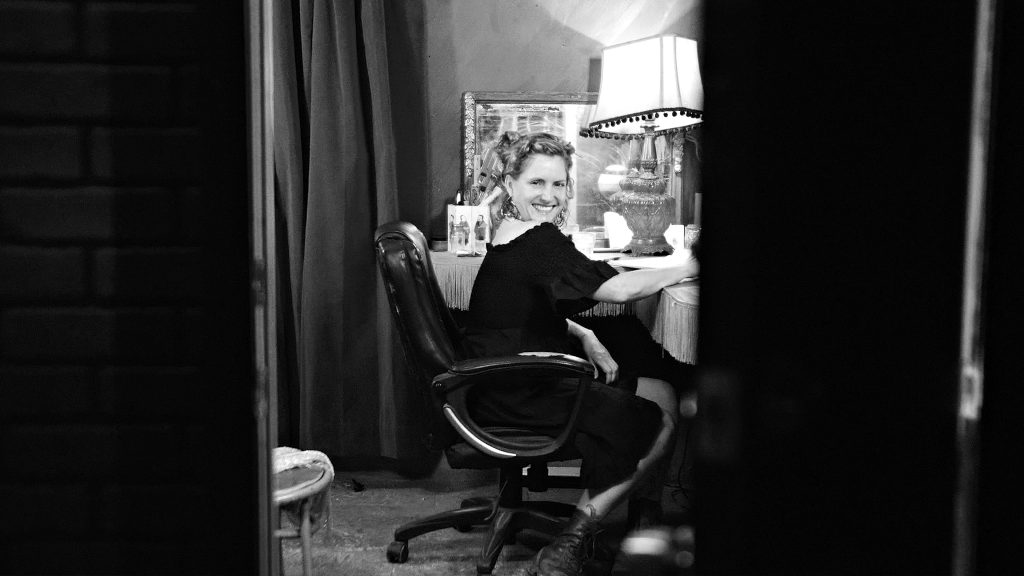
Zalia BeVille
The whole idea of a peep show is that it’s this private and intimate thing. How did you bring filmmaking to that while respecting it, yet being able to still capture the authenticity of that private moment?
I never filmed whoever was in the “audience” of the peep show. I would film from the side angle, and then I would also get in the booth as if I were one of the peep show-goers, and I would put the camera up and that’s how I’d capture the experience. But in terms of the vulnerability and the authenticity of the performers themselves, that takes no work on my part. They are just all such boisterous and vibrant and interesting performers and people to talk to and learn about, so that took really no work from me. Well, I won’t say no work. They were all just very generous to me with their time and their thoughts in every aspect. I felt very lucky that I had so many people that ultimately also really believed in the project with me. We all feel like it’s our thing. So that’s cool.
Was there ever a sense that this film might be the thing that could keep AllWays alive? Or was that not really part of the intention?
I don’t think that we ever really came to a point where the AllWays was in that level of danger, of permanent closure or anything like that. I just think that already there is so much support for the AllWays Lounge, and if that were to ever be the case I’m so positive that the community would rally around the AllWays, no matter what. It truly is the beloved, sacred homespace for the queer performing drag-burlesque-cabaret community in New Orleans. There’s a lot of love there. But I hope that my film will bring even more awareness, everywhere, about the AllWays. I’ve always told people, when they ask, “Where should I go see a show?” I’m always like, “Go. To. The AllWays Lounge. Because you’re gonna see something on stage there every night of the week that you’ve never seen, and it’s just gonna be so special.”
I saw that you started your crowdfunding in January 2022 and reached your goal (of $15,000) in about a month. Do you want to talk about the support you’ve received, either financially or practically? Some of the collaborators who really helped bring this about?
At the New Orleans Film Festival, for To Decadence with Love, we won an award—Best Louisiana Feature—and part of that award was a Panavision camera package. So we were able to shoot these really nice interviews, and that was really cool. [laughs] I actually did two crowdfunding campaigns for I Love You, AllWays because independent filmmaking grants are very, very competitive, and I applied for a zillion, and I didn’t get any grants. I did get fiscal sponsorship through the Southern Documentary Fund, which is really nice. That allows us to have 501(c)3 non-profit status. But apart from that, the film was made through community support, through my network of people and the AllWays Lounge network of people. In 2022, after we finished principal photography, we did our first fundraiser, where we raised $18,000. And then that money just dried up so quick because making movies is expensive. And I wanted to make this one right. And I wanted it to be great. So I ended up needing to do another one earlier this year, which went from like April to May. That also went really well, and we were able to cap it off with a big party at John Cameron Mitchell’s house, the Temple in New Orleans. And that was an event that truly made me realize not only the support that the AllWays Lounge has, and Zalia, and all the people there have, but also I felt a lot of support for my project.
Did you have any particular challenges or surprises along the way, either in the filmmaking itself, or things that developed with any of the characters?
I think that’s just kind of the nature of documentary filmmaking, that you don’t have a script. So I’m kind of “writing” the film as I’m shooting, and then re-writing a million times as I’m editing… That’s what makes the process so fun, but also so challenging because I mean, gosh, I’ve been editing the film for almost three years now, and it’s just taken that much time to make a draft, watch it, have friends watch it, get their fresh eyes, fresh feedback. And doing that process over and over and over again, until finally this past… I would say June? July? I started to see it and be like, “OK. I think we’ve found where we’re going with this.” And then we picture locked maybe two weeks ago. Just in time to send it to the New Orleans Film Festival, so that’s really cool. So yeah, the challenge in editing was the constant re-writing. And filming, like I said, was challenging because we kept thinking it was the end of the story, and then the story continued. I would never say that any of those [events in 2021] were good, but it definitely ended up adding up to a greater film that revealed a greater truth about this community and these awesome, wonderful people who are in the film.
How did you finally decide you’d reached that endpoint?
Ugh. It’s so hard! It’s so funny, because I was listening to a filmmaker speak once about editing a documentary, and they said, “A feature documentary is never finished, it’s abandoned.”
That’s chilling!
I know! I would say that’s one of the things I regret about To Decadence with Love: that I stopped too soon. I know I’m in the New Orleans Film Festival, I’m waiting to hear back from a few others, but I’m still working on it. When I stream at New Orleans, I’ll be taking notes.
That’s to say you’re not technically done editing this one? There’ll be revisions to come?
I think so. I would say probably it’s done once it goes to streaming. But I think we got to the point where we are now—my partner Marcus Shacknow is a writer, writes for television, for the stage. And he was really instrumental in helping me craft the narrative.
Sorry—this is a romantic partner, or partner on the project?
Romantic partner, and he serves as the story editor on the project. Which he also was on To Decadence with Love. So that’s great for me. ‘Cause you could string together your footage and make it the “true” play-by-play events of what happened, but that’s not going to be very engaging to watch. When you watch a movie, you want to feel these—not characters—subjects go on a journey. And that journey needs to have a beginning, middle, and end, and to have narrative payoff. So we finally got to the point where that was working in May or June of this year. So just in time.
Nice! You don’t have to answer this but did the romantic or professional partnership come first? I always love to see people’s relationships working on multiple levels.
Definitely. We were together even before I made To Decadence with Love, and it’s just kind of lucky that he’s so talented, and wants my work to be good, and wants me to succeed. So I’ve been super fortunate with that. And not just him, I’ve been super fortunate with the whole team that I’ve been making this film with. My brother Evan [Sox] is a sound designer and composer who I’ve worked with on so many projects, To Decadence with Love included.
I’ve worked with a lot of different graphics people and animators, title designers, you name it. It’s been really great that I’ve had such talented people to help me make this film. ‘Cause in a lot of ways documentary filmmaking is really isolating. There were a lot of times when I just felt like I wished that I had more collaboration, and it can just be an isolating experience when it’s just me in the edit. ‘Cause that’s a little unconventional too, usually a director doesn’t want to also edit. But I do. I love doing that. If I’m being really honest with myself, I think the edit’s my favorite part. That’s the moment when you see all the hard work and the effort coming together right in front of your eyes on a screen, but it can be hard also doing that alone all the time.
You’re in New York now, you’ve been there a couple months. What’s happening in New York?
I just got a job as the videographer-editor for Out Magazine, and that was after a few months of freelancing and finishing this film. But yeah, I’d been in New Orleans for almost 10 years, and that’s a long time compared to some people. But I’m originally from Mobile, Alabama. I lived there my whole [early] life and college, and then New Orleans for 10 years, so after all that it was just feeling like I needed a change, from a personal perspective, but also a career perspective. And I’d been wanting to live in New York for quite a while. My brother lives here, my partner Marcus is from the area. So yeah, it just seemed like the next step. But I miss New Orleans and I miss the AllWays Lounge, and the different magical places in the city like that all the time.
Well I take it you’ll be back in October!
Yes, I’ll be back for sure. Something really great that I wanted to mention that I was able to do last year—I’ve been thinking about it because Southern Decadence just happened. It kind of just felt like a full circle moment I wanted to share with you.
Yeah!
Obviously I just made this documentary about Southern Decadence and the AllWays Lounge. Well, last year Zalia invited me to walk in the Southern Decadence parade with them, so that just kind of felt like an amazing full circle moment: that I was walking with the AllWays family in the Decadence parade, which is what I made my first film about. That was a very surreal full circle moment and I was very grateful to be a part of that.
Oh, I love that! I’m all about the synchronicities. I did kind of want to talk more about some of your earlier experiences, like, did you go to school for filmmaking? How did you get started in the first place?
I studied at the University of South Alabama in Mobile, where I also grew up, and I did a communications degree there with a track in video production. And actually before I had chosen that major I’d just… started doing whatever I was mildly interested in. So I wrote for the school newspaper at South Alabama, I did some TV work for our news station, and then I also took some film classes. And then after making my first short film, that’s when I was like, Ohhhh I love this, this is what I wanna do. I had that moment during editing where I was like, Oh, I am actually getting some joy out of this. So that’s why I pursued that. And while I don’t consider narrative work to be my strong suit—it’s been a while since I made anything like that, probably since film school—the one thing that I made in my time at South Alabama that still stands the test of time is a BTS [behind-the-scenes] video that I made for all the short films that I had made at film school. So it was basically documentary-style. And then also, a lot of what I’ve done since has been freelance stuff for different businesses or companies or people. All kinds of stuff. And in a lot of ways that is documentary work: telling a story, finding that throughline. For most of my time in New Orleans I was the videographer/editor for Tulane University, for the Office of Admissions. So that was another thing that allowed me to sharpen and hone my skills. That’s how it all started. And it was just kind of this thing, I knew I wanted to make a feature. Like, more than being a videographer and editor, I had aspirations as a filmmaker. So that’s how I’ve been pursuing that so far.
Well, it seems like you’re well on your way! Is there anything else that you wanted to shout out or acknowledge? I know you mentioned you have this new job—any other personal projects on the horizon?
I’m just really excited for the New Orleans Film Festival. I know that it’s going to be a really great atmosphere there, because it’s gonna be playing at home and it’s just gonna be a really cool event to be part of. That was what I envisioned while putting in all this hard work: the big screen moment, watching the film with all the people who made it happen. So I’m truly grateful and I can’t wait.
I Love You, AllWays screens virtually beginning October 16, and will screen in town on October 20 at The Broad Theater, and October 21 at Prytania Theatres at Canal Place. For more info check out neworleansfilmsociety.org/lineup-events.
All photos stills from I Love You, AllWays
Top: Tsarina Hellfire
