
In 2024 it seems we all got a little older but not wiser, stared at the sun but never in the mirror, and at year’s close ended up in crisis (tale as old as time), our adversaries laughing up at us from hell. From sexy babies to monsters on the hill, from screaming to dreaming, prices and vices, this year truly ran the gamut. Here is our annual Top 5, one last graveyard shift, leaving us all a little pierced through the heart (but never killed).
Top 5 Political Moments in the Music Scene
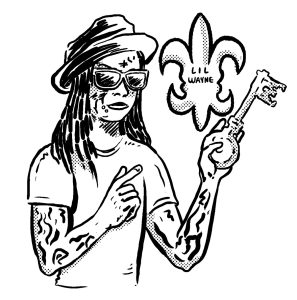
1. At November’s Lil Weezyana Fest, Mayor LaToya Cantrell came on stage to award hometown honoree Lil Wayne an honorary key to the City for his “unparalleled contribution to the [music] industry” and praised him for uplifting the city. This celebration follows Wayne’s grievances for being “snubbed” from the 2025 Super Bowl hosted by New Orleans. In anticipation of the national event, the City selected Percy “Master P” Miller as its inaugural Entertainment Ambassador. On the festival stage, Miller announced that Wayne will be one of the first inductees of the New Orleans Walk of Fame, a Hollywood-esque pathway of fleur-de-lis plaques on Canal Street celebrating historically influential New Orleanians. The first 50 plaques won’t just feature artists and musicians, like Allen Toussaint and Jon Batiste, but also include politicians like Cedric Richmond, Troy Carter, and Cantrell herself.
2. At Jazz Fest in May, Walk of Fame inductee Irma Thomas joined the Rolling Stones to sing the Stones’ rendition of her song, “Time Is On My Side,” a historic guest feature for New Orleans fans. After the Stones’ performance of “You Can’t Always Get What You Want,” Mick Jagger made a jab at Governor Jeff Landry, who was apparently in attendance. In a spiel about inclusivity, Jagger made an exception for Landry because “he wants to take us back to the Stone Age,” likely referencing Landry’s sweeping conservative legislative agenda. Landry responded on Twitter, “The only person who might remember the Stone Age is [Mick Jagger].”
3. Everyone was made aware (whether they liked it or not) that Taylor Swift was coming this October for the second year of her Eras Tour, which yet again attracted the long arm of Landry in New Orleans. A week before Swifties descended on the Superdome, Landry authorized his contingent of Louisiana State Police—called Troop NOLA—to clear the Calliope overpass homeless encampment, giving residents two days to relocate with no direction on where to go. City officials and protesters pushed back, pleading for more time to get more homeless folks into the City’s active case management plan to put residents on the path toward stable housing. Despite pleas for delays and legal guardrails for state authorities, state troopers proceeded with two days of sweeps up until the first day of Swift’s concert. They were only halted by a temporary restraining order after two unhoused residents impacted by the sweeps filed suit.
4. The Taylor Swift situation is reminiscent of the French Quarter sweeps in August led by the New Orleans Police Department’s Eighth District with assistance from—you guessed it—Troop NOLA. These sweeps are meant to make the Quarter a “nuisance-free environment” and “eradicate illegal vending and negative quality of life issues,” including removing street musicians. French Quarter street performers were commanded to pack up and, in some places, told to get a permit to perform. The Music & Culture Coalition of New Orleans confirmed in their September ANTIGRAVITY column that these permit requirements to perform in the French Market did not exist, speculating that the state police’s involvement is another Landry-backed effort to “clean up” the Quarter, similar to the Times Square sweeps under right-wing former New York City Mayor Rudy Giuliani.
5. In July, the Music and Culture Coalition of New Orleans (MaCCNO) assisted Councilmember Helena Moreno in successfully passing the Musician Minimum Pay Rate Ordinance through the City Council, guaranteeing musicians a minimum $200 per hour wage for gigs paid by the City. This ordinance was informed by community engagement efforts led by MaCCNO which collected community input from survey data and focus groups that played a major role in crafting the ordinance. Survey responses indicated that local musicians are increasingly burdened by rent, which presented the dire need for an adjustable guaranteed pay rate that accounts for inflation. A separate New Orleans Music Census was administered following the ordinance from May to June 2024 by the Office of Nighttime Economy, which outlined the top needs of the music community.1This section has been updated from the original print and web version, which originally stated: In July, the Office of Nighttime Economy successfully spearheaded the Musician Minimum Pay Rate Ordinance which passed the City Council, guaranteeing musicians a minimum $200 per hour wage for gigs paid by the City. This ordinance was informed by community engagement responses as part of the New Orleans Music Census, administered from May to June 2024, which outlined the top needs of the music community. Three of the key insights in the Census included additional support for live music performers to understand City regulations, training on the permitting process, and representative advocacy within City government, which is increasingly critical as the state’s interference continues encroaching onto New Orleans streets. —Van Le
Top 5 Public Health issues (in addition to COVID-19) to follow into 2025
1. H5N1 (Bird Flu)
In March 2024, the first cases of Avian Influenza A (H5N1), known as the bird flu, were detected in dairy cattle in Kansas and Texas. The next month, the first case of pathogenic H5N1 was detected in a human, in the first case of a cow-to-human transmission; the virus can infect other species too, including domestic cats. At the time of this writing, there have been 55 confirmed human cases in seven states—most of whom had direct contact with dairy cattle and poultry—and at least one serious case in a teenager in Canada. H5N1 virus can survive and remain infectious in refrigerated raw milk and poultry products, yet another reason why you should consume pasteurized and well-cooked food. Criticisms abound regarding the USDA and FDA’s (lack of) data sharing, as well as concerns about gaps in response and cases being undercounted, indicating that the lessons from COVID-19 are not being heeded. H5N1 once again highlights the intersection between zoonoses (animal-to-human transmitted diseases), animal husbandry practices, labor rights for farm workers, and the need for more robust public health services. There is an H5N1 vaccine in development, thankfully, though it might not be ready for months. In the meantime, do not panic, but do take this seriously: Exercise normal flu precautions (seasonal vaccines, handwashing, masking), watch symptoms, keep up-to-date on H5N1 developments as best as you can, and, once the vaccine is available, get vaccinated against H5N1.
2. Abortion Rights and Access
In the two-and-a-half years since the Dobbs decision overturned Roe v. Wade, abortion access is now either limited or restricted in most of the United States. Unsurprisingly, the effects of Dobbs have already been detrimental, with increased morbidity and mortality of both pregnant people and infants in states with abortion restrictions and bans. In Louisiana, standard pregnancy care has been disrupted, and the abortion pills mifepristone and misoprostol were reclassified as controlled substances by the Louisiana legislature this year, creating barriers to prescribing these medications, which are also used to manage miscarriages and other reproductive health issues. Texas is now trying to follow suit. There are some small glimmers of hope in these dark times, though. In the November election, seven states passed abortion rights amendments, most notably Missouri, which overturned that state’s restrictive abortion ban. And, in New Orleans, the City’s Health Department has launched a formal investigation into the effects of the state’s mifepristone and misoprostol restrictions on reproductive health and medical care. Remember, too, that the Louisiana Abortion Fund and abortion funds across the country are still doing vital work.
3. STIs
In 2023 (the most recent data from the Centers for Disease Control and Prevention), there were over 2.4 million diagnosed and reported cases of sexually transmitted infections (STIs) in the United States. The good news: The total number of all STI cases decreased by 1.8% between 2022 and 2023. This is a promising change from the increase in the number of reported cases observed during the COVID pandemic. However, we are not out of the woods yet. The number of syphilis cases at all stages in 2023, including congenital (present at birth), was 209,253, the highest number of cases in the U.S. since 1950. Louisiana still ranks among the states with the highest STI burden, too. There are many reasons for these increased numbers, including lack of access to comprehensive sexual education, sexual health care and preventive services, and reproductive health care; stigma around STIs; and other social inequities.
4. Overdoses and Harm Reduction
Some good news: Provisional data from the CDC indicates that there was a 14.5% decrease in drug overdose deaths between June 2023 and June 2024. Reasons for this may include wider distribution of the opioid overdose-reversal drug naloxone (brand name Narcan) and fentanyl test strips, both tools in overdose prevention, as well as access to treatment and harm reduction services. However, non-opioid overdose deaths have increased, and overdose deaths in Black and Indigenous populations are rising. With pushback against harm reduction efforts and progressive drug policy, including Oregon’s now-repealed Measure 110, and with Trump threatening to escalate the War on Drugs with a “War on Cartels,” some experts believe that harm reduction is “in peril.” As always, support your local harm reduction programs in whatever way you can.
5. Dismantling of Health Institutions
There are many things to be concerned about with a second Trump administration, least not the effects on the United States’ public health and health infrastructure. There are, of course, many legitimate criticisms to be made of our current systems, but the nomination of Robert F. Kennedy, Jr. for secretary of the Department of Health and Human Services—which oversees, among other agencies, the CDC, Indian Health Service, the Food and Drug Administration, and the National Institutes of Health— and TV’s Dr. Mehmet Oz for head of the Centers for Medicare and Medicaid Services makes it all-too-apparent what is at stake. Just for starters: Proposed funding cuts and Kennedy’s promotion of anti-vaccine, anti-science, and anti-trans beliefs could be devastating for public health in the United States and abroad. To err on the side of caution, make sure you are up-to-date on your vaccines and other medical appointments as soon as you can, if you have the ability to do so. —Mary Beth Campbell
Top 5 Unexpected Celebrity Food Endorsements
Famous people have always enjoyed visiting New Orleans, where eating and drinking establishments are said to be accommodating (and tasty) without being obsequious or filled with fawning crowds and paparazzi. But 2024 brought some unusual shoutouts to New Orleans cuisine from an unexpected array of famous people.
1. Bob Dylan recommends dining at Dooky Chase’s. The Nobel laureate musician has, for his own mysterious reasons, taken to the former Twitter in recent months even as others leave the Elon Musk-owned platform. Dylan has gotten worldwide attention for posts praising the 1927 Lon Chaney film The Unknown, an obscure 1894 book called The Great God Pan as published by a small South African publisher he sought out at a sprawling book industry fair—and Dooky Chase’s. “If you’re ever there I highly recommend it,” he posted on X.
2. Helen Fuckin’ Mirren. That’s the uncensored name of a cocktail at Pal’s Lounge, the cozy neighborhood dive steps from Bayou St. John, named for the celebrated British actress. And when Mirren appeared on The Kelly Clarkson Show, she video chatted with two bartenders from the establishment, which she called her favorite New Orleans spot and her regular hang after annual visits to Jazz Fest. The bar was founded by Mirren’s late stepson Rio Hackford.
3. Late night eats with Lana Del Rey. Lana Del Rey has, not unlike Bob Dylan, crafted a slew of songs based on sly takes on American late night and roadside icons (and recently married a Lafourche Parish swamp tour guide), so it’s probably not surprising that in June she posted an Instagram photo from the Tic Toc Cafe, a 24-hour Heinz-ketchup-and-Crystal-hot-sauce diner just off I-10 in Metairie. It’s unclear what she ordered, but we’d be happy to dispatch a reporter to join her on her next visit—or introduce her to Lamplighter Lounge, Gerald’s Donuts, Joe’s Cafe, Dots Diner, or any other kitschy suburban greasy spoon of her choice.
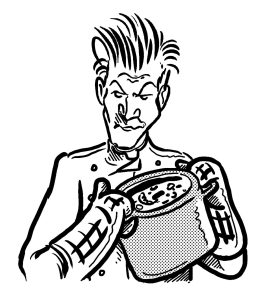
4. Gordon Ramsay comes to Li’l Dizzy’s. TV chef Gordon Ramsay built a name for himself around his gruff personality, but when he visited Li’l Dizzy’s, the breakfast and lunch spot on Esplanade Avenue in Treme in early October, he was reportedly quite “sweet” to the staff. Ramsay, according to the restaurant’s Instagram, enjoyed fried chicken and gumbo, and bought an autographed cookbook from the founding Baquet family along with some gumbo mix. He also apparently enjoyed the food enough that he came back later in the week, posing for some more pictures with an enormous stock pot along with Li’l Dizzy’s staff.
5. Travis Kelce pooh-poohs jambalaya. While Taylor Swift fans mostly loved her recent appearance in New Orleans, her boyfriend and Kansas City Chiefs player Travis Kelce was a real tight end about the city’s food on his podcast in October. Kelce, a self-described picky eater, described jambalaya as “soupy rice,” even calling it “pooey” for its brown color. We’re hopeful for his sake he won’t have to return for the Super Bowl. —Steven Melendez
Top 5 Times Landry Made Good on his Promises (to Run Louisiana like a Fucking Asshole)
1. Clearing the Calliope Encampment. For the last few months, City officials have been diligently working to find housing for the people living under the Calliope overpass, understanding their presence there as the inevitable consequence of a lack of alternative options. But ahead of Her Royal Highness Queen Taylor Swift’s arrival, Governor Landry decided to substantiate our fears that he would freely use the Louisiana state troopers during his time in office as his own personal army, and had them clear the encampments over the begging, pleading, and vociferous protestations of City officials, who stood united in the knowledge that forcibly removing people with nowhere else to go was a disaster waiting to happen. But with 150,000 Swift-loving teenyboppers on the way, Landry remained determined to treat these unhoused individuals as eyesores rather than people. “We are committed to ensuring New Orleans puts its best foot forward when on the world stage,” shrugged Landry’s spokesperson.
2. Ten Commandments. When a judge recently blocked Landry’s attempt to put Louisiana’s public schools under “God’s law” by requiring a copy of the Ten Commandments at the front of every classroom, Governor Landry responded, “I don’t see what the whole big fuss is about.” Of course, that’s not quite true. The First Amendment may not be Landry’s favorite law, but that doesn’t mean he doesn’t know it’s there—his full awareness of the hornet’s nest underfoot upon signing the Ten Commandments bill into law is a matter of public record. Shortly before he did it, Landry gave a keynote address at a Republican fundraiser in Nashville, parading the move as a victory in the culture war. “I’m going home to sign a bill that places the Ten Commandments in public classrooms,” he crowed, “and I can’t wait to be sued.” So while it is heartening that courts are now finding this blatantly unconstitutional law to be, well, unconstitutional, it undercuts the victory somewhat to consider how much energy we’re hemorrhaging playing defense on so many fronts. It seems uncoincidental that one of the few battles we’ve actually won this year is largely a symbolic one—the kind that keeps us distracted and overextended, leaving an unobstructed path for more sinister policies like criminalizing abortion providers and restoring mass incarceration’s reign of terror to its former glory.
3. Rolling Back Raise the Age. In the bad old days before prison abolitionism changed the mass incarceration conversation, there was a certain relish with which the ruling class spoke about crime as an act committed by subhumans. The disparaging hardline rhetoric of Harry Connick Sr. and Leon Cannizzaro is echoed now in Landry’s defense of his rollback of the Raise the Age law, which means the state once again prosecutes 17-year-olds as adults. “These juveniles are not innocent children any longer; they are hardened criminals,” he sneered in a speech outlining his proposed crime policy. “They violently attack our citizens, our law enforcement officers, and even our juvenile correction officers without hesitation.” But according to a damning report by Richard Webster of Verite News, within the state’s three largest parishes 69% of the teenagers languishing in places like Orleans Parish jail were not accused of violent crime.2This section has been updated from the original print and web version, which originally stated: “But according to a damning report by Richard Webster of Verite News, within the state’s three largest parishes only 70% of the teenagers languishing in places like Orleans Parish jail have been accused of violent crime. If Landry’s underlying motives were, in fact, to deter violent crime, it might have occurred to him that trapping teens accused of petty offenses in gruesome hellholes wherein their lives and sanity are under constant threat will only make matters worse. But with his sado-racism firmly behind the wheel, what chance did we ever have of a statewide, rational crime discourse undertaken with the goal of affecting the change we all want to see?
4. ConCon 2024: A Constitutional Cluster for the Ages. You’d be hard-pressed to find someone who considers the Louisiana constitution a functional document; the long overdue need for reform has been gnawing at the back of every state politician’s mind for years. No one has beat that drum louder or more consistently than the conservative money man and self-described “kingmaker” Lane Grigsby, who is not so much troubled by the constitution’s lingering racism or its structural conflicts with common law as the many ways it roadblocks his vision of a low tax and anti-union government. After failing for years to either pocket John Bel Edwards or get his own candidate elected, Governor Landry’s ascent must have been the kingmaker’s dream come true—at last, someone who could carry his constitutional vision to fruition. And shortly after Landry was inaugurated, so it seemed to be. After all, nothing says “Lane Grigsby pulls my puppet strings” like coming out of the gate waving the Louisiana constitution in one hand and a lighter in the other.
Other governors might have taken their time setting up the first constitutional convention in 40 years, knowing it to be a powder keg shitshow that must be handled with extreme caution. Instead, Landry immediately put Grigsby at the head of a transition team charged with constitutional reform and together they attempted to bulldoze their way to a constitutional convention that very spring, hoping lawmakers wouldn’t notice that the proposed “ConCon” was a catchy name for career suicide. And though state legislators very much did, Landry and Grigsby were undeterred. Next they tried to hold a special legislative session to shove through their proposed constitutional changes onto the November 5 ballot, a move in which opportunities for public participation were conspicuously absent. Landry may have underestimated the widespread aversion to jumping headfirst into this legal nightmare, but he may yet wear his colleagues down. Since Landry’s malevolent ambitions probably aren’t what we want behind the all-powerful document that circumscribes our daily lives, we’d be wise to have a constitutional vision of our own ready to go if and when he does.
5. Taxpocalypse. If you can’t have your dream budget enshrined in the constitution, you can always settle for a brutal spate of tax cuts to strongarm your constituents into the same program done a different way. And so it is that Landry unilaterally decided to completely restructure our economy without so much as a by-your-leave. The pre-Landry tax structure may have been a feast of scraps, but it’s what we had, and upending it without inviting the participation of those who were relying on it is going to leave a lot of hungry folks. Economies are delicate systems, and just sweeping the table with one big bear paw is no way to run a democracy. Unless, of course, you’re a fucking asshole.
There is a lot to untangle with Landry’s proposed tax cuts, and not all of it is bad news—especially since a few key proposals didn’t go through. Had he gotten his way entirely, we would have lost the tax structure that makes our local film industry—otherwise known as the only way a creative person can currently make a living wage in this town—possible. And then there was his proposed demolition of the historic tax credit here, a clear indicator of his undisguised hostility towards New Orleans, a city whose integral continuity with the past is such a large part of what makes it so special. But the increased sales tax did go through, offsetting lowered income taxes by raising prices on consumer goods. For those who make less than $40,000, this means that the lowered income tax may be moot in light of the increased cost of living. —Holly Devon

Top 5 Local Icons
The City recently announced the first inductees for the New Orleans Walk of Fame, featuring cultural icons such as Allen Toussaint, Big Freedia, and Irma Thomas, as well as luminaries like embattled Mayor LaToya Cantrell and garbage person Sidney Torres IV. But a few names were missing. Here are five local icons that didn’t make the list.
1. Mylar balloons. Shiny. Stunning. Pure elegance. Terrible for the environment. No celebration would be complete without them. And talk about impact—many local politicians claim to be changemakers, but most are full of hot air. Not these balloons. And not just because they’re actually filled with helium. In August, one of these free-floating rebels bumped into an Entergy powerline, shutting down large parts of the city’s grid—including water treatment facilities, triggering a boil water advisory in all of New Orleans for days. In response, the City—literal party police—proposed criminalizing them, rather than address the underlying infrastructure that collapses at the touch of a balloon (or squirrel or bird).
2. Rats. This year, the vermin brethren we all know and love expanded their operations. In March, the furry insurgents infiltrated the New Orleans Police Department headquarters, breaking into the evidence room and eating confiscated marijuana. And they did it with a smile on their little faces. “They’re all high,” NOPD Superintendent Anne Kirkpatrick said, despite the impossibility of rats getting high from eating weed. Then, in September, the city’s rodents became the subject of a malodorous mystery at City Hall, when a heavy stench was attributed to their rotting corpses, shutting down entire departments. Reports are unconfirmed on a possible varmint alliance between rats and squirrels—their tree-dwelling cousins—in their ongoing war against the city’s infrastructure.
3. Patch. The New Orleans Police Department has struggled with recruitment and retention for years, so the department widened its net—possibly following Air Bud rules. Much like Caligula before her, Mayor Cantrell swore in a 16-year-old miniature horse named Patch to provide emotional support for the Percheron draft horses of the City’s mounted units, and though unintended, emotional support for the rest of us. His job is to reduce anxiety, and dammit he’s good at it. He’s three feet tall. His name is a play on “eye-patch,” because he was born with one eye. And he has an Instagram (@nopdpatch). And yes, he’s adorable. But sadly, ACAB means Patch, too.
4. Jeffrey Vappie. What would you do for love? Call former NOPD officer and personal bodyguard to Mayor LaToya Cantrell, Jeffrey Vappie, a romantic, but apparently it’s illegal now to be head-over-heels. Gone are the days when you could conspire with your amour. Now, it’s allegedly “fraud” to pocket more than $7,000 for hours you claimed to be on duty but were really with your beloved. It’s “improper” to bill city taxpayers more than $47,000 in travel expenses with your married lover. It’s a “crime” to lie about your affair to federal agents. In federal court, Vappie may have entered a not guilty plea on seven counts of wire fraud and one count of making false statements, but in the court of love, he’s guilty as charged—Public Official 1 in court filings, but Number 1 in our hearts.
5. Scrim. In times like these, the city needs a hero. And we found one in a two-year-old terrier mix named Scrim. He came to New Orleans from Terrebonne Parish, where he was set to be euthanized. The little rascal escaped and went on the lam, evading capture for six months. But he managed to capture our hearts. Possible sightings in Mid-City were reported. Grainy, Bigfoot-like photos of a blur of white fur were posted. He was on the evening news. Seeing Spot run, Scrim showed up in City Park, was caught eating cat food on Tulane Avenue, and chased off railroad tracks—a true vagabond. When he was finally captured, he had a high fever, was missing a chunk of his ear and a toenail, and had two bullets embedded in him. Our neighborhood friendly Scrim was honored by City Council. At press time, he was once again—after jumping from a second-story window—on the lam. —Drew Hawkins

illustrations by Romey Petite
