
JULIAN PRIMEAUX
Like many a Louisiana native, Julian Primeaux grew up in a musical family and began playing his instrument, in earnest, around the age of eight. He was performing by 12 and hasn’t stopped since. His axe has taken him all over the states and across Europe, earned him a Grammy nomination, and just this year, an induction into the Louisiana Music Hall of Fame. A frequent collaborator of Corey Ledet, Primeaux has also performed with or opened for Anders Osborne, Gary Clark Jr., Sonny Landreth, Eric Johanson, the Reverend Horton Heat, and Dr. John. I caught Primeaux via Zoom, in his dressing room, en route to another induction ceremony for the Louisiana Music Hall of Fame. This time, he was performing to honor the next round of chosen musicians. We spoke about the benefits and challenges of playing left-handed, what he uses the 20+ pedals on his board for, and the perils of playing for cats.
What’s the first instrument you started fiddling with?
The very first thing I remember picking up would be the old, broken harmonicas laying around the house. I was really just tooting around with those. I still play them in a few songs in the show but they’re not my main thing. I used to use Lee Oskar harmonicas but they’re not quite as road-worthy as I need these days. I have a cool neck brace that’s magnetic, so I can switch ‘em out fast. But if there’s nothing magnetic in the harmonica, it won’t hold, so I’ve been trying out this classic old Hohner, but it’s got shoe glue on it ‘cause it kept falling off the brace.
Last time I saw you, at French Quarter Fest this past year, did you mention that you still have your first guitar?
I do! It’s my #1 writing guitar. It’s a Yamaha FG-345 acoustic and it’s old, from the late ‘70s. It was my mom’s guitar. My grandfather on my dad’s side had it for a while. He’s a musician too. I have musicians on both sides of my family. The guitar is left-handed, I’m left-handed, my mom is left-handed—but my grandfather was right-handed, so he restrung this left-handed guitar right-handed, which was really odd. When I was eight years old my mom got it back from him and I started taking guitar lessons on a left-handed guitar that I was playing right-handed. I took lessons for a month like that and I was ridiculously terrible. Then I had to sign my name for something, and they saw that I was left-handed and went, “Ohhh, that makes a lot of sense!” So they restrung it left-handed and then learning started to click.
Do you ever pick up a right-handed guitar from time to time?
I can. I’m not as good at it but when you go into music stores, a lot of times, they don’t have left-handed guitars. Or when you’re at someone’s house and there’s a guitar in the corner, it’s usually right-handed, so you just kind of figure it out. My guitars are currently tuned the “classic” way with the high E string facing the ground and the low E string [facing] the sky, but I can play it [in] reversed tuning as well. When I’m playing with someone right-handed, and we’re playing the same thing, it looks like a mirror. In a way, it’s actually pretty handy and easier to follow—once you’ve adjusted—but when I’m jamming with someone who’s never played with someone left-handed before, it can be very weird for them.
Are there any other benefits to playing upside down, besides the convenience of being able to fiddle on whatever guitar is laying around?
This old blues guy, Albert King, plays left-handed but upside down and it’s really good for all the bends. When you do a regular bend, you’re pushing out, you’re moving away from your hand. But if the strings are reversed, the mechanics actually work better for bending, because it’s into your hand, so there’s more strength. Doyle Bramhall II also plays like that, and Eric Gales. But for country bands and any type of music where you’re keeping some of the strings going while you play… there’s advantages to both. I think playing chords works better in the standard way, but these things are based on the history of the guitar and the way it was designed and played through the centuries. Music would probably be different if everybody played that other way. These are the things I think about at night. I wake up in a cold sweat, thinking about the evolution of music. There’s a parallel universe where we all play over the neck. I was probably born in that universe and something happened and I got over here somehow.
Since you’re literally sitting in front of your amp stacks, cradling a guitar right now, let’s talk about your rig.
I’m a big Telecaster person. That’s my favorite. Physically, with my body, height, shape, it fits me well and I like the simplicity of it: two knobs, 3-way pickup selector, I can do everything I need to do with a Tele. It stays in tune really, really well. I can go crazy on it and it’s solid. I very seldom have any issues with them. I’ve flown a lot, where I’ll land in another country and my guitar’s been in the overhead compartment, from Louisiana (where it’s hot and humid) to a city where it’s freezing cold and dry, and then from the plane I’ll take a train or a shuttle or a van and get to a hotel room or a gig and—a lot of times—the guitar is still perfectly in tune. I have two of them with me but this first one is made by a guy in New York, named Rick Kelly, of Carmine Street Guitars, in the Bowery, so it’s a Kelly Tele. It’s one guy who makes ‘em by hand. The wood is reclaimed swamp ash lumber from over a hundred years ago and the neck is maple, also from a hundred years ago. It’s really light and really resonant. If you play a chord, you feel your hand vibrate and it’s got a chunky, fat baseball bat neck, which I really like. You want me to grab another one?
Yes, please!
None of these were relicked or anything, by the way, [pointing to all the rubbed off paint finish] this is just how they look from me playing them. [The headstock] says “Fender Esquire” on it but I put this guitar together. Warmoth is the brand that made the neck. A guy in Colorado made the body for me—it’s pine… I put all the parts together and wired it. It was the first one I put together. I’ve put together a lot more since but I really like this one… I love all of [my guitars], they’re like living things. As a kid, I’d be playing guitar, I’d lay down, I’d still be playing guitar and I’d fall asleep with it in my hand. I know this is crazy talk but I feel like they each have a personality. I have one more with me, do you want to see it?
Is it the guitar that belonged to your mom?
Actually, this is one of my fly guitars. You see these dots? That’s fingernail polish. This guitar has a dot on the 10th fret, instead of the 9th fret, and in the heat of battle, it’ll throw off my brain. Also, more fingernail polish all along the sides, so I have visible fret markers. You can see these holes on the front, because it’s a right-handed guitar that I’ve flipped upside down for playing slide. [It’s] from the ‘60s, 1966, DeArmond is the brand, it’s got a gold foil pickup. I took out the volume and tone knobs so it’s just the pickup straight to the jack. So whenever I turn it on, it’s just full blast, wide open. You can’t mute it, you can’t turn it down. I switched out the bridge. The neck is fatter than the body. I keep tuners on it. I keep it in open slide tuning. There was a music store in New Iberia, Louisiana, Romero’s Music, and when they shut down you could go and buy whatever they had laying around, so this body was a Decca but someone shaved it down so I had to put glue and shims to get it to sit right. There’s a piece of plywood under the bridge. A fan of mine also went to the music store and brought me a whole box of random parts from there, so I played matchmaker and put all the stuff together. It was inspired by a 1965 Harmony Bobkat, like what St. Vincent used to play, that I have at home and also use for slide guitar. (This is the stuff I nerd out on.)
I’m afraid to even ask about your monstrosity of a pedalboard.
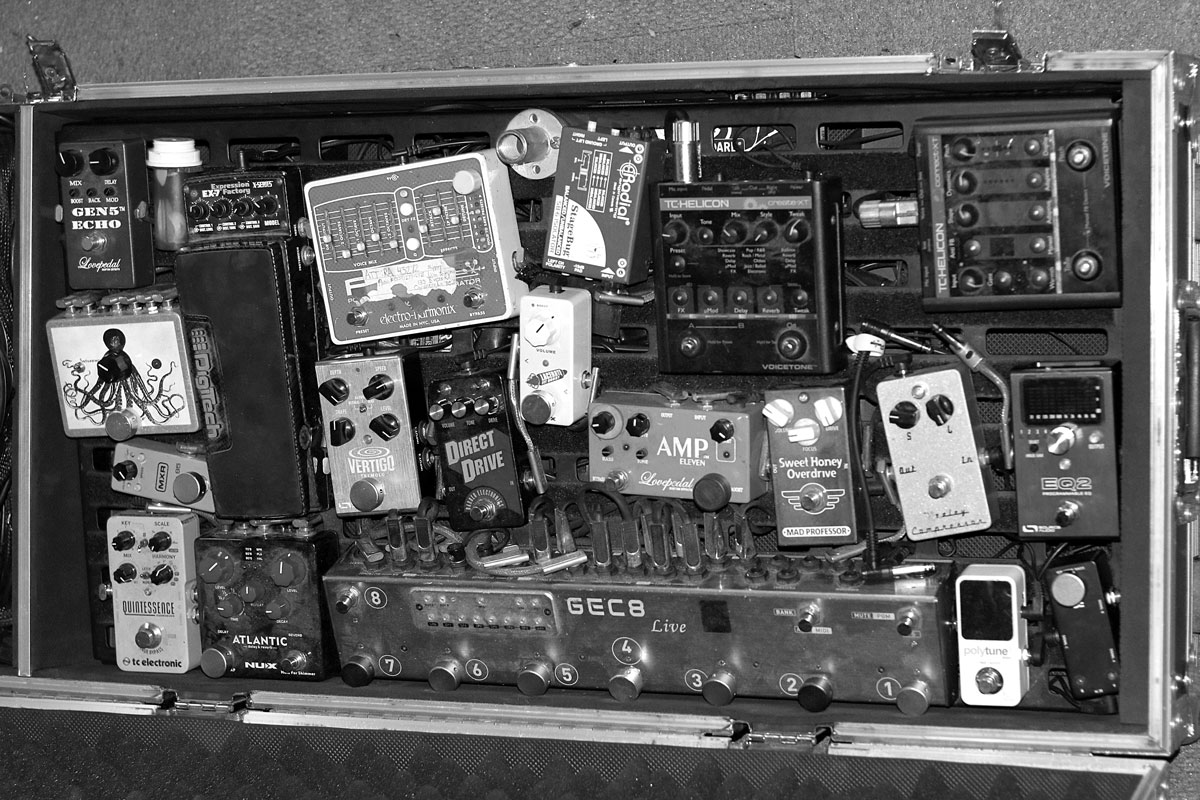
Let’s go through the path. My first [pedal] is just a basic EX A/B [switch], because, for some shows, I’ll also play lap steel, so I use it to switch over to a different portion of the pedalboard. This one’s not wired up at the moment but it’s a Source Audio EQ2 EQ. I just use that if I’m using a wireless during the gig to go walk out in the crowd. The wireless unit changes my tone so I use [the EQ] to neutralize the sound ID of the wireless. This Keeley Compressor is kinda always on. Then it goes into this MOEN GEC8 Live switcher. This is by far the most complicated setup I’ve ever had.
How heavy is that board to carry around?
Ask the other guys in the band—this is the first thing they’ll complain about. In the case, it’s heavier than a lot of my amps. I changed up my whole board during COVID. The switcher just allows me to turn on and off a bunch of effects all at one time because I’m doing a lot of singing… It allows me to program and not have to spend so much time looking down and tap dancing. It turns on different sets of pedals. It’s complicated. People look at it and think, “You must suck at playing guitar if you have all of this stuff,” but what they don’t understand is that someone can suck with or without pedals… This overdrive is the next pedal. It’s made by Mad Professor [Amplification] from Finland. It’s called the Sweet Honey Overdrive. That’s probably my favorite pedal of all time. It’s just a low-medium gain overdrive. This one’s a Lovepedal Amp Eleven. It’s a little darker and has a little more low end to it. This has a built-in boost so I kick that on sometimes. It’ll get it fuzzier too ‘cause the boost goes into the overdrive and it’s not a clean boost so it’s already pretty dirty. This is a NUX Lacerate [FET] boost [pedal] and you can use it clean or dirty. This one’s a Barber [Electronics] Direct Drive. I’ll use it if I need more of a high gain distortion for some solos but I don’t use it for rhythm. Then I go into the Electro-Harmonix POG2 [Polyphonic Octave Generator] and I’ll do some kind of organ stuff with it sometimes, [which] goes into this Source Audio Vertigo Tremolo. Both of these together gets me a Leslie [speaker] kind of a sound.
That’s for taking people to Blues Church.
That’s it, exactly! Then the board splits. From there, that goes into one amp and then the path goes to this NUX Atlantic delay and reverb that goes into just one amp. From there, it goes into this Lovepedal Gen5 Echo. That’s my wet sound, out into one amp. The other way goes into this DigiTech EX-7 Expression Factory (it does weird kinds of stuff); you can do a wah and different kinds of things. I don’t really do that too much. That goes into the other amp with this MXR Phase 95.
That’s the only pedal I also have on my board!
I really like that pedal. I like stuff that’s small and simple. I borrowed that from someone and then became the buyer. The octopus pedal, I don’t know what to tell you about because I designed it. I drew up a rough sketch of what I wanted the pedal to do. It has a million ins and outs (eight actually, like an octopus) and it can basically run out to both my amps and it has a buffer and helps get the signal there strongly. Then I have a Radial DI box. That’s mainly there because I run two amps, so sometimes you can have an issue with grounds, or if the power’s kind of weird, I can cut off a part of the board or there’s a ground lift, if I need it. Sometimes I’m getting shocked or it’s noisy and that’s for that. And then these two are just some old TC Helicon pedals that I use for harmonica, just a little reverb or delay, because I’m playing harmonica through the vocal mic.
That is quite a lot going on.
I also have a glass slide on my board that I keep in a plastic pill bottle as a little joke to myself because the original slides were made of old glass medicine bottles. But it’s perfect, because since it’s plastic, it won’t shatter and it’s a prescription to rock. I also mess around with brass slides and I’ll use all sorts of found objects during the show to make noise. I’ll go walk out into the crowd and use a whole pool stick, something that there’s no way it’s gonna sound good, just to be silly.
Time to talk amps?
I have an amp endorsement. It’s a Louisiana company, J. Ray Amplifications. They’ve made three amps for me so far. They’re 1950s Fender-style amps with some tweaks that they made and things that I requested. This one’s a modded version of a [5F4] Tweed Super. It’s got an old school sound that’s really cool. For most gigs, I’ll use two amps, so I’ll use that and then I’ll use a Fender Deluxe Reverb. This one’s from the ‘90s but the same company rewired the whole thing. The circuit board inside blew up so it’s all hand-wired, they both are. They’re awesome.
Last question, your personal fashion style is really colorful and notable. What inspires it?
This shirt is new—well, new to me. Hardly anything I ever wear is new, in terms of brand new. I buy a lot of thrift store stuff, a lot of women’s blouses. If your grandma went to the casino in the ‘80s or ‘90s, there’s a chance I may have her shirts. If your aunt liked the nickel slots and, heaven forbid, something were to happen to her, and there’s an estate sale, feel free to call me and I will peruse the collection.
And the pants?
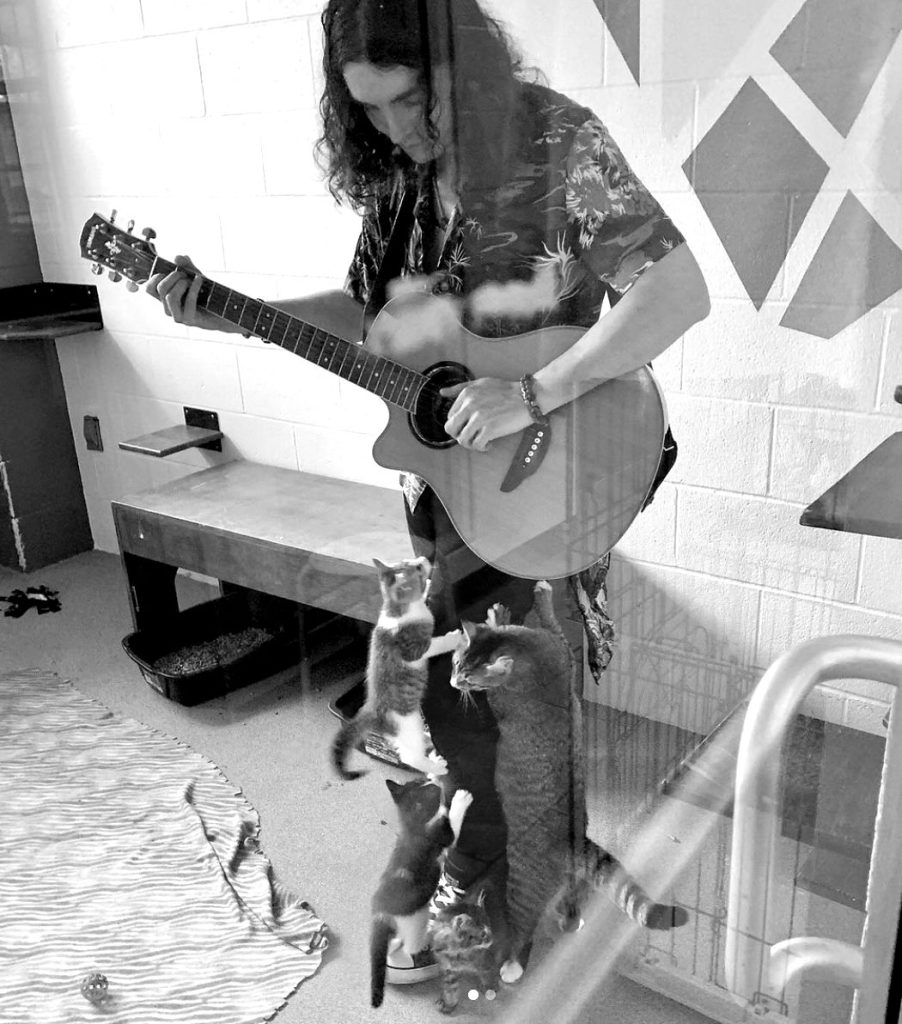
I have occasional regrets about the pants. I did two shows this year for animal shelters: One was for the dogs and one was for the cats. Let me give you some friendly advice. If you’re going to go play for kittens, don’t wear velvet pants. I did. And they were just clawing up them, climbing my body. I was performing, standing there, playing guitar, and I became a cat tree.
For more info, check out julianprimeaux.com.
Cat shelter photo courtesy @julianprimeauxmusic
