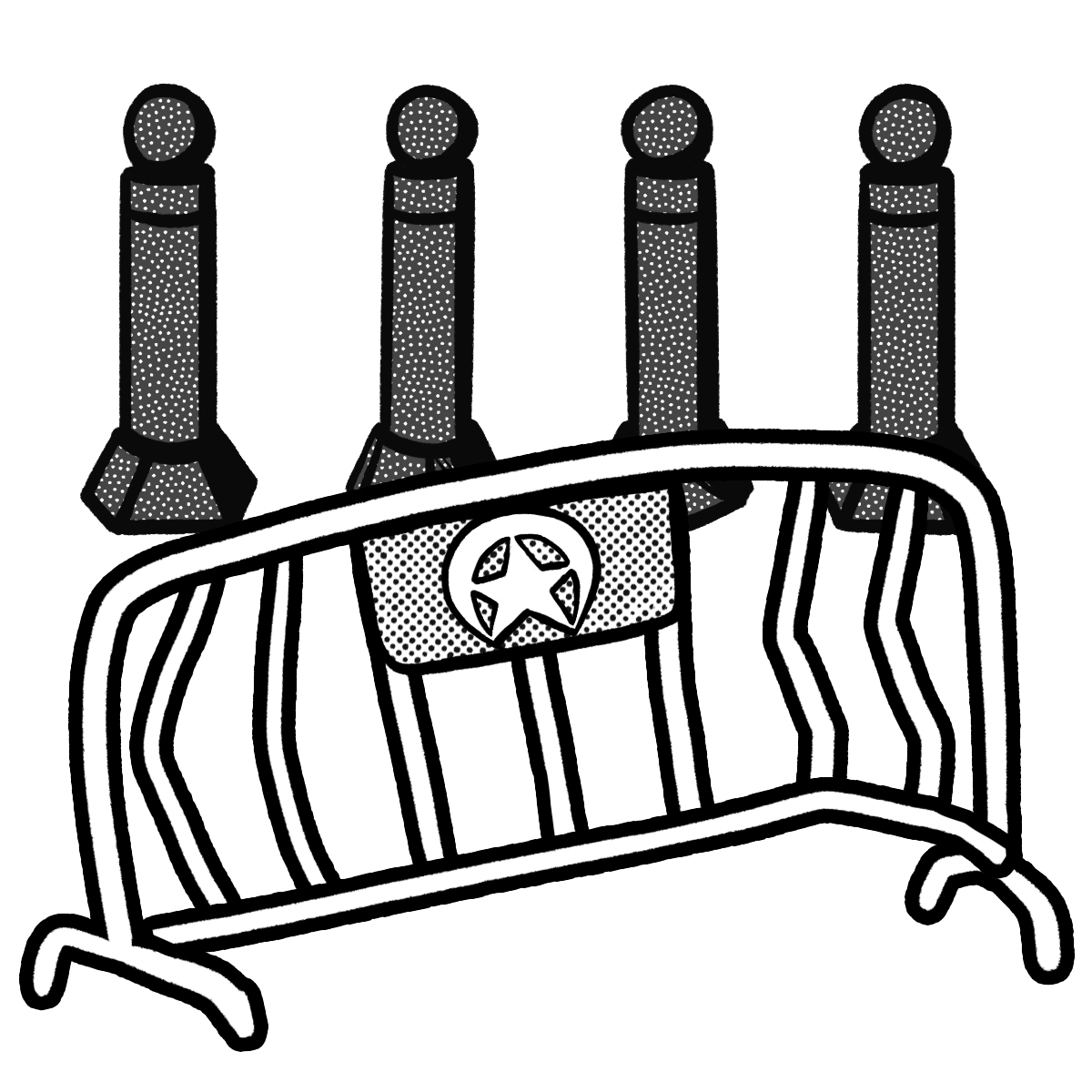
On January 8, the New Orleans City Council Joint Public Works – Criminal Justice Committee held their first meeting of 2025. It was in the immediate aftermath of the New Year’s Day massacre where U.S. army veteran Shamsud-Din Jabbar drove a truck around a police cruiser parked as a makeshift barricade at the intersection of Canal and Bourbon, onto the sidewalk, and into the throngs of revelers and workers on Bourbon Street, killing 14 people and injuring far more. At the national level, veterans are the most likely to perpetrate so-called “mass casualty events,” perhaps stemming from the army’s recruitment of people more likely to have a traumatic background, and refusal to halt recruitment among likely extremists. And across the country there’s the continuing pulverization of public services and safety nets, the rise in economic precarity and homelessness, as well as a barrage of misinformation and right-wing radicalization in online spaces. At the local level, the barricades themselves were not functional (seemingly due to an accumulation of trash that clogged the mechanisms—reflecting New Orleans’ skeletal public works department), and the NOPD failed to utilize mobile bollards that were at their disposal at the time. This attack was carried out in an incredibly tightly-surveilled part of the city, where all of the cameras adorning the lampposts and balconies did not, and could not, prevent a single act of violence—for no camera ever can. In all of my time watching City Council meetings, I have never seen the Council as agitated and defensive as they were on January 8, as they and Police Superintendent Anne Kirkpatrick were faced with a furious and grieving public. The following are a selection of comments submitted in-person and online before the Committee. They have been edited for clarity and length.
How do we address safety in the community without acknowledging the violence of U.S. imperialism as a primary contradiction? On January 1, New Orleans woke to the news that Shamsud-Din Jabbar deliberately drove into a crowd, exited the vehicle, and began shooting at police. On the same day, Matthew Livelsberger blew up a Tesla in Las Vegas. Both served in the U.S. army and spent time at Fort Bragg; both served in Afghanistan. Our soldiers are stationed around the globe at [almost] 800 overseas bases, commanded to commit violence daily. They return home and are unable to cope with what they’ve done. Some turn to self-harm, others turn to violence on those around them. Unfortunately, Jabbar chose to enact violence on those he did not know, who had not harmed him, as surely he was trained to do in Afghanistan. We cannot make the community safe while our government is violent abroad. No amount of enhanced law enforcement presence can impact random acts of violence in a nation where there are more guns than people, in a nation whose primary manufacturing jobs are making weapons of war which are shipped abroad via the port of New Orleans. The U.S. unhoused population increased 18% in 2024 which is violent and on purpose. Not addressing this as the root cause of petty crime also makes us unsafe. As we continue to send Americans overseas to commit acts of terror—and make no mistake, those at the receiving end of U.S. bombs and bullets consider it terror— [returning] home without any mental health care to cope with what they’ve done, on behalf of a rapacious capitalist system with a for-profit war machine, we will continue to be unsafe. It is moot to talk about violence without addressing the root cause, which is U.S. foreign policy.1Terry F.
A few things:
1. The mayor and the police chief should be fired. How do you not know that there are blockades [barricades] in storage??!
2. Replacing the bollards should not have been happening this close to the Super Bowl. You KNEW they needed replacing and didn’t. You also seem to think stopping 5000 lbs GOING 10 MILES AN HOUR, will suffice. Shame on the entire city govt for failing us constantly. Do better and protect us or leave.2Cate E. (online)
What is the City’s excuse for not yet having a system to fully pedestrianize any part (or all) of the French Quarter quickly and easily? This oversight exposes not just a liability to terrorist attacks like we saw on January 1st, but a vulnerability to impaired drivers. The French Quarter has more pedestrians than any part of the city, yet pedestrian safety remains an afterthought. The Quarter was not designed for cars; vehicular traffic is damaging to the aging buildings and roads (which are crumbling due to decades of deferred maintenance). Put in hydraulic bollards made to a higher standard than S10 (which is able to stop a vehicle going under 10mph). The bollards being installed currently are, at best, security theater. There is no reason for personal vehicles to be in the Quarter at all except for delivery vehicles, and cars of Quarter residents. As an urban planner, I recommend that private vehicles, with few exceptions, are banned from the Quarter entirely and that true anti-vehicle security measures are installed, maintained, and used correctly every time. Put another way: Pedestrian tourists are what make your money in the Quarter so it would behoove you not to let them be killed by vehicles. Have you ever seen Jaws?3Julia M. (online)
I recently lost a friend to this senseless violence that occurred on 1/1/25 in the French Quarter. I ask that you please improve safety measures to reassure that no event like this could ever occur again in our city. I would like vehicle access in the French Quarter to be limited to residents and workers, for barriers to be used during parades and other large events. We went to the vigil last night on 1/4/25 and the barriers were there, but not in use. There were thousands of people at the scene and everyone knew that this was in place!4Isabella P. (online)
I’m sure some residents are currently calling for intensified policing in the French Quarter. Some responses, such as limiting roadway access and increasing the use of barriers, may help prevent future attacks like the one on New Year’s Day. While such actions may improve safety outcomes, I urge the Council and my fellow New Orleanians to avoid kneejerk responses that increase police presence downtown while ignoring the needs of our community. Keeping the people in the city safe—including locals, Superintendent Kirkpatrick—will be crucially important during the upcoming Super Bowl and Mardi Gras events. But please, do not reach for militarized solutions that resemble martial law. If you want to prevent future attacks like the one on New Years, invest in our communities, invest in access to mental health services, and invest in care for our veterans.5Bobby B. (online)
I was at the hearing in 2017—as you know, I’ve been living in the Quarter for about 13 years. You can’t say this wasn’t anticipated. There was a whole demonstration about truck bombs coming down the street. There was a whole commitment of $40 million for protection stuff. So it’s not about the money and it’s not about the foresight, it’s about the execution. It’s about the middlemen who are pinching the money, it’s about: who would expect that a Mardi Gras bead would fall down the thing and break the whole system? I said you should give a million dollars to 40 community organizations, [which] would do more to prevent crime than a bunch of cameras. I lost that argument! Y’all won that argument, and what’d you do with the $40 million? You flushed it down the toilet and watched a guy drive down the street. This city is really good at hiring their cousin, and having no oversight, and getting nothing done, and that needs to end!6Bruce R.
I’m a formerly incarcerated person. I need to lead with that. Being in these positions, you gotta have some tough skin. I’ll give a shoutout to a VOTE member, Natalia Kennedy, she lost her brother, Terry Kennedy, in this tragic event. And I want to give a shoutout to some of the bouncers, some of the waitresses, the sex workers, they showed up and they helped people too. This is what happens when we give Homeland Security control over our house. Chief says she don’t know the answers to these questions and I’m saying to myself, who are we to rely on? Who’s supposed to know these things?7Earl H.
illustration by Anneliese DePano
