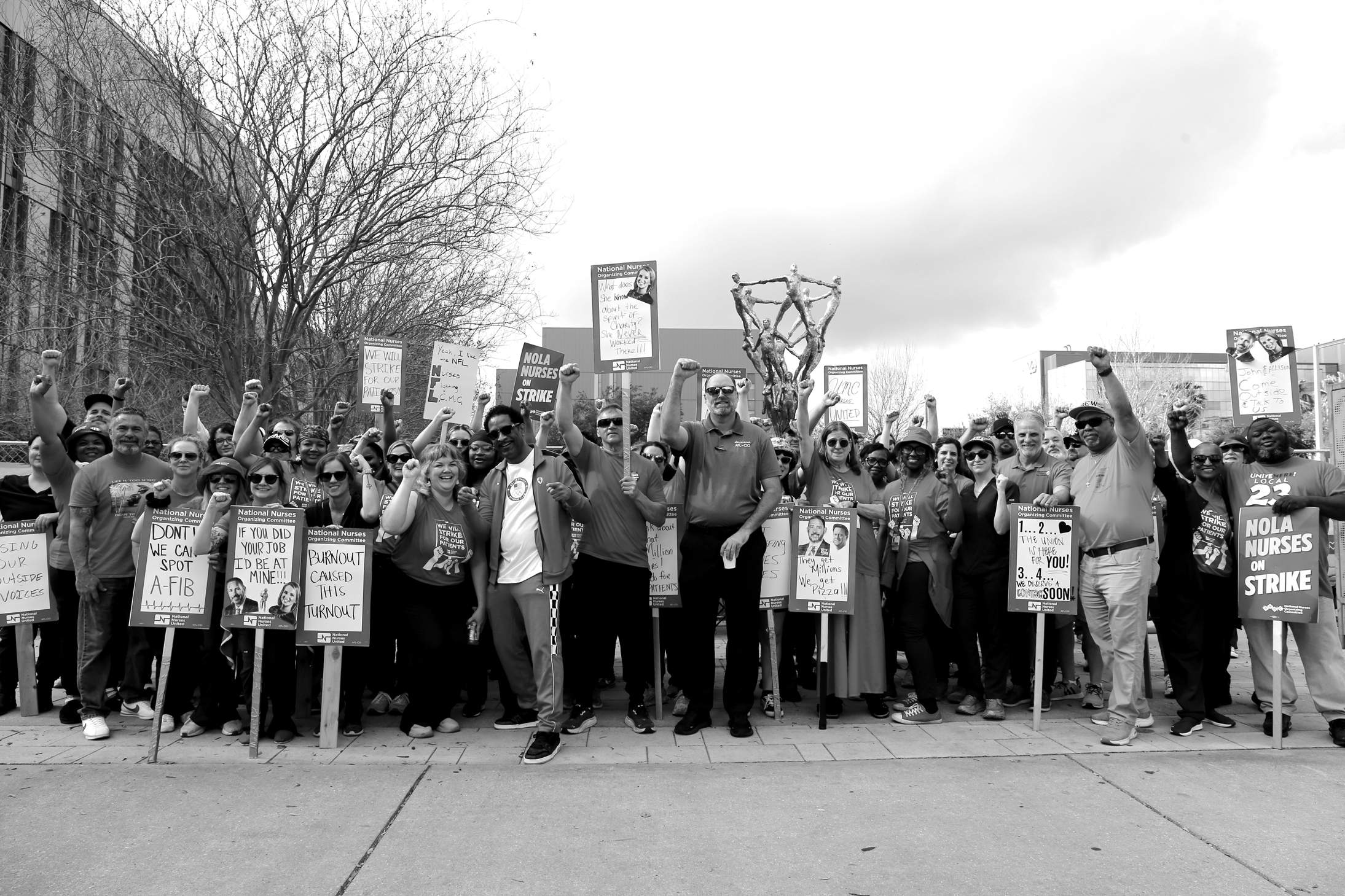
On February 5, downtown New Orleans was a frenzy of last-minute painting and patch jobs as the city prepared to host the Super Bowl, while only a few blocks from the Dome, the nurses’ union at University Medical Center (UMC) was marching in a picket line—for the second time in less than six months. Nurses chanted in call-and-response, “Am I right or wrong? You’re right! / Are we weak or strong? We’re strong!” and “I don’t know but I’ve been told / UMC has a pot of gold / And if they don’t give it up soon / We’ll be marching til next June!” The nearly 600-member union authorized a strike after negotiations had once again stalled with LCMC (the administrator running UMC, as well as seven other New Orleans hospitals) for their first union contract. Back in December of 2023, nurses at UMC voted overwhelmingly in favor of forming the first private-sector nurses’ union in Louisiana history, and began negotiating in March of 2024. But after nearly a year at the bargaining table, including a one-day strike in October where nurses were locked out of the hospital for an additional two days, nurses voted to authorize a second strike for two days in January. This time around, nurses were locked out for three days after LCMC claimed they were obligated to contract with strike nurses for a minimum of five days. Nurses have been calling for improved pay and benefits as well as improved staffing ratios—measures that nurses say will reduce burnout and improve patient care. LCMC is one of only two hospital administrators in the New Orleans area (forming a “duopoly” with Ochsner) and operates the only Level I trauma facility (UMC) as well as the only pediatric trauma center (Children’s Hospital)—they essentially have no competition. While nurses say that some of their colleagues are struggling to make ends meet, CEO Greg Feirn collected a salary of over $2.4 million in 2022, and the top 10 employees ranked by compensation at LCMC all collected salaries over $550,000 (of those top 10, two are physicians). The contracts for labor during the strike reportedly cost the hospital $10 million. (LCMC did not respond to repeated requests for comment.) As the nurses returned to the bargaining table following the strike, nurses Hailey Dupre and Heidi Tujague, both members of the nurses’ bargaining team, joined me via Zoom during the lunch break of their first bargaining session to discuss their strike, the status of their contract negotiations, and the struggle ahead.
So how was today?
Heidi Tujague: Oh, we’re just getting started. We had one session so far and it’s been nice.
Is that different than how it usually goes?
Hailey Dupre: I don’t think I’m overstating by saying it sometimes feels emotionally abusive, but today the main negotiator who kind of likes to antagonize us wasn’t here, so it feels a lot more productive.
HT: There was more mutual respect and communication today.
I was wondering if you two could talk a little bit about getting to the point of the strike. What triggered that decision?
HD: What we just said about how the negotiations usually feel, [that] has largely brought us to this point. It often doesn’t feel very productive at the table; it feels like a bad song and dance. And we are just really ready to make meaningful movement on our proposals that really matter. Like our safe staffing, our pay proposal—which we gave them back in July and have yet to hear a response on—ultimately [we’re] ready to get a contract. It’s been nearly a year since we started negotiating, a year-and-a-half since we unionized, and we’re just ready to get it done and move on.
HT: We feel like we’ve just not made good progress that we should be making at the table, and we’re seeing the negativity, we’re tired of it—the lack of mutual respect is hard!
Would you say there was movement at the bargaining table after your October strike to now? Were things changing?
HD: It does feel like they have finally started responding to some of our more hard-hitting proposals. Initially, we spent so much time deliberating jury duty, and time off to vote, and things that are important, but they’re not the reason that we started a union. And it does feel as though after our October strike, there’s been more conversation about those bigger things that we are fighting for, like safe staffing, patient ratios, and improved wages (although they still haven’t responded to our wage [proposals]). But there’s at least been some conversation more around those technical nursing issues. But I think that there is still a good ways to go. [To Heidi Tujague] Is that your feeling as well?
HT: Yeah, it feels like we’re getting more substance. We’re actually getting into the things that are gonna affect us more.
HD: My sense was that they were hoping to tire us out, but they saw how successful our strike was and were like, “Maybe they’re not as tired as we think.”
Can you talk a little bit about how it felt going on strike a second time?
HT: Being on strike, it’s hard. I would rather be in the hospital taking care of my patients. But when I walked out to that strike line, when I saw everyone who showed up for the picket, when I felt the energy and the community support—especially the way the community rallied around us—with the GoFundMe, with the NFL Players Association supporting us, with [Robert] Tiger [Hammond III] from the AFL-CIO making that phone call to Mitch Landrieu and cancelling his appearance—I mean helping him realize he shouldn’t make his appearance at the hospital—that was empowering, seeing all the support around us.
HD:You may have seen the NFL Players Association’s statement that they put out Friday and we actually got to meet with them over the weekend. It was very, very cool having such a big union on our side and seeing other different sports unions reposting that. We’ve gotten a lot of local recognition, but having national recognition, and them asking how they can help us and directly saying, like,“OK, we’re going to reach out to our contacts, we’re going to see who we can get out here,” that felt huge. And going back to my statement about community support and how emotional that’s been, just to really have people know that our struggle is also their struggle… We know what our strength is inside of the hospital, and I’m reminded of it daily, and especially walking out to the picket line and seeing so many people in their scrubs—but I think it’s easy to lose sight of how much the community supports us until we do have these public things, and they’re literally showing up for us. That’s the part that makes me really emotional. Actually, a high school nearby, they came by during class and were interviewing us to learn more stuff. They were actually holding signs, picketing with us. That was just incredible to see. And I love their teachers for taking them out to see what justice is about, and fighting for your rights.
And when you mentioned Mitch Landrieu, I don’t actually know the details of that. What were you talking about?
HT: So while we were on strike on Wednesday, the hospital decided to hold a tailgate kickoff thing, with giveaways for AirPods, a Kindle, and so much more! Food and whatnot. And they were going to announce the winner of the raffle for two Super Bowl tickets, and they invited Mitch Landrieu, and he didn’t know what was happening outside the hospital. And when Mitch found out he was like, Yeah, no. I am not crossing the picket line.
HD: And it was the most New Orleans thing ever because [Tiger] was like, “I don’t know if I have his number, so I called his sister, Mary,” and everyone’s screaming because everyone knows Mary Landrieu, and then, “I did have the right number, ‘cause Mitch called me back!” [laughs]
HT: Yeah, AFL-CIO was big on his campaign, and he’s not going to do anything to go against the nurses of New Orleans.
NOLA.com reported that some nurses crossed the picket line, can you respond to this? Is that true?
HD: Ideally we would love 100% turnout, but I think that’s not super realistic. I do know that there were a lot of people who do support the union and support our cause, but due to financial reasons, and with the snow storm, OR (operating room) nurses and people in areas [of specialty] who don’t have a lot of opportunities to pick up extra shifts, like some of the other areas of the hospital do, they felt like they couldn’t afford to lose those days of work. And on top of that, the hospital lock[ed] us out after our strike that was only for two days, [they] lock[ed] us out for an additional three—you know, that really kind of put some people’s pay in jeopardy. And so there were hard decisions made there, where people did opt to cross the picket line, just because we don’t have the fair wages that we need, to be able to make that sacrifice.
HT: And I had people reach out that were concerned about what could happen on the weekend, with potential for another terror attack, and that the hospital would not use our patient protection task force [a task force meant to ensure that nurses on strike had communication from within the hospital to be able to respond to emergencies, if necessary] effectively and allow us back in the hospital if something did happen. They were worried that the hospital wouldn’t make the right decision and say, “Y’all come back, y’all signed up for this patient protection task force, in case of an emergency.”
Can you respond to LCMC’s point that they had to hire scab nurses for five days? Is there documentation to prove that point? The last time it was three days, right? And this time it’s five.
HD: Now, you have the same observation we have. [Both laugh]
HT: We haven’t seen anything so far. I’ve spoken with contract [strike] nurses in the ER who said they’ve worked these one and two-day strikes without these continued lockouts, and this is coming from nurses who work strikes on a regular basis. They think it’s potentially not true [that the contract had to be for five days]. But we’ve not gotten any proof from the hospital that the contract employer was requiring it. And really, who’s in control here, the hospital or some outside agency?
HD: And if we have to negotiate a contract, why can’t they?
Over and over again, nurses have been talking about safety concerns at work. Can you talk a little bit more about that, and what measures you want to see from the hospital to address your concerns about safety? Nursing is actually a very risky job when it comes to workplace injuries and workplace violence.
HT: Definitely one of the big things is having more available staff for helping to lift and turn patients; that is going to decrease injuries right there. If you have more people, then the person who shouldn’t be trying to do these things [alone] won’t be doing these things [alone]… or [you need] the proper equipment to lift and turn and move patients. The hospital has implemented some safety procedures, like the metal detectors. But who’s to say that those things are guaranteed, until we get our contract? Yes, they’ve hired a few more security personnel, but we would like more people protected, which is why we’re fighting for this contract. The biggest thing is having enough people to do the work instead of scrambling, because while you have three [nurses] moving one patient, that’s those three [nurses’] patients that are not being easily attended to.
HD: I mean even something as simple as people getting their full break that they are entitled to. Nurses are going on their lunch breaks with their phones on them, ready to get up and respond to whatever need that their patient may have, and that’s not truly a break. Having enough staff for people to take their prep breaks and not having so many patients that they can’t take care of them properly. All of that just turns into better safety for nurses and their patients.
How does it feel to not have a contract after almost a year of negotiations?
HT: We knew it was going to be a little bit of a fight, I just wasn’t expecting it to be this hard of a fight. We were the first hospital in Louisiana to do this, and we know there’s some outside pressure potentially trying to keep us quiet. But, I don’t know about you, but I’m not stopping anytime soon.
HD: You can’t really quiet me now, so… [laughs]
HT: I would have liked to not have to keep fighting this, but we’re not going to back down. We know the importance of this, and we’re going to keep fighting.
How does the mood feel among your coworkers, coming back post-strike?
HD: I only had one shift back so far but—while strikes are hard, they’re very empowering. They don’t want us to feel very empowered, but for the nurses that went on strike and were on the picket line, they saw how much community support was there—they really saw where their strength lies, it lies within each other. Going back to work for me yesterday, people just feel really excited and motivated and they understand that the fight is still here, but they are ready to continue that fight.
HT: For me, I was one of those nurses that was not replaced and was invited to return after the strike, and I worked Friday, Saturday, and Sunday. And I had a lot of people saying: “What are you doing here?” And I told them, “No one was hired to replace me, so I was invited back in.” And I even mentioned to a few people, “It’s nice that they appreciated some people, it would be nice if they appreciated everyone else as much as they appreciated the 15 to 20 people who they invited back in.”
Can you talk about how the hospital has offered certain benefits to non-unionized workers in the hospital system?
HD: At the end of last year, they initially were offering better insurance, maternity leave, free parking, extra PTO to all LCMC employees that are non-union. So that’s across their eight-hospital system. They like to announce these things in emails, and in one of the most recent emails it said, scroll down to see who’s excluded! And it’s like, union nurses are not included in this! And it’s stuff that we’ve proposed that they will kind of water down, try to claim as their own victory. But you know, I’ve had respiratory therapists and X-ray techs come up to me and thank me for the free parking. I think a lot of the people at the hospital recognize where this actually came from.
So at this point everyone working at the hospital is getting free parking, except you guys?
HD: Yes.
What is keeping you motivated these days to keep fighting for this first contract?
HT: I know for me, it’s because I’ve seen how good working conditions can be, and I want to get back to that. And I’ve also seen how things have degraded our quality of life as nurses, and I want the future of nursing to be as good as it used to be, if not better. So I’m fighting for the future.
HD: For me too, the grander political climate, what’s happening out there and knowing there are fights to be had everywhere—I recognize how important the fight is within us, with ICE [U.S. Immigration and Customs Enforcement] and everything in that realm—we care for those patients. [By] us having a voice, we will be able to continue to care for those patients and advocate for them.
And now that we are under a new National Labor Relations Board that will most likely be much less friendly to unions, does that change your strategy on the ground when it comes to organizing and fighting for your contract?
HT: I think it’s going to be… making sure that we all know that the more we come together, and the harder we fight, the stronger we are. We had this amazing rally where the nurses showed up saying, if you take on one of us, you take on all of us. This is not just our fight in Louisiana, we have the backing of all nurses in NNOC (National Nurses Organizing Committee) and NNU (National Nurses United), and showing that we are really united in this fight, there’s a lot of us. [laughs] And if we can get through these next four years showing how united we are, then we’ll have that forward momentum for our next administration.
HD: We know throughout history that the law and administration isn’t always on our side, but we know that when the people band together, that’s bigger than anything, and I think that’s definitely what’s in our hospital.
You can follow @rankandfile.nola and @nationalnurses on Instagram, or visit nationalnursesunited.org/press for more updates about this campaign.
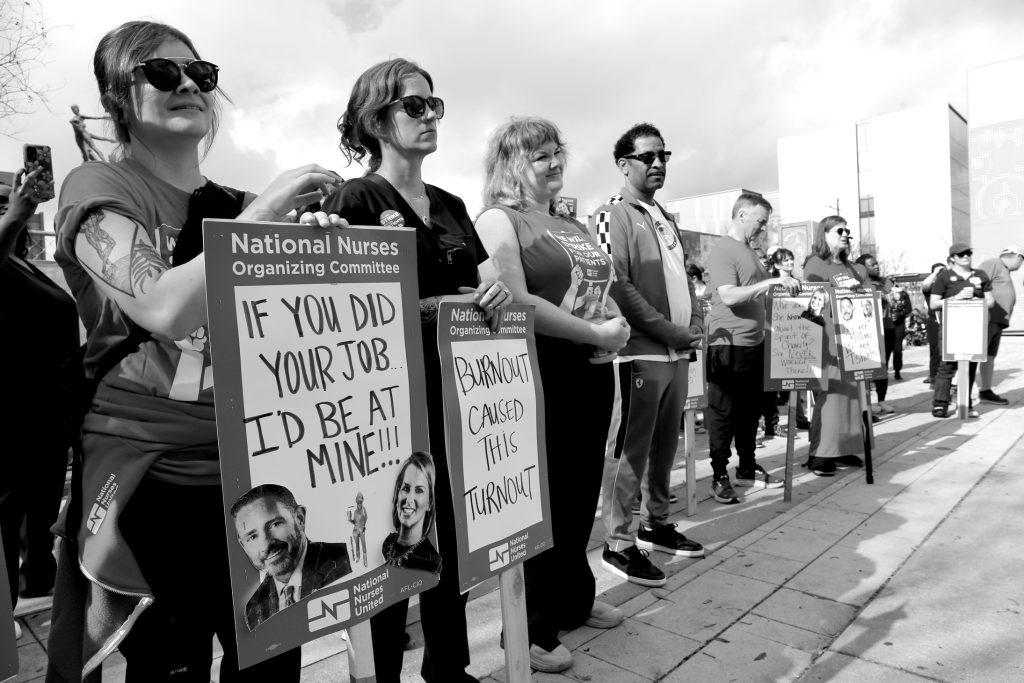
Photos by Temple Blacksnake: Striking nurses and supporters gather outside of University Medical Center on February 5, in response to drawn out negotiations with LCMC Health System over their union contract.
