
Times being what they are, my daily news consumption has become nothing short of shocking to those around me. There is a growing consensus that the only way to avoid a perpetual state of panic is to shut out as much of what’s going on as possible, that otherwise there is no way to function. And believe me, I get it—there’s nothing like reading the news to make you understand why people don’t read the news. But I also know that no driver makes it through patches of rough road with their eyes closed. Historically speaking, when shit gets real, the ones who survive and thrive are those who read the writing on the wall.
If you only have the bandwidth for one impending disaster right now, allow me to make the case for the escalating trade war. On April 2, the president is expected to announce a new round of retaliatory tariffs. These will be levied against political rivals and former allies alike, tariffs being his weapon of choice in everything from the drug war and political disputes to his absurdist fantasy wherein he rescues an American economy that he imagines as a damsel in distress, cruelly ravaged by the thieving nations of the world. Understandably outraged, the governments of these accused nations have shot back with tariffs of their own, and their constituents are following suit with consumer boycotts of U.S.-made products. If the parties involved make good on all their threats, you can soon expect the already precipitous cost of living to blow sky high.
Trade networks, even the neoliberal death cult that answers to the name of “global economy,” are about interconnection. To try to break away from that web without also abandoning corporate interests will push the cognitive dissonance of our political leadership to its breaking point. Like it or not, the global supply chain is what keeps most households on the planet running these days, and disrupting it is sure to have far-reaching consequences. I’m not alone in my speculations—as we speak the bigwig capitalists are crying “Mayday” from every pulpit. The World Trade Organization has been sidelined, the Federal Reserve can’t cut interest rates fast enough, and the stock market has a bad case of the jitters. According to The Wall Street Journal, these dark portents herald the coming of the dread “stagflation,” described by one headline as a “two-headed monster stalking the economy.”
The reason I am urging us to turn our attention towards this economic telenovela is not to further frighten my already terrified community, but because of all the nightmarish tableaus under the category of current affairs, this is the only one in which we have any real power to affect the outcome. The draconian legislation increasingly strangling our way of life is in the hands of politicians who have no obligation to listen to any of us until they’re up for reelection. The future of intensifying structural violence and the armed conflicts reaching their boiling points belong to a dystopian military machine that never has been, and never will be, accountable to anything other than itself. But no matter how bad things get, the economy is somewhere we will always retain the ability to chart our own course. Whether we know it or not, the fact remains that we are the economy. Within totalitarian consumerism, it is our hunger, our thirst, our fear, our curiosity, our desires, our sorrow—everything, in short, that makes us human—fueling the economic engine. That the economy must go where we tell it to is just a matter of mechanics.
The president has been referring to the occasion of the April 2 tariff announcement as “Liberation Day,” and although I’m tempted to dismiss the name as Orwellian doublespeak, I think it’s worth asking exactly what it is he’s seeking liberation from. If the obsession with tariffs is the cornerstone of an ideology which sees freedom as the absence of any mutual obligation, we are talking about a serious acceleration of consumer capitalism’s most suicidal tendencies. I point this out not to state the obvious, that our nation is being driven off a cliff by a certifiable lunatic, but because I think it clearly outlines the path forward for those of us who want to live. If their version of freedom requires severing all ties, liberation from that reality is a matter of holding each other close. If they want to frighten us into submission by holding our food and shelter hostage, then we simply have to find a way to need them less and each other more.
I can think of nowhere I’d rather take that project on than New Orleans, Louisiana. My faith that we are more than up to this challenge comes to me from just about every direction. I’m strengthened by knowledge of this city’s past, of how many times the forces of order have been subdued by the wild power of this inimitable place. Here, the word freedom never lost its meaning the way it did so long ago in the nation’s capital. It is an undisputed fact that if ever a place were to turn pirate within the continental United States, it’s New Orleans. In the last five years alone, we’ve seen it happen twice: first, with the pandemic era solidarity economy, and then in the community heroics which so efficiently organized resources during Hurricane Ida, both of which were achieved without the help of any centralized governing structure.
Economics is only complicated if you buy into the fictions of the discipline. Grasping a warped logic that rationalizes finance as something other than a centuries-old pileup of overdrawn gambling debts might take some serious mental acrobatics, but seeing the interdependence of living things does not. When New Orleanians are ready to leave that world-historical vision to its demise, it will simply be a question of making conscious choices to take care of each other, only feeding the systems that keep us fed in return, and go on doing what we do best: defying the odds with our continued survival, and having a damn good time doing it. —Holly Devon
illustration by Laura Frizzell
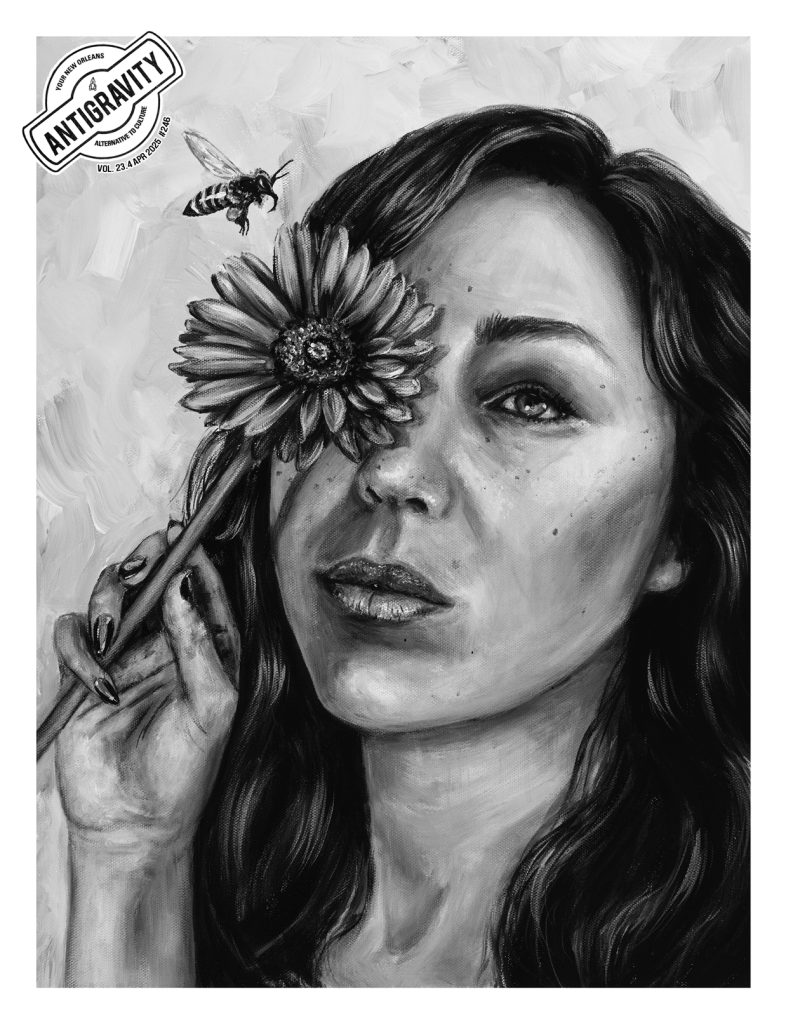 April 2025 cover by Lillian Aguinaga
