
Danielle Nelson is a practicing therapist and Licensed Clinical Social Worker (LCSW) who focuses on sexual health and wellness, trauma and recovery, self-esteem and resilience building, life transitions, and general mental health concerns. Though Danielle is a trained professional, this column is not a substitute for advice or care provided by your licensed medical or health care professional.
This month’s inquiry got me thinking a lot about shame and how dangerous it can be. It thrives in silence and isolation and can really hinder our personal growth. It also messes with our self-perception—sometimes leading us to believe and act on the worst beliefs about ourselves. If you’re carrying something too heavy, I encourage you to try to set it down. Talk to a trusted friend or therapist and practice self-compassion. We’ve all got our own shit: bad behaviors, poor decision-making, regrets, and the like. Possessing those things only makes you fully and perfectly human. You’re doing the best you can with what you’ve got right now. Why not be kind to yourself?
A few months ago, my ex and I broke up pretty amicably—I initiated it, and even though it was hard it was for the best. Now he’s dating someone new and I’m obsessed. I find myself googling her and looking at her IG profile (even though it’s private and I can’t see anything). I think about running into them and how I would react. I’m scared I’m going to click on her LinkedIn or accidentally message her. It’s driving me nuts. I’m not jealous, I don’t want him back, we only dated for a few months, and I’ve never even met this woman. I feel like a creepy stalker, but I can’t turn off this part of my brain that thinks about it. How long is this going to last and is there anything I can do to cool off the mild obsession?
If it’s any consolation, I know from both professional and personal experience that what you’re feeling, and the resulting behaviors, are incredibly common. It’s normal to be curious about the people tied to our past and what they’re up to. Sometimes there’s a need for resolution or closure and sometimes it really is just genuine curiosity that leads us back to the characters from our past lives.
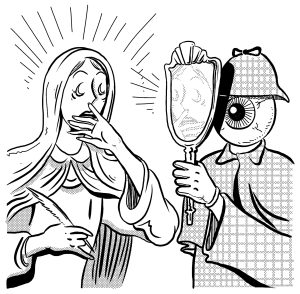
This is a complicated subject to unpack because there are a lot of important factors at play. Let’s start with the ease with which we are able to access information about one another. Social media offers the illusion that we have a glimpse inside the lives of others. With a few clicks and some scrolling, we can learn what someone does for a living, where they last vacationed, what they’re reading, and even what they’re making for dinner tonight. In addition to providing entertainment, social media scrolling sometimes creates a parasocial relationship. Often used to describe feelings of familiarity with celebrities and media figures, a parasocial relationship is a one-sided relationship rooted in a feeling of intimacy, connection, or attachment to someone with no reciprocation. An example would be finding an ex of your current partner and familiarizing yourself with their life to the point that you feel a connection with them. I use that example for a reason: It’s the most common type of parasocial relationship I hear about in my practice.
In some ways, parasocial relationships are inevitable in a cultural climate where socialization happens on one side of a screen. Having access to all of this seemingly personal information can affect our self-worth. It’s easy to forget that the information provided is often purposefully selected, edited, and almost always out of context. Studies show that increased Instagram usage often leads to decreased self-esteem. And here’s where it gets interesting: We keep going back for more. Why? Well, I’ve got some theories.
Recently, a client of mine found herself with access to her partner’s email account. She said it felt “reflexive” to search for correspondence and photos from their previous relationship. She described the sensation as frenzied—stating several times that she couldn’t stop. Only after reading an email so intimate and vulnerable that she began to weep did she close the laptop and stop. When I asked her how the experience made her feel she said excited and a little naughty at first, like she was doing something she shouldn’t; but later, she admitted to feelings of shame and guilt. I asked her what she was hoping to find in the emails. She couldn’t answer. At our next session, once she’d had a week to reflect, we got closer to the truth: She’d always feared her partner was happier with their ex than they could be with her. She was looking for evidence to confirm it. While she acknowledged the deep pain reading the emails caused her, in addition to the burden of guilt for snooping, she admitted there was a payoff: Those emails gave her a sense of validation. In the moment, she believed those emails confirmed what she feared all along—that her partner wasn’t capable of loving her the way they loved their ex.
So how does all of this relate to your inquiry? Well, you mention being “over” the relationship—and I believe you—but maybe there are some unresolved issues. Let’s look at what those might be. The first question that comes to mind is: When you seek out information about this woman, what are you looking for? Like my client, is there a thought you’re trying to validate? Are you looking for evidence for something you believe to be true about your ex, yourself, or even his new partner? Maybe you’re looking for a self-esteem boost by confirming you possess something she doesn’t. Or perhaps it’s the other way around and you’re attracted to something you believe she has that you don’t. If you can allow yourself to destigmatize the fact that you’re curious, and go one step further to explore what’s driving the curiosity, you may learn some valuable information about yourself. I also wonder if this “mild obsession” is keeping you connected to the relationship in some way. Letting go requires time and distance. If you find yourself launching your investigations, try redirecting the behavior. Instead, try to pivot away from the screen. Do something you enjoy. Get outside, stretch, reach out to a friend, etc. I check out coffee table books from my local library for moments when I’m deliberately screen avoidant. A visually appealing book can be a cozy reprieve from blue light overstimulation. Find your version of that. My guess is that with time, the previous excitement you experienced when looking for information will be replaced by a slow but steady disinterest.
If you need to speak to someone right away, call 504-269-COPE (2673). The COPE crisis line provides free, confidential crisis counseling, suicide prevention and information, and mental health referral services 24 hours a day, 7 days a week.
Submit your questions to goodcounsel@antigravitymagazine.com (email and sender info will remain confidential), or use our anonymous Google form.
illustrations by Romey Petite
