
The past 11 months of this year have taken us along many unconscionable and exhausting turns, and we know more challenges lay ahead. As an organization with roots in a collective living enterprise and whose work is intended to advance housing affordability and neighborhood stability, we at Jane Place are struck by the extent to which so many of these events beg the question: What does it mean to live in a world and a time so consistently defined by forced displacement? How can we resist such displacement for ourselves and our neighbors, near and far?
Insofar as acknowledging and documenting such displacement is important in the greater effort to fight back against it, we find ourselves looking back on the year and feeling struck by the monumental scale of efforts to remove people from their homes and communities.
Here in New Orleans, our year began with the Louisiana State Police forcibly relocating our unhoused neighbors to a maritime industrial warehouse site under threat of arrest. The warehouse closed 10 weeks later and came with a $17 million price tag, all so that Super Bowl and Mardi Gras tourists wouldn’t have to see the reality that this is a city and state where our collective neglect of housing issues has forced many individuals and families to live outside.
At the time of this article’s writing, immigrant and unhoused communities and those who stand in solidarity with them are bracing for the arrival of as many as 200 federal Customs and Border Patrol officials, who are reported to be arriving in New Orleans by the week of Thanksgiving. Local youth, cultural, safety, and housing programs are also facing cuts amid New Orleans’ severe budget shortfall, which will worsen the extent to which targeted individuals are vulnerable to federal cuts and increased federal enforcement.
Similar threats to safety, community, and stability are happening around our country. The border officials on their way to New Orleans are coming by way of conducting parallel actions in Charlotte and Chicago, where racist profiling and enforcement has seen teachers, children, delivery drivers, people awaiting court hearings, and folks waiting at bus stops snatched from their daily lives and taken to detention facilities, or disappeared entirely.
Since the overturning of the Supreme Court decision City of Grants Pass v. Johnson that previously prevented localities from enforcing criminal penalties against those who slept or camped outside when no other shelter was available, unhoused individuals across the country have been faced with forcible sweeps and relocations into jails and sanctioned encampments at a terrifying pace. Federal occupation of Democratic cities has seen such tactics escalated—in DC it is reported that agents from National Guardsmen to the Postal Service police facilitated the mass displacement of unhoused individuals and their property on a citywide scale.
Undeniably, such forced displacement is happening around the world. Indigenous people are being violently removed from their homelands, and their deaths have not proven to be an unacceptable cost for those who seek to hasten their removal, to access their land’s natural resources, or to turn their former homes into beachfront properties.
There’s nothing that can be said that makes all this violent displacement and removal easier to witness on our blocks, in our communities, or through our screens. Indeed—witnessing such acts shouldn’t be easy, and it shouldn’t feel normal.
While we don’t have all the answers on how to live in and survive times so defined by displacement, we do know that investing in the interconnectedness and rootedness of our community is of paramount importance. While the powers fighting to separate us and our neighbors from their homes have seemingly endless funds and tools for violence, we uniquely have each other. So let us encourage you: If you haven’t yet today, say hello to your neighbors. The only way forward is together, and while a conversation with your neighbor can’t undo the damage of this year’s acts of forced displacement, it can be a balm for these times. Furthermore, the work of building home and community is always helpful preparation when challenging times are ahead.
In the vein of coming together in trying times, we invite you to join us at our annual End of Year Celebration on Friday, December 5 from 6 – 9 p.m. The event is a free (no cover) party at Twelve Mile Limit. There will be a live DJ, quality free food, and a raffle that will help fundraise for our work. You are welcome and wanted.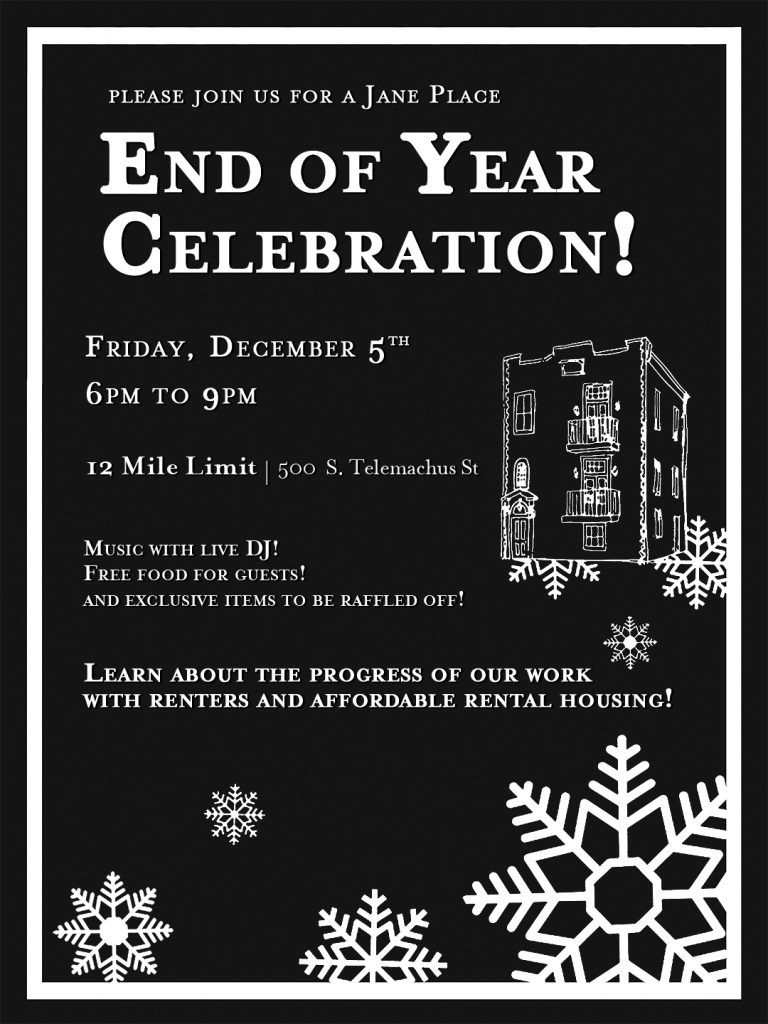
This space is provided to Jane Place Neighborhood Sustainability Initiative as a community service and does not necessarily reflect the opinions or editorial policies of ANTIGRAVITY.
