
For many across Louisiana, the 2026 state legislative session was overwhelming and disheartening. Amidst the chaos, however, there were a few victories, including the passage of Act 177, which updates Louisiana’s HIV criminalization law—famously one of the most restrictive and punitive in the United States—to reflect modern scientific knowledge around HIV transmission. Instrumental to this effort has been the Louisiana Coalition on Criminalization of Health (LCCH), which for the past decade has been a leader in advocacy and education around HIV criminalization, largely due to its statewide focus and diverse coalition. While Act 177 does not repeal the law nor the decades of harm it has caused, it is an important step forward. This is not merely an issue of reform but one of empowerment, providing justice for people living with HIV (PLWH) who have faced stigma and discrimination since the onset of the HIV/AIDS epidemic.
HIV Criminal Laws: A Public Health and Social Justice Issue
At the height of the HIV/AIDS crisis in the 1980s, legislation that specifically criminalized the exposure and/or transmission of HIV began to appear in the United States. Louisiana’s HIV criminal legislation was enacted in 1987. There are currently 32 states with HIV exposure and transmission offenses on the books (Figure 1). Five of these states, including Louisiana, may require registration on a sex offender registry (SOR) as part of the punishment for a conviction under the law. In Louisiana, individuals who are convicted must remain on the SOR for 15 years, unless an appeal can be made. HIV transmission does not need to occur for criminal charges to be filed: A person need only “expose” another person without disclosing their HIV status, something which is hard to prove in court. Individuals convicted under these laws face felony charges, up to 10 years in state prison, up to $5,000 in fines, as well as being added to the SOR. These laws were originally passed when the science behind HIV, including how it is transmitted, was still not fully understood. It would be several years before highly active antiretroviral therapy (HAART) became available and changed an HIV diagnosis from a death sentence to a chronic, manageable condition, as well as before the advent of pre- and post-exposure prophylaxis (PreP and PEP) medications for the prevention of HIV infection.
In 1987, the Reagan Administration’s Presidential Commission on the Human Immunodeficiency Virus Epidemic—ironically, formed to address discrimination against people living with HIV—recommended that states adopt criminal laws specific to HIV. The reason? It was believed that existing sexual assault laws were not punitive enough, and that there needed to be a more extreme deterrence for intentional exposure. Discrimination against people living with HIV therefore worsened, with the Presidential Commission promoting the removal of burdens of proof (such as intent to harm), with these laws. This contributed to the creation of a “viral underclass,” in which already marginalized communities are more dramatically impacted by a disease once it emerges.
As we similarly saw during the COVID-19 pandemic, stigma, misinformation, and fear around HIV were abundant, an issue that remains to this day. Many of the HIV criminalization laws were fueled by homophobia and racism, with a fear that the so-called “gay disease” would spread throughout the heterosexual population. Dorian-gray Alexander, an HIV advocate and co-founder of LCCH, explains that “You have this sense of justification for vilifying HIV/AIDS and anything associated with it because of the history of where it was found in the Western world, who got it, and all the [stigma] around it being sexually transmitted, being shared from needles, blood transfusions. So it’s treated differently than any other disease, I think, in modern times.”
While viruses do not discriminate, our laws and other systems certainly do. HIV criminalization does not end with HIV. Dietz (who goes by the one name), the executive director of LCCH, states, “One of our taglines is ‘You care about HIV decriminalization, you just don’t know it yet,’ because HIV as a disease state with all of the stigmas that are attached to it really does cross over to pretty much every social justice topic.” It has only been 15 years since federal immigration law was changed to allow PLWH to enter the U.S. for either visitation or immigration purposes. To this day, HIV criminalization laws disproportionately impact LGBTQ+ individuals, Black Americans, immigrants, people who use drugs, sex workers, and anyone who is already marginalized by society. Zach Schultz, who is involved in the LCCH Speaker’s Bureau, Steering Committee, and Communications Sub-committee, expands, “When we talk about people living with HIV, how we live with stigma, it’s not just a theoretical or abstract concept. People bring these kinds of ideas and prejudices with them into the State House. They make laws with these things in mind.”
The Williams Institute—which conducts research on sexual orientation and gender identity law and public policy—reports that, for Louisiana, the majority of HIV-related incidents only involved allegations of a crime, with most of those cases based on non-sexual contact. HIV can only be transmitted via certain bodily fluids—blood, semen, vaginal fluid, breast milk—and certain behaviors: anal and vaginal sex without condoms, sharing syringes, perinatal transmission (Figure 2). And though we have had this knowledge for decades, many of the HIV criminalization laws in the United States do not reflect modern science. Certain behaviors—namely, biting, kissing, spitting, scratching—do not transmit HIV, though 50% of all HIV-related criminal cases over the past five years were related to alleged exposure via biting and spitting. While HIV remains a major public health issue and prevention efforts remain tantamount—including using condoms, PrEP, and PEP, as well as maintaining an undetectable viral load via HAART (Undetectable = Untransmittable, or U=U), if you are living with HIV—transmission is also not as frequent as the HIV criminalization laws would suggest (Figure 2). Science, not fear, should be driving public health policy.
The fear of being convicted under the charge of HIV exposure also disincentives people from getting tested. Jazmine Carroll, LCCH mobilization specialist and wellness center coordinator at The Philadelphia Center in Shreveport, explains, “The idea that once somebody knows their status and that if they get tested and they test positive, that they have to disclose their status from there on out to any of their partners intimidates people out of and disincentivizes people out of wanting to get tested, therefore preventing us from reducing transmissions in our state.” Disincentivizing testing also means that individuals who do not know that they have a positive HIV status are not getting linked to treatment, and that others are not getting linked to PrEP and other resources.
This is an issue everywhere, especially in Louisiana, which ranks fourth in the U.S. for HIV diagnosis rates. According to the Williams Institute, 63% of all suspects in HIV-related crimes in Louisiana were Black, with Black men making up 45%. For incidents where an arrest occurred, all individuals were Black, with Black men making up 91% of the total people arrested on HIV criminal charges. In addition, 75% of HIV registrants on the state Sex Offender Registry in Louisiana were Black men, even though they only make up 44% of PLWH in Louisiana and 15% of the total state population. “This illustrates the depth of racial injustice in our state and the disproportionality and how that impacts Black bodies in our state,” says Carroll. She continues, “We know that it says 91% of [Black] men [and] we are sure that includes trans women. We are sure that those people are misgendered when that information is obtained. And so I think, again, this law perpetuates this history of violence and mass incarceration within our state.”
There are real people behind these statistics, whose lives have been disrupted and harmed. Sonya Milliman, whose many roles include director at Capitol Area Reentry Program in Baton Rouge and the LCCH steering committee, has been living and thriving with HIV for a decade. She wants people who do not live with HIV to know that, despite the fact that she has maintained an undetectable HIV status since three weeks after her diagnosis, she “actually [has] to have proof [that she disclosed her status] to have any kind of [sexual] pleasure.”
Robert Smith, an LCCH member based in Shreveport, was convicted on HIV criminal charges and placed on the SOR 12 years ago when a former partner—to whom he had disclosed his undetectable HIV status—went to the police after their two-year relationship ended. At the time, Smith was not aware of the HIV criminalization law and, unable to provide any evidence of his disclosure, took a plea deal. This led to him being added to the SOR. With support of LCCH and his legal team, Smith has been working tirelessly to remove his name from the SOR, as it has negatively impacted all aspects of his life: his relationships, his options for employment and housing, and his ability to move freely in the world. “These laws are incredibly dehumanizing,” he explains. “This criminalization law, it discriminates.”
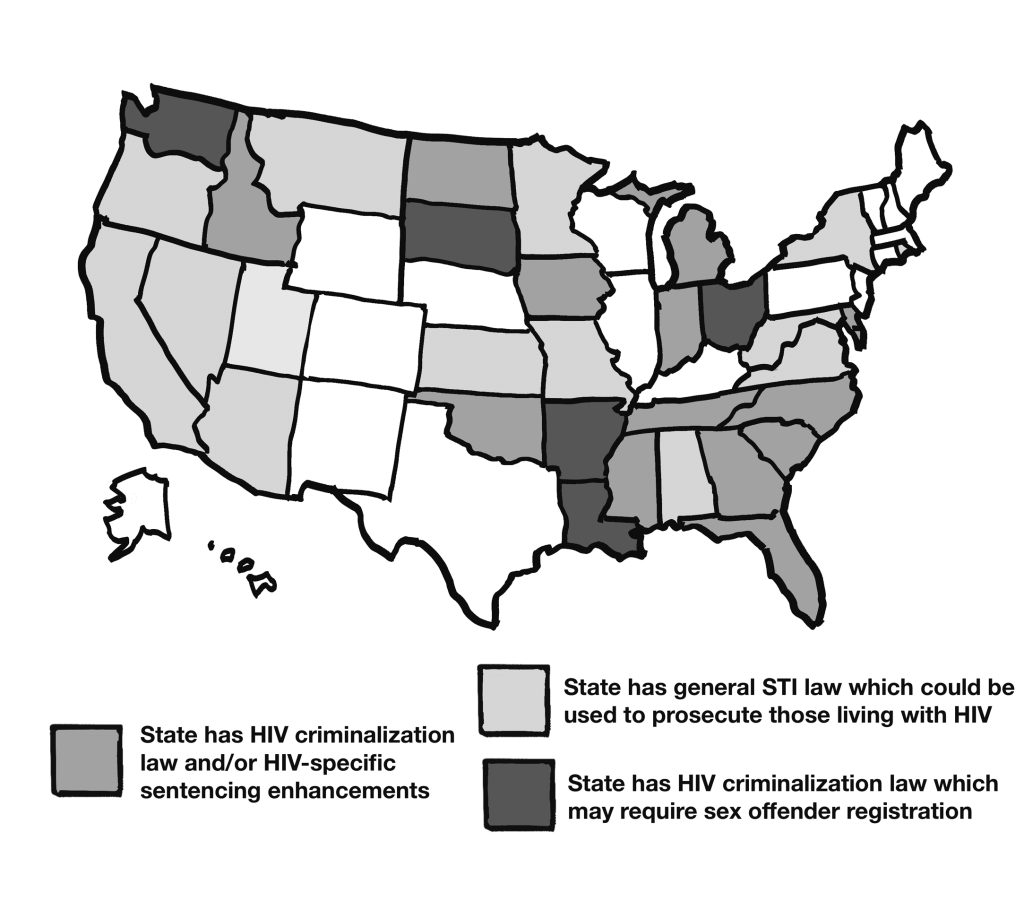
Figure 1 (Source: hivlawandpolicy.org)
LCCH and the Road to Reform
For decades, advocates across the United States have been working to reform, if not entirely dismantle, HIV criminalization laws. The LCCH was founded in 2016. According to Dietz, “It was kind of a breaking point where everyone knew this was an issue, but no one had formally, to the best of our awareness, ever centered around this issue in the past in Louisiana. [LCCH] got together with the Center for HIV Law and Policy (CHLP) to essentially brainstorm what the best approach for trying to move forward with addressing the law should be and started the coalition with a summit in 2016.” In 2018, the Louisiana HIV criminal law was amended without any input from LCCH or legal consultation. The amendments made the law one of the most restrictive in the country, updating the language of exposure to “any means or contact” and adding increased penalties for exposure to first responders, which includes law enforcement, firefighters, and emergency medical professionals. There has only been one documented case of an occupational-related HIV transmission in the U.S. since 1999 and no documented cases of a first responder or law enforcement agent contracting HIV while on the job in Louisiana, despite the heightened exposure penalties.
In reaction to these punitive laws, LCCH began expanding its education and coalition-building efforts across Louisiana, which included holding regular meetings with open forums, strengthening ties with community members and experts such as the CHLP, and formalizing their decision-making process. “We made decisions and criteria in our operating procedures that required that more than a majority of the people who helped make decisions were people with lived experience,” explains Dietz. “So it was truly a movement led by people who this law was directly impacting, not folks who were allies who thought they knew better.”
During the 2023 legislative session, LCCH, in partnership with House Representatives Aimee Freeman and Mandie Landry, initiated the HR130 Task Force to educate members of the Louisiana legislature on the real-life impacts of the HIV criminalization law on PLWH in Louisiana. Nine focus groups were held, one in every state public health region, in order to ensure that the study findings reflected the voices of PLWH across the state and not just in New Orleans and Baton Rouge. In 2025, LCCH and allies played an instrumental role in preventing Rep. Pat Moore’s (D-Monroe) HB76—which called for the expansion of the HIV criminalization law to include all sexually transmitted infections (STIs), both curable and incurable—from moving forward. This led to Legislative Study HR322 in 2025 to examine the public health outcomes of incurable STIs, which LCCH played a key part in.
“Those were really crucial pieces in getting us to where we are today [with Act 177],” explains Dietz. “I think it’s really important to name that people with lived experience created our body of data that oriented us towards what we knew needed to be prioritized in terms of changing the law.”
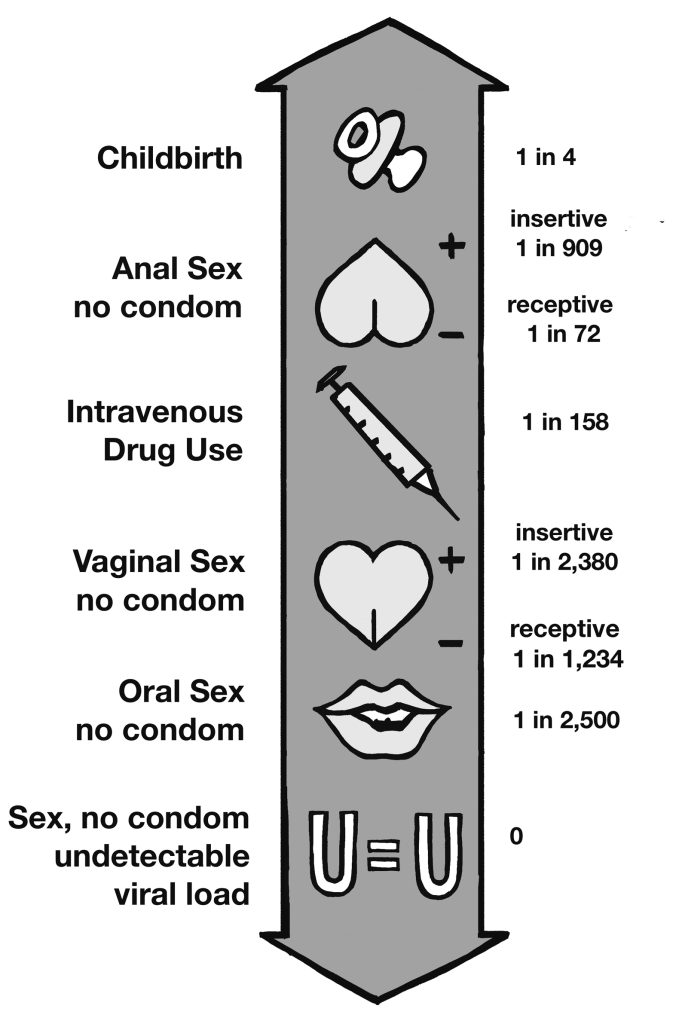
Figure 2 (Source: aidsmap.com)
HB808/Act 177: Modernizing Louisiana’s HIV Criminalization Law
Act 177 began the 2026 Louisiana legislative session as HB808, the culmination of LCCH’s past decade of advocacy and education efforts. State Representative Wayne McMahen (R-Minden) sponsored the bill. He had been assigned to meetings for the HR130 task force in 2023 and 2024. Rep. McMahen is a veterinarian by trade, and though he did not have a specific background in HIV, his education in the sciences gave him a perspective that his peers might not have had. McMahen viewed the existing criminal code as an impediment to HIV prevention efforts and, says Dietz, “I was very grateful that someone who maybe doesn’t fit the same criteria that we might imagine an ally might have, a white male Republican from a rural part of northern Louisiana, was able to get this information and objectively say, this is wrong, there’s something going on here and we need to do better.”
Having bipartisan support was key, as was support from the Louisiana District Attorneys Association (LDAA). Members of the LDAA had also been assigned to both HR130 and HR322. Zachary Daniels, the executive director of the LDAA, was most engaged in HR322. “I believe he came to every single meeting,” recalls Dietz. “So that meant that not only was he sitting down and getting the information pretty directly, it also meant that I was sitting down next to him and I got to have conversations with him as a person, not even anything about HIV, but just: How’s your mom and them?” This direct relationship building, an often unsung part of advocacy work, proved effective, as the LDAA formally supported HB808/Act 177 in the legislative session.
While support from McMahen, Daniels, and the LDAA were important to the success of HB808/Act 177, Kytara Epps, public health and advocacy strategist at CHLP, wants to emphasize that “really the foundation of why [LCCH] were able to get this done compared to states that we see that are more like blue and liberal [is] because they have such a foundation and principles that they’ve stuck by since its inception to center the voices and leadership of people living with HIV from around the state, not just that blue dot of New Orleans.”
After a long and exhausting legislative session, HB808 passed both the full Louisiana House and Senate unanimously. It was signed into law as Act 177 on May 15, and went into effect on August 1. The updated law now reflects modern science, limiting criminal prosecutions to actions posing a “substantial likelihood of transmission,” which means that behaviors and interactions that are known to pose no threat of HIV transmission (e.g., biting, scratching, kissing, spitting) will not result in criminal prosecution or felony charges. People who are on anti-retroviral medication with undetectable viral loads may also be exempt, as HIV cannot be transmitted at undetectable levels. Act 177 also allows for medical records used in court proceedings to be sealed to public access, and it improves systems that allow defense attorneys to submit medical records to support a defendant’s innocence.
These changes are a major achievement, though there is still work to be done. Compromises to the original bill language had to be made along the way, a reminder of just how politically charged HIV, and HIV criminalization in particular, remains. The original version of HB808 changed the language to require actual transmission of HIV for criminal charges to occur, not exposure. That language was walked back. The requirements for disclosure of HIV status before engaging in vaginal or anal sex remain (it is unclear what protections an undetectable status might provide). There is the additional challenge of proving in court whether or not disclosure did indeed take place, as well as whether a condom was used. And even if someone has evidence of disclosure, jail and bail requirements have not been removed. The heightened penalties for exposure to law enforcement agents and first responders remain—though contact must still prove to be a substantial risk of transmission—as do the penalties for alleged intentional exposure: up to 10 years in state prison, up to $5,000 in fines, felony charges, and 15 years on the Louisiana Sex Offender Registry. These felony charges can have long-term effects, impacting a person’s housing, employment, voting rights, and access to federally-funded social services, including FEMA.
It is thus important to view Act 177 not as the end, but as an important step in reform efforts. And despite the reforms that are still needed, Act 177 is an important victory for LCCH, PLWH, and allies, not just in Louisiana but across the country. Sean McCormick, staff attorney at CHLP, states, “We’ve seen the political representation in Louisiana [and the United States] shift over these years, becoming increasingly more conservative and carceral, even outside of political lines. So this type of reform is really remarkable… But we’re also not entirely surprised because of the organization of folks on the ground in Louisiana.” Adds Sonya Milliman, “I feel like we actually have some freedom in our lives.”
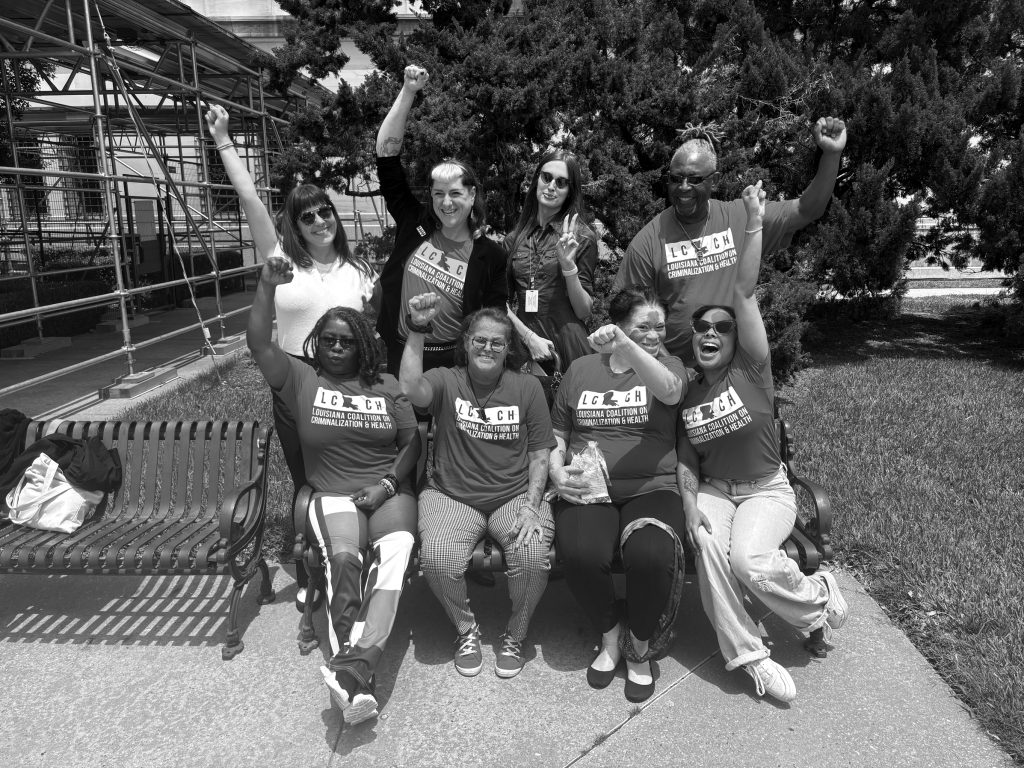
Members of the Louisiana Coalition on Criminalization and Health (LCCH) gather at the Capitol in Baton Rouge on April 28. Top (Left to Right): Jenny Holl, Dietz, Peyton Rose Michelle, Robert Smith. Bottom (Left to Right): Millicent Foster, Sonya Milliman, Cara Twillie, Jazmine Carroll. (Photo courtesy LCCH)
What Comes Next?
Now that Act 177 has gone into effect, LCCH’s work has not subsided. In addition to discussing future plans for further reforms, they are currently engaging in a statewide Know Your Rights campaign to educate people about changes to the HIV criminal law. Their focus is not only on training PLWH about their rights under the law, but also public defenders, defense attorneys, medical professionals—anyone who might be working with people affected by HIV criminalization.
At this time, it is still unclear how the law will be upheld in an actual case. There are particular questions, too, around whether a person’s undetectable HIV status will legally protect them in the event that they are not able to provide evidence that they disclosed their status to the person who is accusing them of exposure. LCCH and allies are waiting for the first “test cases” to arise, and they plan to offer support to the defendants whenever the cases do occur.
Like so many others involved in this work, Dorian-gray Alexander “want[s] to see real change and real outcomes,” from Act 177. “The law is [only] as good as how prudently it’s enforced or applied and how successful it is to avoid misjustice,” he explains. Act 177, too, is more than about modernizing language around HIV transmission and reducing stigma. It is also an opportunity to empower PLWH, the people who are most affected by these laws and who have been leading these advocacy efforts for decades.
This is, of course, the heart of the issue. It has been over 40 years since the world first became aware of a mysterious illness that we now know to be HIV. People living with HIV have led efforts to advance science, expand social services, and reform policies, even in the early days, when they knew that they might not live to see the results of their labor. Act 177 is an example of what broad advocacy and coalition building led by people with lived experience can accomplish, and why it is imperative that they continue to be centered in this work. “We really need to use everything that we can,” Alexander emphasizes. “If it’s reform of criminalizing laws, if it’s demanding more transparency and accountability of systems that benefit from public monies, people living with HIV should feel like they can speak up and speak out in public forums. People living with HIV have more power than they know. They need to take it back.”
For information on LCCH and their upcoming Know Your Rights trainings, please visit lacch.org or @stigmaisntjusticela on Instagram.
Illustrations by Kate Lacour
