
Hello there! It’s February, and we’ve begun to slink our way into the year of the wood snake (木蛇 mù shé in Chinese). In the Chinese zodiac (or Shēngxiào 生肖), the combination of this element (wood) and animal (snake) happens once every 60 years and is considered very potent. The snake represents wisdom and creativity, and wood is a symbol of growth and stability. The transformative power of the cyclically molting snake, combined with the strength deeply ingrained in wood, produces a year of monumental growth. According to the South Morning China Post, we are “entering into a year of death and rebirth, a year to make responsible decisions to evolve spiritually, moving away from old ways and habits that no longer serve us well.” I am particularly curious to see what 2025 has in store, because I was born in one of those snake years. Birthed in ‘77, I’m a fire snake. Hopefully the wood element will cause my fire to burn bright but not out of control. I’ve read that through methodical planning, the fire snake will experience a career boost. My hands are raised in prayer that this prediction is true, because, due to a mass exodus of my New Orleanian clients whose property tax and insurance premiums doubled and sometimes quadrupled, things were slow for my biz Eco Clean Cleaning Service in 2024. Thanks, City of New Orleans and sheisty insurance industry! Whilst snakes are wise, they can also be cunning and dangerous, as we are witnessing with the reptilians that are currently running the world. Conspiracy theories, woot woot! So we must be strategic in order to navigate the year of the wood snake, brimming with the possibility of lots of booty but also potential booby traps. To aid in our reward reaping, as we tactically tip-toe through 2025, it’s a good idea to get organized. So clean your closet and scrub your tub, because this is gonna be an interesting year. Cleaning questions and answers await you below.
I spilled rotten milk in my car. How do I get rid of the smell?
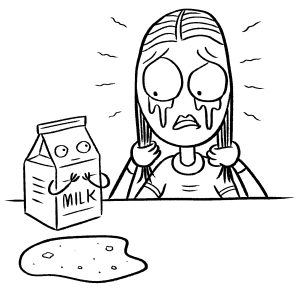
Eek! I’m so sorry. This is indeed a foul situation. The old adage, “There’s no use crying over spilled milk,” should read, “There’s no use crying over spilled milk… unless it’s spoiled. If the milk is rotten, it’s OK to have a good cry because rotten milk sometimes smells like a dead body.” Firstly, it’s very important to remove the foul mammary juice ASAP, so crank all the windows down (remember when all car windows cranked?) and open the doors. You want to avoid this lactic nightmare soaking deeper into your car upholstery, because, as previously stated, there’s a very good chance that your rotten spill will begin to smell like a dead animal if left to putrefy for too long. Being that milk is produced by mammals, it contains some of the same chemical compounds and so rots like an unembalmed corpse. So yeah, grab a rag to soak up the slop. Do not rub the spot with the rag, as this will force the spill deeper into the upholstery! Lightly tamp the area. Soak the contaminated area with a mixture of 2/3 white vinegar and 1/3 water. Sprinkle some baking soda over the vinegar and let the mixture sit all day. Once the area is dry, suck up the powder with a vacuum. Next, you’ll want to put your face over the spot and breathe deeply. Do you smell that fun, bacteria-producing, butyric-y acid smell? If so, repeat the process, adding a few drops of lemon juice to the baking soda for some fresh-smelling, acidic cleaning power. I hope that works for you. Another idea for banishing the smell is using an enzymatic cleaner. I’ve talked a lot about enzymatic cleaners in the past, because they really are a magical elixir. Because enzymes gobble up organic matter, they completely disappear the odor-causing culprit. For this particular job, I recommend SCD ScentGuard. Good luck!
How do I get soot off of walls?
This question comes from a friend of mine who lives part-time in L.A. My heart goes out to all those affected by the devastating fires there. Removing soot from walls can be tricky. If your walls are completely coated with soot, I don’t recommend tackling this mess yourself. For extreme cases, call a professional cleaning company that specializes in fire damage remediation. In more manageable cases, start by opening the windows for ventilation. Be sure to wear goggles, gloves, a long-sleeved shirt, pants, and a dust mask. Soot is toxic. It contains traces of carbon monoxide, particulate material, and polycyclic aromatic hydrocarbons (PAHs). PAHs are a class of chemicals naturally occurring in things like coal and gasoline. They’re also produced when organic materials such as garbage, fossil fuels, and wood are burned. PAHs are carcinogens and can cause kidney and liver damage, cataracts, and jaundice. Use a vacuum with a brush attachment to carefully suck up as much dry residue as possible. Applying light pressure, use a soot sponge, a.k.a. dry cleaning sponge to wipe away the stains. For more stubborn stains, gently wipe the walls with a mixture of warm water and a degreasing dish detergent (I prefer Dawn). Soot can be greasy, as it contains oily particles from incomplete combustion, so a degreaser can be helpful. I really hope this helps.
How do I remove the dust from paintings without damaging them?
I love this question, as cleaning art is a dream of mine. But (and this is a huge but) since I’m not a trained art conservationist, I’m going to err on the side of caution and advise you not to introduce any water or cleaning solvents into this equation, but to dry dust your beloved works of art. To accomplish this task, lightly and gingerly remove the dust with a soft-bristled paint brush or a lint-free duster. Good luck!
Got cleaning questions? Email isabel@antigravitymagazine.com
illustrations by Ben Claassen III | @dirtfarm
