
Love Letter to Skateboarding
Last spring, Humidity Skate Shop hosted a one-night art installation and release of a new, limited edition skateboard designed by New Orleans artist and skater Miro Hoffman. The image on the board featured a bag of ice and the installation included ice merchandisers, corrugated tin, and tires spray painted with the ubiquitous “WE SELL ICE” logo. Miro’s visual vocabulary is full of urban objects articulated with stencils and an industrial palette. He is represented by traditional galleries, but I discovered his work in 2021 in a show called “Skater Art” at Under Nine, a mixed-use venue with a wooden skate bowl in Chalmette.
Art has been a part of skate culture from the beginning. They share a preoccupation with aesthetics and exist at the convergence of tradition and self expression. Both art and skateboarding have been considered countercultures, participants deviating from prevailing lifestyle norms. Both art and skateboarding can offer the actors and witnesses moments of transcendence and beauty.
There is a commonly-held assumption that beauty and art are necessarily connected, but that’s often not the case. Even when a work of art achieves aesthetic heights, many contemporary art writers don’t mention beauty. I hardly mention it myself, and experiencing it is rare. To me, beauty is not within an artwork, but in a convergence of visual uplift, the sensation of paused time, and—when the stimulus is human-made—a feeling that being human is a gift. If you ask me to name something beautiful, I’m as likely to think of skateboarding as I am to think of art. Those who write about skateboarding use the word beautiful even less than art writers, but artists and skaters both talk about less abstract visual qualities like style, which in art and skateboarding distinguishes one practitioner from another.
Personal style in art is developed over time as an artist discovers their authentic and unique perspective. Style can’t be faked; it’s written in the body and innate aesthetic leanings. Technique can and should be taught in art, but style is revealed. In skating, style also goes beyond technique and includes everything from dress to the position of the hands in flight and the way one rolls away from a trick. Skater Tristan Funkhouser said in a 2016 interview, “Skating is an expression of yourself… you could do a kickflip on flat ground, and if it’s stylish it’ll go way further than some sketchy fucking Tre flip noseblunt on a flatbar… skateboarding is more an art than it is a sport.”
Style and beauty are experienced in real-time moments of skateboarding and in the documentation of it. Some skaters dedicate themselves to this. Fred Simonson is a skater, photographer, and restaurant professional, and has documented the New Orleans skate scene since 2017. When we exchanged messages he wrote, “Photography is kind of how I digested skateboarding when I was a kid. It’s how I learned about the people and the kind of goings-on in the world outside my little neighborhood.” His black-and-white photograph, Lance, crafting a nollie flip at One Shell, shows a downtown skate spot viewed from the middle of a wide sidewalk. Pedestrians in the course of an ordinary day are captured walking toward and away from the camera. Suspended above the sidewalk, crouching in profile, is Lance Chapin, frozen in a moment of defying gravity in the literal and figurative sense. The street in the photograph looks noisy, but I imagine the silence that follows wheels leaving the pavement, time stopping before board and skater land. The image reveals something about cities, and skating, and brief soaring moments. Still photography captures these moments while videos capture movement.
John Kosch, a skater and videographer-editor who works as a rigging grip, has spent hours filming on a skateboard. The camera is held low, recording an angle that no person actually sees but that articulates the speed and precision of a line or trick. He told me, “At the end of the day, it all comes down to how it makes the viewer feel.” When I look at paintings in a museum, I am looking at something I understand because I paint. When I watch skateboarding clips—and I watch at least a few a day—I’m not looking at something I’ve done and yet I experience what I would call uplift, exhilaration, vicarious stoke—beauty.
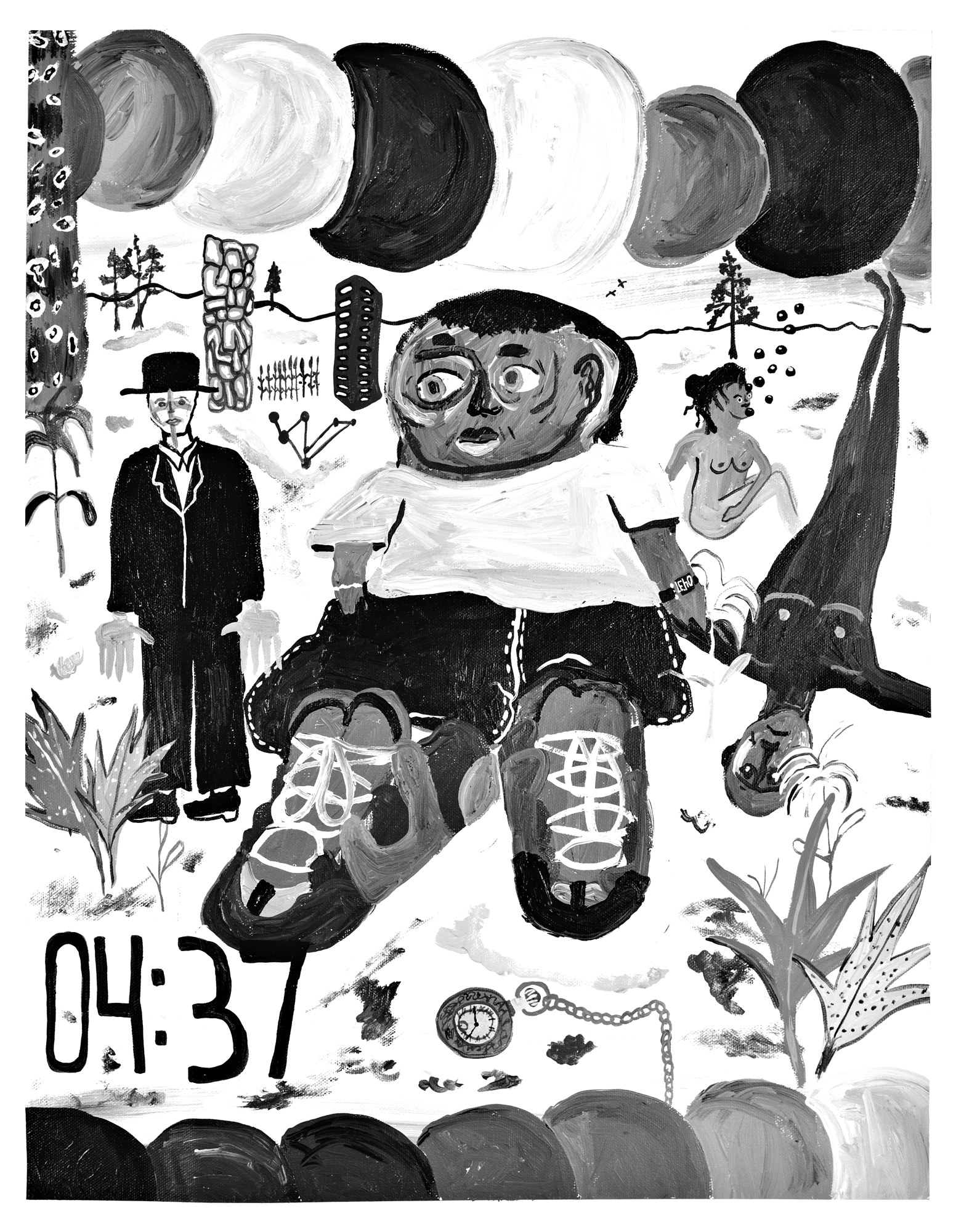 Nathan Henry, 04:37, acrylic on canvas board
Beyond the activity and the art of documenting it, another beautiful element of skateboarding is the community. The hub of the New Orleans skate community is Humidity Skate Shop in the French Quarter. The shop is owned by skater Phillip (Philly) Santosuosso who suggested I talk with Nathan Henry about the overlap of skating and art. Nathan is not a so-called gallery artist like Miro. Nathan makes his living in Jackson Square selling paintings characterized by warm, bold colors, simplified outlined forms, and fantastical subject matter. There are evident traces of ‘90s skate graphics but some of his paintings remind me of Henry Darger and others of Jules de Balincourt. Nathan and I spoke at the skate shop one morning. “Toy Machine and Ed Templeton were my first taste of the art world… I’d go to Ed Templeton’s blog, and he’d post about his paintings and shows and other artists. I was introduced to the Beautiful Losers [documentary] and that completely sold me on being an artist. I started drawing and painting every day.” The day after we spoke, Nathan sent me a message: “I really want to emphasize just how important Philly and Humidity have been to me in my career and life as an artist. He has always put the spotlight on my art.”
“I try and step in to bridge the gaps,” Philly told me, and I cannot help but envy the way skaters support each other in skating and other aspects of each other’s lives. I imagine artists putting this kind of effort into each other’s success. It may be an unfair comparison, the making of art being a mostly solitary endeavor, unlike skateboarding. But skateboarding, a relatively inexpensive activity with few opportunities to make a career, has not been marred by monetization or academization the way art has. There are no MFAs to divide practitioners. There are very few rich skateboarders and what they do does not yield an object that has the capability of flaunting or hiding wealth. Art can’t help that it’s a commodity, but I think artists could hold on a little tighter to their original joyful rebelliousness the way skaters do.
Alex Daly, founder of the iconic skate magazine Muckmouth and one of my favorite writers on Instagram told me, “Skaters have always been artistic. The whole thing is art… Study someone bombing down a hill or popping a perfect backside flip—it wipes the floor with Picasso!” Tuesday evenings, “Old man night” at a skate spot called CP3, skaters, mostly men 30 or older, arrive from day jobs, greeting each other like neighborhood kids. The light becomes orange and they take turns, the sound of polyurethane wheels on concrete. Suddenly, everything feels harmonious—the cooling air, the gliding bodies, “Goodbye Horses” playing from a small radio—and everything belongs. Time slows down. After failure upon failure, a skater lands a trick. The jubilant reaction of those watching from the hill is part of the beautiful experience. As Fred Simonson put it, “Beauty is just the necessary byproduct of this joy.”
Top photo: Fred Simonson, Lance, crafting a nollie flip at One Shell, digital photograph
