
Danielle Nelson is a practicing therapist and Licensed Clinical Social Worker (LCSW) who focuses on sexual health and wellness, trauma and recovery, self-esteem and resilience building, life transitions, and general mental health concerns. Though Danielle is a trained professional, this column is not a substitute for advice or care provided by your licensed medical or health care professional.
My general process for writing this column is to read what you’ve given me and mull it over. If there’s an inquiry I can’t stop thinking about, I start writing a response. This month’s contribution came in and I found myself not only thinking about it quite a bit, but also talking to a lot of people about orgasms (or lack thereof). I was surprised at how many folks were suffering from shame, insecurity, and bruised egos. I was also surprised at how many people seemed eager to share their experiences, relieved to have an open dialogue that usually involved more questions than answers. To me, that’s a sign of a solid conversation.
My partner of three months can’t have an orgasm with me. He says he’s been able to do it with previous partners and he thinks the reason he can’t is because he recently changed the dosage of the antidepressant he’s taking. I feel like a failure for not being able to get him off. I’ve even started getting in my head about not being as desirable to him as his previous partners, which has been affecting my ability to feel as close to him as I’d like to. It’s even causing me to have difficulty having an orgasm. And when I do have an orgasm, I feel guilty. He says he loves having sex with me and he does seem to enjoy it—but if that’s the case, why can’t I get him off?
I know how frustrating that feels. It can be easy to get down on yourself when you feel unable to please your partner or live up to a standard, but here’s the thing: The ultimate goal of sex is pleasure. There are no standards. Let me explain.
Traditional narratives of sex are often limiting, exclusionary, and unrealistic. A common narrative is that sex is goal-oriented. The goal? Climax, orgasm, etc. There are several problems with that framework, the primary being the implication that sex is only “successful” or “good” if one or both partners achieve orgasm. When we approach sex from this mindset, we’re setting ourselves up for disappointment. Orgasms are facets of sex, not measures. In fact, many people can’t climax at all—and that doesn’t indicate a problem. Some people go through periods where they can’t orgasm, but will at a future time. Others experience phases where they can, then they can’t. All absolutely normal. Another challenge of this goal-oriented mindset is that it can create anxiety, tension, and stress—which can diminish the many pleasures of sex. Not to mention the pressure to have an orgasm almost always makes orgasming more difficult.
In order to relieve this pressure (and achieve that aforementioned goal) many people fake orgasms. Maybe you’ve faked in order to wrap things up—sending an indication that sex is complete. In goal-oriented sex, orgasms are often a signal that the sexual encounter is over. Or maybe you faked it to protect your partner’s ego, again, perpetuating the idea that a “good” lover is one with whom you can experience an orgasm. Faking isn’t uncommon. Many of us have done it. One study in The Journal of Sex Research shows that 25% of cis heterosexual men and 50% of cis heterosexual women have feigned orgasm. The problem with faking it is that it gives your partner false positive reinforcement. In short, they may think what they’re doing is satisfying when it’s not, and therefore may keep doing it and you ultimately sacrifice your own pleasure in the process.
So, if we strip away the idea of there being a destination or goal, we can focus on what matters: what feels good. Goal-less sex, sensual sex, or—simply put—pleasure is what feels good to our bodies. When we center pleasure, we’re focusing on the sensations and emotions that arise from physical intimacy. In this sense, pleasure is more diverse than orgasm and may not look like what we’ve seen in formulaic portrayals of sex in pop culture or pornography. Sex is often portrayed as linear, with a beginning, middle, and end. However, this kind of thinking can limit the experience. With no destination in mind, think of pleasure as stimulation for the sake of stimulation. What feels good?
If you’re interested in learning more about mindful and goal-less intimacy, I highly recommend the book Come As You Are by Emily Nagoski, an informative read with lots of reflective tools for personal and sexual growth. Aside from masturbation (a low stakes opportunity to explore and discover what turns you on), it’s also important to consider what brings you pleasure outside of sexual activities. For example, do the clothes you wear feel good on your body? What activities bring you joy? Travel? Music? Listen to your body and notice when it softens and what sensations rise to the surface. Slow down. We’re often surrounded by external stimuli that can set a pace that isn’t conducive for sensuality. Unplug and make a focused effort to shift from work, chores, etc. A good way to slow down is to take deeper, slower breaths. Gradual arousal can provide a safe space to become mindful of bodily sensations and help identify what’s pleasing.
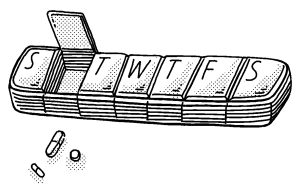
A final note on antidepressants and sexual dysregulation: It’s real and if it’s affecting you, it might be worth talking to your doctor. Many antidepressants known as selective serotonin reuptake inhibitors (SSRIs) can reduce desire, make it difficult to get aroused or sustain arousal, and make it difficult to reach orgasm. In addition to adjusting your dosage and tweaking your medication, your physician or psychiatrist may be able to provide you with tips to help get your groove back.
If you need to speak to someone right away, call 504-269-COPE (2673). The COPE crisis line provides free, confidential crisis counseling, suicide prevention and information, and mental health referral services 24 hours a day, 7 days a week.
illustrations by Romey Petite
Submit your questions to goodcounsel@antigravitymagazine.com (email and sender info will remain confidential), or use our anonymous Google form.
