
Mary-Devon Dupuy is a New Orleans native who currently lives in Gentilly with her wonderful husband and their four-year-old son. When she isn’t violently ill from pregnancy, Mary-Devon does stand-up comedy (Moral Panic at SPORTS DRINK every second Thursday!) and also teaches middle school students.
Mommy’s Throwing Up
After years of identifying as a working mom and cherishing quality time with my son, I never thought I’d be unemployed with a four-year-old in school. My husband and I debated for years about having a second child, ultimately deciding to begin trying when our son was about three and a half years old. Not factored into our decision to get me pregnant was extreme illness. When I was five weeks pregnant, a little over a week after seeing two lines on the stick, I was stricken with relentless nausea and vomiting. Eventually, I was diagnosed with hyperemesis gravidarum, commonly abbreviated to “HG.”
Hyperemesis gravidarum’s most common definition is a severe form of nausea and vomiting in pregnancy. HG is sometimes referred to as “severe morning sickness,” one of the more infuriating euphemisms that pregnant and postpartum people endure, right up there with “the baby blues.” While the cause of HG is unknown, there are theories linking it to changes in hormones, gastrointestinal syndrome, and/or genetics. Most sources will tell you that it ends after the first trimester, 20 weeks at the latest. This has not been the case for me. At 32 weeks into this pregnancy, I believe HG is here to stay until I deliver the baby.
Living With Hyperemesis Gravidarum
Nausea and vomiting doesn’t paint the full picture of what HG is. Mine has been particularly resistant to medication, only really responding to IV medicine when it gets really out of hand. Furthermore, the physical exhaustion is unlike anything I’ve ever experienced, almost flu-like even during periods when I am not vomiting multiple times a day. There are times when the only effective treatment is lying in bed without sound or light, which is hard to achieve in a one-story house where your four-year-old also lives.
In September 2024 I was an active toddler mom who worked out, did stand-up comedy as a hobby, put in 40 hours a week as a teacher, and still managed to do fun things with my son every evening and weekend. By October, I was bedridden. I couldn’t exist vertically or even drink water without vomiting.
The official numbers say that between one and three percent of pregnant people get an HG diagnosis, but the number of sufferers is likely much higher. Many have argued that HG is under-researched and often dismissed as normal pregnancy illness, when in reality it is a debilitating condition that can be life threatening. The HER Foundation exists because an HG mom named Kimber Wakefield MacGibbon was so deeply impacted by her own experience with the disease that she founded a nonprofit dedicated to improving care and outcomes for those impacted by it.
After taking 12 weeks of Family and Medical Leave Act (FMLA) and realizing I still did not feel well enough to return to work, I quit my full-time job. More transformative than our reduction in income was the way HG forced us to parent totally differently, seemingly overnight. My husband had to become the primary caregiver while working full time, a total shift from our typical dynamic. I feel guilty for the sheer amount of work he has to do, but I mostly feel depressed about how much time I am missing with my son. I stay in bed as much as possible to avoid being readmitted to the hospital, because I have learned not to push myself.
Knowing When to Rest
I used to take advantage of days when I felt “OK.” If I was able to keep down food and water and just felt tired or nauseous, I would take my son on outings, attend family gatherings, and do errands and work around the house. I learned the hard way that HG is not linear. At 30 weeks pregnant, after about 10 weeks of being semi-productive and avoiding dehydration, I had to be readmitted to the hospital—and in much worse condition than when I was admitted in the first trimester. I was vomiting every 30 minutes and lost all of my strength. Now I use “good days” to rest, because I know what happens when I overdo it.
Resting is the right decision, and my husband gets mad at me when he sees me doing too much around the house or offering to take our son somewhere on my own. I think it’s common for moms to wait for someone else to tell them when to stop because we’ve been conditioned to stretch ourselves until we break, unless someone else validates our need for rest. I am grateful to have a husband who forces me to set limits that I wouldn’t set on my own. However, knowing it’s right doesn’t change the fact that it’s devastating to miss out on so much at such a critical time in my son’s life. I missed my baby’s 4th birthday party. Easter Sunday was yesterday, and my husband took our son to both sides of the family while I went and got fluids and blood work at the obstetric emergency department. The emotional toll of HG has been nearly as bad as the physical aspect of it.
Friends, family, and acquaintances text me to ask how I’m doing all the time. “I hope you recover soon!” is a common thing they say. These are well-intentioned, kind people, but I am sick of answering. If I say I feel OK, I feel like people don’t realize that could change at any moment. When I feel really bad, I feel like I am disappointing everyone, because they want me to be well by now. But this will persist in some form for the rest of these last eight weeks of pregnancy, and I just want to tell most people that there’s nothing they can do. And if another well-meaning person asks me if I’ve tried any kind of ginger, or B6, or any of the most common remedies for morning sickness, I will become homicidal.
Finding Gratitude in the Misery
We are extremely lucky to have a lot of help from family and friends, but babysitters can’t raise a kid for you. The day-in, day-out of parenting continues when you’re sick, tired, and even when you’re physically incapable of doing it. No one else except a parent is engaging in a bedtime-stretching ritual, reading out loud every single title of each book only for your child to refuse each one in order to buy himself more time with you before he finally submits to much-needed rest. I used to be the expert in maintaining my patience in these rituals, because I was more practiced. With HG, bedtime reading makes me gag and puke in a giant popcorn bucket I carry with me everywhere I go. Four-year-olds don’t care when their mom is puking, by the way. They will sigh frustratedly and ask why you’re taking so long. My husband does bedtime stories whenever possible these days.
One amazing thing that has come from what is definitely the darkest time of my life has been seeing my son view dad as his go-to parent and realizing how exhausting it was to be that person for so many years. As much as we wanted to be egalitarian in our parenting, it felt impossible until nature forced our hand. I was the parent to take three months off when I had the baby. I nourished the baby with my body for a year, which means I was the bedtime parent. It was easier for me to take him places by myself while my husband cleaned the house, because I was the one who was breastfeeding.
I positioned myself as the default parent, which made it hard for my husband to convince our son that he was also capable of being a parent. Every night for years, he called “Mommy!” when he woke up in the middle of the night and rejected daddy. He expected mommy to take him to the zoo, or the playground, or the grocery store. My husband was hurt that it seemed like our son hated him, and I was mad at my husband for letting a four-year-old’s opinion impact his emotions. It felt like an impossible pattern to break.
Hyperemesis gravidarum made mommy so sick and so boring, that daddy became the default parent. He runs up beaming when daddy picks him up from school. He and daddy go to the playground together without mommy. My son automatically calls “Daddy!” when he wakes up without his blankets in the middle of the night. And I am happy to stay in bed and let my husband get him back to sleep.
As awful as this experience has been, I am very aware of how much worse it could be. Many HG sufferers have to continue to work, don’t have family and friends helping them on a regular basis, or don’t have supportive partners who take their health seriously. I am extremely fortunate to be temporarily unemployed and able to sleep when my body will allow it. Missing out on holidays and birthdays is painful, but we have immense support from family and friends who have ensured that our son’s life is still full of fun memories. After years of feeling as if I was the only one who could effectively manage my son’s life, it’s humbling and also relieving to know that our ship continues to sail even when I am below deck, puking.
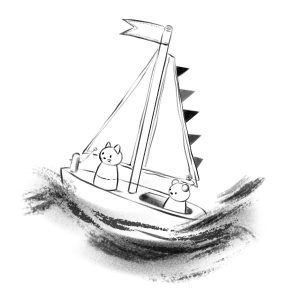
illustrations by Victoria Allen
