
MICHELLE HANKS
Michelle Hanks came to music somewhat late in life. Though she’d always been a visual artist and loved to sing, it took until 2017, a year of major personal upheaval, for her to unite with a bass. Two years later, she and drummer Ana De Ferreira formed the heavy psych duo Spitfire. Two years after that, Spitfire went dormant, added a member (Andrea “Espie” Crabb), and rebranded as the witch doom trio High Black River. In July of this year, they released their first single “Cosmic Child.” Their second single, “Le Bateleur” came out at the end of September. Over FaceTime, Hanks talked to me about the healing power of playing music with other women, how vocal monitors are never loud enough, and how a bass can save your life.
There seem to be several different versions of Michelle: the fierce front woman, the quiet homebody, the goofy friend. How do you reconcile them all?
Who knew being so introverted meant that when I’m on stage, I’m just a big ham? Up until I get on the stage, I’m like, “Oh god. Why did I choose to like this or want this? What am I doing?” It’s very uncomfortable getting up there. We like the art but being perceived is a bit much.
Tell me everything about your Rickenbacker.
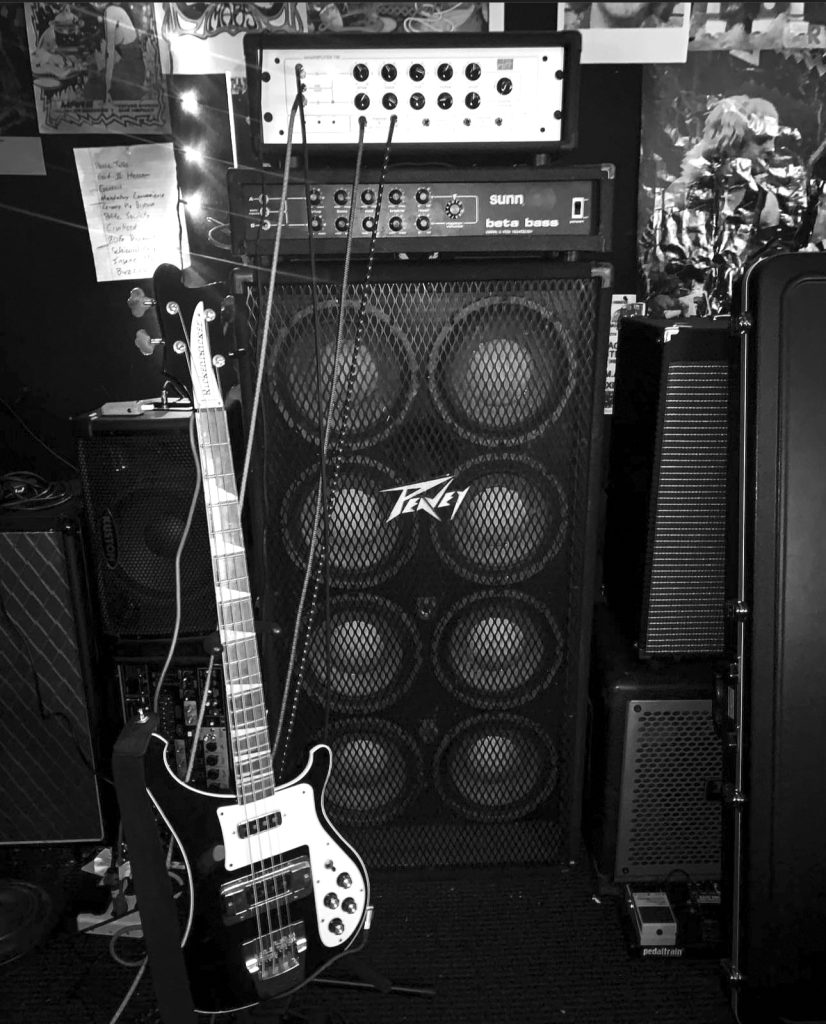
Her name is Jucifer. I bought her in 2017, when I had just gotten out of a five-year relationship. When I tell you I love this bass… It’s a 4003 model. Rickenbacker, when they first came out, made the 4001s, but what’s cool about the 4003 is that it has a toggle switch, so I can toggle between sounding like a vintage bass or use the newer version for a bit more gain. If I want a song to have a softer, warmer feel, I’ll toggle the switch to the vintage side, and if I need to overdrive a little more, I can pop that switch back up. The first thing that most Rickenbacker owners do is to change out the bridge. When I like something I bring it to 11, so I [was] on these forums with Rickenbacker obsessives and the non-purists all suggested that, so I have a solid brass bridge now, which added what feels like several pounds. The bass is heavy as shit now, but the sustain, man. I’d gone to Guitar Center so many times, dreaming about this bass and one day I felt like I kicked down the doors and said, “I’m going to get her, boys!” and they all started slow clapping. That’s what was happening in my mind, at least. She saved me. She helped me de-center men, de-center relationships, and it was like, “New life. New wife!”
You talk about her with such passion!
I talk about gear like I talk about kids because music came into my life at a crucial time, at a time of rebuilding, at a time when I needed something to pour my energy into, and I was able to do that instead of getting down on myself.
The split-rig set up of that guitar really defined your sound in Spitfire.
That function was actually serendipitous. I bought the Rickenbacker just ‘cause it was cool looking. This is the bass of all of my favorites: Cliff Burton, Geddy Lee… It’s always that black Rickenbacker. When I actually started playing her, I thought, “Oh Shit! The Rick-O-Sound is another jack that splits my pickups, so I can sound like a guitar with my treble pickup and I can hold the bass down with the low end.” My wah goes through the treble channel, my overdrive, any sort of mid-range stuff would go through there, and the bass channel is a really good place for echo and reverb—to throw in a little of, I call it, “my spices” versus the meat and potatoes of my wah and distortion end.
You mentioned that you use a monitor at home, even while practicing solo, which is unusual but very cool.
I need it to ground me, ‘cause I am so very, very deaf at this stage. Once I started looking at monitors, I realized I just wanted the loudest thing that I could get, with the most clarity, so it’s an Electro-Voice [PXM-12MP 12” powered coaxial monitor]. In the practice space, it sounds great. At home, it sounds great. Ultimately, I don’t think a wedge is ever going to be loud enough for me to hear my voice at a venue when every instrument is full volume. With the doom genre that we’re going more and more into, the vocals are just a lot lower, softer, and there’s whisper parts that build up to screams, so I bring my wedge monitor and use the venue one too. The hopes are that, maybe if I double it, there’s a chance of hearing myself better. It depends so much on the venue. Maybe I need to watch YouTube videos about how to advocate for yourself with monitors. I’m already overwhelmed and overstimulated when I’m on stage, about to play my show; I don’t know how to advocate for my needs.
Your vocals are so heavy in High Black River. Did you have to train to get there?
All I’ve ever done is wing it, so recently, I’ve been taking vocal lessons with Guy Tem with NOLA [New Orleans] Conservatory [of Music]. He’s a trained opera singer. I figured it’s the same thing with pedals and gear: If I can understand how something works, then I can apply it. It’s not opera training that he’s been doing, it’s more, “This is how you should feel this in your body. This is how to project.” I like knowing the functionality of my voice because it makes me a better musician.
Apparently, the saying, “When the fat lady sings” should be “When the tall lady sings” ‘cause tall people with long lungs can project! Think of a bagpipe. If you have a really big bagpipe, you can get a lot more air. So, little things like that, that I learned through the vocal lessons, have helped me gain confidence and breath control. I scream a little bit now! I’m still working on command but I can do it. With the screams, it’s like, “Oh god, it’s coming!” No amount of vocal lessons, so far, has allowed me to trust-fall myself into a scream onstage. But then I hear recordings that people have sent me and I think, “Well, that doesn’t sound terrible!” But I know that I could do better if I could really hear myself. When I can hear myself well, I soar. I feel like I’m flying!
In Spitfire, Ana wasn’t triggering sounds, she was just playing drums, so every single melodic part came from you. Now that you’ve got a guitar player in the band, how do you share the sonic space?
I keep the whole setup that I did with Spitfire—I like playing with textures. For instance, when I kick on my [Dunlop DD95FW Cry Baby Daredevil] Fuzz Wah [pedal], that’s on one channel, so I don’t lose my low end. It’s almost like another bass player is there because the wah is not affecting that channel. It makes our sound even bigger. With the way that Espie and I work, she’s very rhythm-oriented and I’m very solo-minded. I can hear the spaces in between the notes, the vibe, the textures. Being able to do that on my bass rig and her also doing things with effects on guitars just makes it huge.
What I was doing with Spitfire was, I was running two full different rigs. I had the Sunn [Beta Bass] amp and an 8×10 Peavey [Pro 810 bass cabinet] for my bass side and then a Hilbish [Design Beta Amplifier 700] and a 4×12 Peavey [6505 Reissue Slant guitar] cabinet for my guitar side. Even as we were tuning, people’s heads would turn. They would be confused, like, “Why does it sound like there’s more people up there when it’s only two people?” From a gear perspective, those were my tone princess moments. But it was, again, serendipitous that Espie found us because she didn’t have any gear and I was like, “I have an entire set up for you. Here’s a bunch of pedals too!” So she plays through the Hilbish and I play the Beta Bass. I bought the Hilbish ‘cause it was supposed to be a clone of the Beta. It isn’t, but it does sound great on the guitar. It’s like two girls with the same clothes who can trade what they wear. I never had that experience growing up, but now I have it, with amps.
High Black River only released its first single this summer but it feels like you and Ana and Espie have been rehearsing for years.
We have! It took us two years to get to the place where we were ready to play live. Most of [the songs were] written a long time ago but our very last song in the set, I was still finishing a week before [our first show]. When we met Espie, she wasn’t even supposed to be at Santos that night. It was [Spitfire]’s second-to-last show and at the end, she came up on stage, shook my hand, made eye contact and had this fire and excitement and I was like, “We’re done.” It all existed from there.
Spitfire was the “Get yer feet wet” project when it came to recording, and now with High Black River, I’m learning to just let go in the process, which is a big deal for me, ‘cause I am a control freak. It’s been freeing because if I understand how something works, then I can adjust it or apply [that] to the venue and circumstance, but everything’s a moving target and I’m OK with that now. I think that’s some sort of therapeutic breakthrough.
Your look and vibe for the new band is so satisfyingly witchy.
I love costuming, so that’s been fun to play with. It’s nice feeling pretty but I also want to scare men. I want to dress like a swamp witch. When I was growing up, there was never any representation for me. There were no tall, curvy women [in the media]. I’m finally the most confident I’ve ever been because I’m living for how I want to live. I’m exploring, I’m questioning these things that society used to tell me I needed to be. After we played Creepy Fest, I could feel how proud teenage me would have been.
What a debut! Wild that that was only a few months ago.
Oh yeah, I’m fully in with this now. Music really saved my life. I’m gonna start going up to people and instead of talking about Jesus, I’ll say, “Have you met the riff? Have you met the tone?” You don’t even need to make the riffs to feel the power. You can just see the riffs and it’s still cathartic. It’s a somatic release: dancing, screaming, moshing, music.
What’s the first pedal you couldn’t live without?
I’m constantly chasing tone but the first pedal that I thought I was in love with, for years, was the [Green] Russian [Big] Muff [Pi fuzz / distortion / sustainer]. The lore of this pedal was that the metal they used to make the pedal was from old Russian tanks from WWI or WWII. In my mind, when I saw all the bass players that I liked in the stoner category, they were using the Russian Muff, but here’s what’s so funny about gear. You think that this is what you want and then you get it. My reaction, when I finally played it, was, “Why is it muffling my mids?” and my friend was like, “Because that’s what it does” and I thought, “Well, that’s not at all what I want!” The muff is cool for basic chords, any sort of basic rhythm, but if you want to play with clarity, and quicker, then that’s gonna mess all that up. Every pedal I get, I’m like, “You’re gonna fix everything!” and that is not how it works.
So what’s your true love pedal then?
If I were to pick one off of my board, it’s my [BOSS Re-202] Space Echo [digital delay pedal]. That one tends to be very post-rock, post-doom, and I really love it.
I’m surprised that you love jamming, because as somebody who likes having control, jamming requires a lot of letting go.
I think the reason I love jamming is because, when I started, I was so hungry. I needed to play. I needed to get it out. I was catching up. I sucked but I knew I’d get better the more I played. And it led me to this band. It’s more than just a band. It’s the communal, feminine space that I’ve needed my whole life and, once I got it, I was like, “I’ve been living wrong.” There’s nothing like having that space, where you can do the work, but also not have to mask emotions and be able to be honest about your shitty days. Having the feminine space, within a band setting, to be honest about “Hey, I’m struggling today” without judgment is the healthiest relationship I’ve ever had. It’s based on respect and having a common goal. If women are accomplishing things, I am always going to be their biggest fan, because this shit’s hard. Being alive is hard. When women come up to us after shows and say, “That was great. I really felt it” I’m like, “Good, because that was for you.”
For more info, check out highblackriver.com.
Photos by Sabrina Stone
Got some production news, studio tips and tricks, gear, or creative space you love and want to talk about it? Email us at soundcheck@antigravitymagazine.com.
