
Located in a former Family Dollar in the Lower Ninth Ward, the Fred Hampton Free Store offers free goods and services and hosts community events such as all-ages roller skating, the A.C.A.B. Zinefest, punk shows, and more, in addition to sharing the space with various local harm reduction initiatives such as Trystereo. The FHFS was inspired by the radical community care initiatives that Fred Hampton and the Black Panthers established. An American Marxist-Leninist, Fred Hampton was active in leadership and organizer roles in the NAACP, the Black Panther Party, and went on to establish the Rainbow Coalition which became a model for organizing working class people across race and location. Hampton and the Black Panther Party developed initiatives, like the free breakfast program, which later inspired the national sponsored School Breakfast Program. Hampton was killed by police at the age of 21 in what’s often called a deliberate assassination. FHFS is organized as a collaborative, creative, and safe space with 501(c)3 status that grew out of the Greater New Orleans Caring Collective. I spoke with FHFS director Dan Bingler one week before the presidential election. Dan’s business card reads, “We will be there for each other.”
Tell me again where you were born.
Dan Bingler: I was born in Plaquemines Parish, at a place called Fort St. Philip. But then I grew up in Florida, mostly in Gainesville.
So you know the South intimately, and you know the area.
My whole life. My dad’s lived here my whole life, too. So I spent many summers and winters here.
The Greater New Orleans area and all its intricacies is a really hard thing to learn, or to really tell people from the outside what it’s about.
I mean, even the idea of GNO is something that I think it takes knowing people who have been here a while to even articulate like that. It is the Greater New Orleans area—”NOLA” is not what it is. It’s everything from the Northshore to Belle Chasse, to Chalmette, to Kenner and Waggaman and Old Aurora, right? All these places.
When the pandemic happened, how did you respond? Were you already well versed in social justice? Were you thinking about the Black Panthers? Were you thinking about neighbors caring for neighbors and mutual aid? Was that already part of your vernacular, your friend group, your culture?
Yeah, absolutely. I was always organizing or around organizing for social awareness, social justice, and leftist causes as pragmatically as I could. Fred Hampton has been a hero to me for a long time. So it wasn’t a fresh idea at the time, even. It was day one of COVID. It was the day we got sent home from all the service industry jobs. And I was just like, well, we’ve got to do something. If we’re asking people to stay self-quarantined, that’s a very classist request unless we’re willing to be there for each other. So if you’re immunocompromised and you need to not go outside, then that means we’ve got to make your groceries for you. These school meals are suddenly available, but you gotta go pick them up? We’ve got to get those home to the parents. If there are people who inevitably will not have a washer and dryer at home, how are they going to do laundry? We’ve got to figure that out for them… We set up a local phone number with Google Voice, and then made a flier. And then three days later, it was like 50 families per day calling or leaving a text to say they needed something. So then it was like, I can reach out to this online community of people on these Facebook groups and all these mutual aid groups that were emerging quickly. Saying, “Hey, if you really want to do something, I have exact things you could do. And I have your neighbors who you could help, in your zip code.” Because the need was everywhere. And it just kept going. It was very in the moment, non-hierarchical, autonomous, hyper-local leadership. Let’s get people as close to these neighborhoods and these neighbors as possible to be the ones who check on them. We’re not just doing a service. We’re not just giving them food. It’s community care. It’s emotional support. And three months later—1,100 families and 300 volunteers. You could look at the map and say, there’s 90 families in Central City. There’s 120 families on the Westbank, which is really a large area with many places I never knew. I learned so much about neighborhoods and zip codes. You can kind of cluster these people together. If I’m going to have someone bring five families groceries, how do I make it less stressful for that person? Especially when they might only have one hour to give. And if you make that one hour into two hours, how many times are they going to trust you to give them a task?
How was it to ask entities who may have resources? What was that like?
It happened pretty quickly. Within a week, I had many other volunteers who were ready to take over the phone bank. They essentially said: We’re gonna start doing this, please go find us resources. When you start off, you’re like, “Oh, we’re gonna make people’s groceries for them.” You put in an order and we’ll pick it up for you. And then we have two or three days of food and you think, all right, we need more structural resources as we keep getting families in. So I started getting on some phone calls just because of the connections I’d made. It felt crazy to me and almost insulting to other groups at the time that I got so much quick legitimacy for GNO Caring Collective. It certainly wasn’t just me, but I’m the one in those conversations, and I’m the white, male-bodied person in the meeting. And people were like, “Oh, you run a thing? Sure.” Like, yes I have a house that I have stuff in and we’re just like, buying $50 of groceries for people. But we would get on these calls and people would be saying things like, “We have all this money for dry goods, but we need to identify home-bound and immunocompromised families. We need to figure out how to pay Uber or Lyft to drive the goods to them, and then we need to find people who can coordinate that.” And I’m just on this call to say, I guess that’s me. We have 200 families already, and we’re just doing that ad hoc… By June I’m renting a moving truck every week, getting 18,000 pounds of groceries from Second Harvest [Food Bank] and bringing them back to a closed-down micro school that we’re granted use of and splitting them up for 850 families. We’re getting 500 more pounds through other partner organizations to undocumented families. And then it grew into whatever else was needed—prescriptions getting picked up, calls being made, time being spent, you know, just caring about each other.
Did you find that social media was key in all of this? Or was it a lot more direct calls? Were you able to put something online and get a bunch of calls?
We made the one post and I just shared it on all the Facebook groups I could think of, like “Free Stuff to do in New Orleans” or whatever, and it blew up. It had like 90,000 views after a week or two. I just never could imagine anything like that. But the reality was that by making our number a local phone number—a 504 number—we got connected to the people who needed services. People who wouldn’t even call 311 were willing to call this local number. And by day three, there were guidance counselors calling me. There were social workers calling me. Therapists being like, “Is this real? Because my patient needs these things.” And I’m like, it’s real because we’re real people, and we’re gonna do whatever we can… You identify who needs things, and they start letting all their other people know, “Yeah, they really did bring me a box of groceries. They really did call and check on me. This person went and picked up my prescription for me. Here’s their number.”
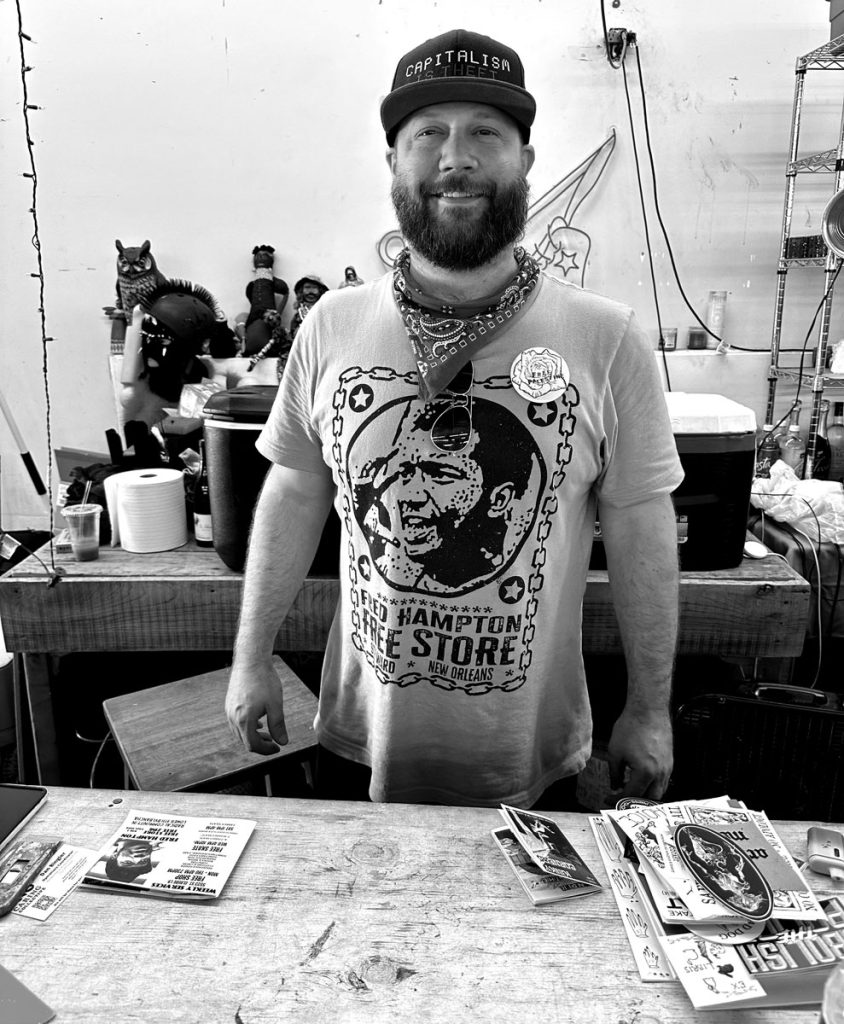
Dan Bingler
Photo by Veronica Cross
So much listening.
Yeah, and that’s how you’re able to never pigeonhole yourself. There were people who said, “Well you’re a food org,” because we were getting 18,000 pounds of groceries every week for like, four or five months. And I always said, “No, we’re a community care and support organization. We’re a community defense organization, we’re a mutual aid organization…” A year later, Hurricane Ida hit and we went and did $5 million of relief work across six parishes, through different community leadership and organizations. We rented a U-Haul for about six weeks and drove it 2,800 miles, just to be where the community was and asked, “Hey, what would you like us to bring you?” Louisiana Coastal Tribes Coalition and Seafood Workers Alliance, these people needed support. So we asked, “What would be helpful to you?”
And you [were] partnering with Southern Solidarity and other care groups?
Absolutely. When we started off, it was all about community care and support… GNO Care Collective does not do unhoused [services] anymore. What we do is we go to Southern Solidarity and we take leadership [direction] from them and whatever they say to do is what we do. So if you are interested in unhoused solidarity specifically, and you want to be a part of that… Go listen to the Black, queer, trans-led organization.
Everything can happen simultaneously and it’s non-hierarchical, yeah?
You can not take up space, you know? I mean, you want to replicate everything. It’s what everyone expects, right? What they really don’t expect you to do is get out of the way.
I love thinking, “I’m gonna go to the Fred Hampton Free Store. What do I not need? What might be useful to someone else?” That is such a wonderful meditation. And that’s a blessing that radiates out, because people can participate in that. They can come by, they can get something, they can leave something. And you’re in this former Family Dollar. Family Dollars are often found in food deserts, especially in lower income areas, right? And then here you have things that are nutritious in so many ways. You have culture, you have support, you have community, you have free services, someone who does free haircuts. You have music. You had the A.C.A.B. Zinefest, you have all kinds of things. And then a wide range of things that people donate and drop off, and someone needs that.
People often ask me, “Is this good enough to bring?” And my rule for volunteers is: If you would feel dignified receiving this, it’s good. And if you would not feel dignified receiving it, let’s not put it out there for people, because it’s not about just giving people anything. It’s about creating a retail experience, but one that’s divorced from money or even barter. It’s truly mutual aid… You’re not doing charity work. This is for you, it’s for me, it’s for them, it’s for all of us together.
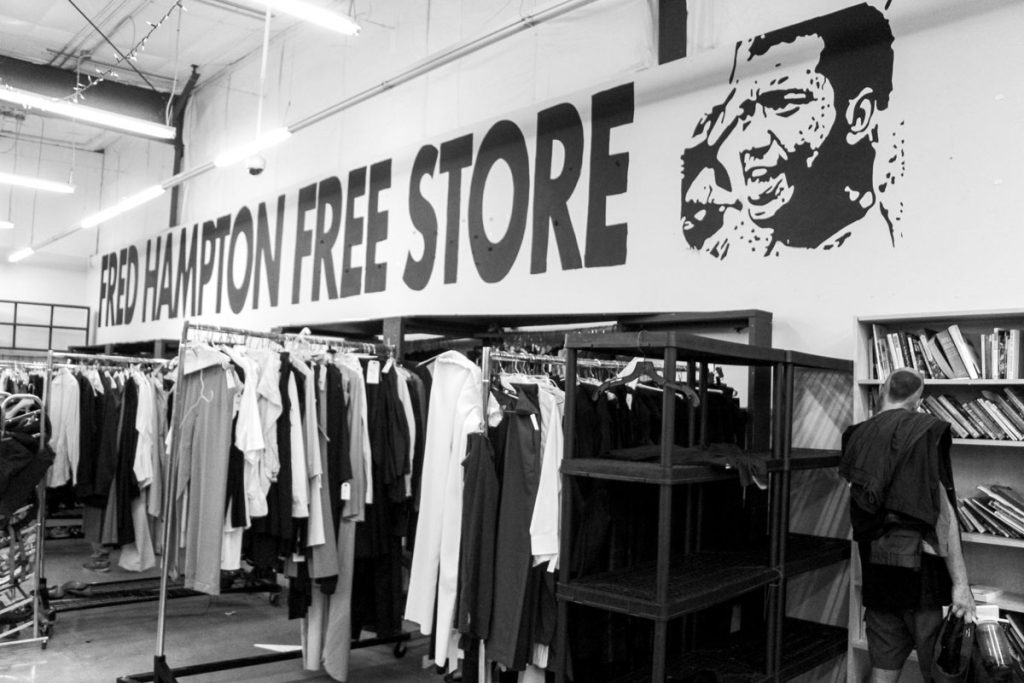
Photo by Rodrigo Delgado Jr.
Those racks and tables are kind of like a neutral zone, right? You don’t have to take it, but someone may need it.
And there are few things that make it on those racks for more than a week, even random things. I like thrift shopping. But sometimes we get a thing and I’m like, what even is this? And who could even use it for anything? And then it’s gone that day.
And Greater New Orleans being as creative as it is, you may see it on a costume somewhere.
I think another crazy and beautiful thing about getting whatever, and people feeling they can bring whatever, is that organizations and larger groups are contributing. The film sets have been donating stuff. I got 500 lamps at once, like nice lamps from multiple TV shows that are like prestige television, right? And 500 portrait frames and computers, fancy old houseware and things like that. A giant amount of clothing on z-racks—20 z-racks full of nice, stylish clothing. Also a lot of men’s clothing, where you wouldn’t normally get a lot of men’s clothing donated.
Men’s clothing is hard. It’s hard to find good men’s clothing that’s used.
I know many men who are very particular and have a very eccentric sense of style, or many shoes or things like that. We’re absolutely fully swept up in consumer culture as much as anyone else… We’re not even considering the fact that [the majority] of unhoused people are men, you know? So when we go out and take food and supplies through Southern Solidarity, I get a lot of women’s clothing donated. And the truth is, maybe 20% of what’s donated is men’s clothing.
It’s such a late-stage capitalism mindspace to be so isolated and to be in love with stuff, but just not be part of something bigger than yourself. And here you have this neutral zone where you can just relax and give and receive in community.
And I want to make a point that it’s so important that this is also a space that’s accessible to the youth. We do all-ages punk shows through Belly Up. We do roller skating from 4 to 10 p.m. every Wednesday, and we have lots of kids and families come in from 4 to 7 p.m. We’ve even added Saturday skating… But also, people need to see what community means, what radical community means. They need to see queer and trans [people] being treated completely normally as they should be, with all the respect and autonomy they deserve, just being around doing things together. All the leftists—even people who never agreed about one single thing except for that they’re leftists—in one big room, being chill with each other. As someone who is about to make 41 next year, I recognize that we’re not the leadership we probably think we are. The youth is the leadership and I’ll tell that to anyone who will listen. The leadership is already there… I say this as a non-hierarchical organizer and as an anarcho-syndicalist: We need to be offloading through horizontal organizing everything we can to these people who are already really the leaders of whatever we’re gonna be doing in the future. They’re already there. We’re just not creating spaces that are accessible to them, for them to be a part of it and see what’s going on.
Horizontal. I love that term.
It’s very important. When people ask me, “How did you get this space?” I tell them I don’t pay them rent. I have a 501(c)3, and I pay for the water and electricity myself. I don’t even fundraise for it. I don’t even ask people for money for it. We do events, and it pays for some of it. And it’s fine, because it’s not nearly as expensive as anything else you could be doing with that money.
When did the store officially open?
It’s been open since last April, I got here last March.
Did you have another Fred Hampton Free Store at one time?
Yeah at the [former] UU Church Uptown. Between Ida and here I was there in the gymnasium for a while, and then in some of their other offices, and then the whole upstairs for a year.
Is that a meditation for you to be in the moment with this space? Like everything is good for now, but do you think about the future?
The owner is very graciously allowing me to use the space. I’m in the moment that this is a very important space, but I’m also in the moment that nothing is guaranteed for the future. So I’m looking at other places. This is a system now, and it’s a power we have, collectively and as organizers. People who own buildings, who sit on them for years, are paying the bills there, right? They’re keeping the electricity on there, keeping the water on and so if you can come in with a plan… I mean, I got the opportunity through a previous owner, and then the new owner just didn’t kick me out. But they’re going to use the building for something eventually.
If this space were just abandoned, it could fall into disrepair and become a liability for them anyway.
And it would be. I’m a caretaker of the space. I pay for the water and electricity, and the neighborhood doesn’t see it as a blight. I was like, I could feasibly afford this with my serving and bartending tips. Trystereo was here giving out [harm reduction services] in front of the building already. I reached out to them and said, “Tell me what you want to do. I have this opportunity to take this building over. I think that’s good, so I’m gonna do it.” These people are gonna give me the only keys to this entire city block, and I’m gonna run my fucking radical leftist mutual aid group out of it… Because I’m stealing like $20,000 every month from the capitalists right now. That’s what the rent of this space would be… I want people to be able to have beautiful plays here and community fundraisers and events for themselves and their community. And I want the neighborhood to feel a sense of ownership over it and a sense of access to it because this is their space… And now I have numerous friends and community members who I’ll be going to their birthday parties every year for the rest of my life… Miss Green, who lives right down the road, came in in early March. She’s here as often as she wants to be—which is like four or five days a week—cleaning, organizing donations, helping get things out, keeping tabs on folks a little bit, taking care of the space, going out and telling people what’s happening in the neighborhood here… Another volunteer, Erin, who came in on a random Wednesday when we were roller skating, [was] like, “Oh, I take my granddaughter out to Airline every week, and I live three blocks away? I’m gonna bring her here next week.” And then she comes in, and then she says, “These kids need some hot dogs and chili, don’t they? I’m just gonna come in every week and do free hot dogs and chili and nacho cheese.” And so her granddaughter comes in every week. She’s the reason we have a Saturday skate now. I was like: Cool, here’s the lock box.
Perfection. And that level of trust. You can give the code and you can share that. What a beautiful resource.
Yeah, and it’s a safe building. You know, kids’ clothes are always there, so bringing other family members is good, when people have time to volunteer. Miss Green is a perfect example of how someone who comes in here and volunteers can also be an advocate for so many people, because she knows all these families.
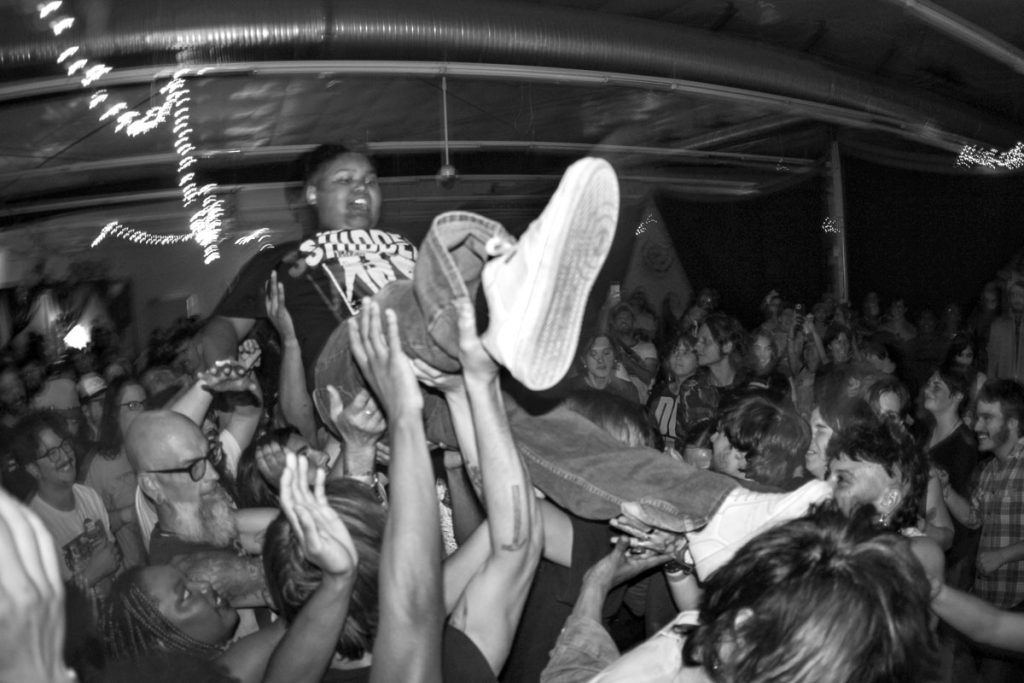
Crowd surfing during Terminal Tongue’s set for a Palestine benefit show on April 13
Photo by Rodrigo Delgado Jr.
So let’s review what people can find here in terms of goods.
On Monday evenings, we take any kind of donation that would be useful to people. I will take anything from clothing, to linens, kitchenware, household goods, trinkets, and decorations. We have a lot of books—so no books right now please—but small furniture, small appliances all the way up to things like couches, good desks. We’d have to be able to see it first, but whatever is useful to people is what we generally get in and we can generally get it out and have the space for people to self-select. I wish that I could give people housing and health care and food and electricity and water, but I can’t. The next best thing would be money, but I don’t have any of that either. [laughs] But what I can get is the things they’re going to spend money on anyways.
And then there’s the services. How often do they come?
Trystereo is here [weekly]. Freestanding Communities is here [every Monday from] 5:30 to 7 p.m. and they bring out a medical group and EMT and do basic wound care and triage. Food Share also brings out about 75 hot meals every Monday. And then sometimes we have other people who want to table. We have about 150 people come in every Monday between 4 and 7:30 p.m. for these various services, so people who want to connect with people, people who want to support people, they should come table at one of these nights and let people know what’s going on. I also want to note that we also have Plan B all the time. Sometimes we get allergy meds, a lot of different kinds of OTC meds. We get nicotine gum sometimes now, but we always have Plan B. Whenever we do events, there’s Plan B at the door. There’s Plan B in the bathrooms. Because basic health care resources are important.
Basic human rights. Seriously, people together and having that experience together in a safe space. Good on you.
The bar is really low for men, so this feels more helpful than it is. It’s just what you deserve, and you shouldn’t have to thank anyone for it, but I know the world in which we live, and I do appreciate it… I identify as non-binary, but I will always benefit from the privileges of white men, so I will always be accountable for that as well. I’ve had Plan B everywhere I’ve been since the beginning of COVID. When the draft opinion of Roe v. Wade came down, I went and bought like 200 packs from California just to have it in the space. Because here’s the funny thing about volunteership and basic social care and services—in general, it’s like 90% not men, right? Who are all the people doing the volunteering? Out of 300 to 400 volunteers, 9 times out of 10, not a man.
Anything else you’d like to add?
Mostly just thank you for being interested in writing about it. I’ve always thought this would be a good medium for people to find out more about the space and why we’re doing what we’re doing and what’s really behind it. Because it is the Fred Hampton Free Store. It’s not “The Dollar Spot.” It’s not “The Abandoned Family Dollar.” It’s a community center. It’s a radical space. It’s a disaster relief hub. It’s a great place to have parties and community events, birthdays and skate nights. All affordable and accessible.
For more information on the GNO Caring Collective, check out gnocaringcollective.org and @gno.cc.eventspace on Instagram.
Top photo: Rodrigo Delgado Jr.
