
Before Harry Potter turned the industry cynical by flooding it with cash, children’s publishing was where adults who believed in magic went to pass along their secrets, to equip children to see through the masks of the world and into the heart of things. Robin McKinley was one of the greats. With The Hero and the Crown, she gifted her readers the ability to grapple with the immensity of evil—and how frail and inadequate any human being that dares to face it head on will feel—made manifest by Maur, the Black Dragon, who awakens after one thousand years of slumber to devour or incinerate everything that lives.
Aerin, the daughter of the king, goes to fight the dragon alone, save for her war horse, Talat. Her folly is obvious the moment she encounters this mountain of flame and malice. Within minutes, her ankle has snapped beneath her fallen horse, half her hair has been burnt off her head, her arm blackened, and her throat and lungs scorched from screaming through dragonfire. But in a desperate act that she believes will be her last, she plunges her knife into the dragon’s eye, and it expires while she loses consciousness. It’s a hollow victory. The dragon has left her charred and mangled, scarcely recognizable to her loved ones when they finally find her. At home, she is feverish and coughs blood. Everyone can see she is dying. Maur’s ugly black skull, hung in the banquet hall as a trophy, sneers at her, telling her that her sacrifice means nothing, that her victory made her feared instead of loved, that she would always be alone. As she loses her will to fight and live, the dragon begins to defeat her at last. Alive, Maur’s danger was external. Dead, its evil insinuates itself into the air, weaving a tapestry of despair that causes her to turn on herself.
Despair, as insidious and persuasive a storyteller as ever there was, is the foe ANTIGRAVITY Magazine was born to fight. We want terribly to meet this moment, and we are not without courage or skill. But we’re also only human, and we’re growing tired, and there’s something in the air that makes anything besides breathing seem like too much trouble. The usual summer malaise feels like small potatoes compared to the weighted blanket that despair has placed atop those of us still trying to kick.
For independent media-makers such as your ANTIGRAVITY editors, every day diminishes what is enviable on the mainstream side of the fence. Jobs that once offered financial stability and at least a halfway decent creative outlet are disappearing, with nothing on the horizon to take their place. You’d think, then, that this moment would be more vindicating for those of us who have been scrapping all along. But what those media outlets still have that we don’t is a default mode. The New York Times has been writing about disaster with informed disinterest for decades, and can continue to do so until their very last subscriber has been cut down by the horsemen of the apocalypse that are everywhere making quick work of this cursed century.
But since this magazine doesn’t pay our bills and costs an absurd amount of our life force to carry on, we have to believe the work is important to justify the effort. As many can attest, justification for expending any kind of effort, towards anything at all, is growing difficult to find. Nothing we say or do makes the difference we wish it would, and blind faith is no longer enough.
According to clinical psychologist (and ANTIGRAVITY advice columnist) Danielle Nelson, generalized despair has reached a crisis point. “Despair is the feeling like there’s nothing to look forward to, and the moment we’re in is a prolonged version of that feeling. It’s unshakeable,” she says, observing how pervasive the problem has grown from the vantage point of her personal practice. “We all want a prescription for difficult feelings, but there’s no putting this in a box. And that scares the shit out of people—it scares the shit out of me.”
As a mental health practitioner, Nelson prefers to avoid quick fixes and platitudes. She’s inclined to put suggestions for “taking action” like going for a run or making a donation in the category of toxic positivity. She does not propose that her clients should seek places hope might be hiding like it’s a lost set of keys. But what she’s noticed does work is something called narrative therapy, which suggests viewing painful truths from beyond the “good” and “bad” binary, and expanding into narratives which make meaning from the broader view. Without the benefit of distance, it’s easy to take an emotional interpretation of events as fact and self-perpetuate suffering out of erroneous conclusions. Nelson sees the story as the place where both the pain can be located and the healing can begin. “Instead of going straight to trying to fix something, I prefer to take a long look, ask about the cause, the root, and let what you discover inform you how to go forward.”
As above, so below.
If the collective consciousness is in critical condition, those of us looking for answers will have to start asking the right questions about the stories we tell ourselves. Try, for example, applying this therapeutic lens to our country’s June 21 bombing of Iran’s nuclear facilities, and you will find the road to Isfahan was paved with stories. A group called Writers Against the War on Gaza recently culled headlines from The New York Times over the past 30 years about Iran’s alleged nuclear ambitions. “Report Says Iran Seeks Atomic Arms” reads a 1991 headline; a 1995 headline fears Iran’s ability to build a bomb in five years’ time. 2005 brought another five-year prediction, 2012 a two-year prediction, with headlines throughout the three decades that state the urgency and necessity of bombing and escalating in Iran in order to “stave off war.”
War requires an instigator, and if you fire the opening shot, you’ve claimed the role. But if you want to have your cake and eat it too, you can weave a tale of your opponent as a growing menace, in the shadow of which you can portray your opening shot as preventative. The retaliation that inevitably follows will justify the next round of mass death that was the plan all along. Noam Chomsky and Edward S. Herman refer to the phenomenon as manufactured consent, and it is not a new strategy in the government playbook. In a world divided between heroes and villains, you only have to prove the Other is the villain, making you the hero by default.
But fictions do not belong only to the fabricated heroes. Prison abolitionism—a movement predicated on complicating what we think we know about good and evil, transgression, redemption, crime and punishment—and its proponents consider storytelling central to the work of liberation. There’s a reason that one of the leading voices in abolitionist thinking, Mariame Kaba, also writes children’s books—children are simply learning, rather than unlearning, and that is fertile ground for world-building beyond what our adult eyes can’t see past. In Prisons Must Fall, she and co-author Jane Ball ask and answer questions such as “Some may wonder: without prisons how will we mend harm? Compassion is a good place to begin, open up your arms!” In fiction, we can deconstruct the narrative pillars of the trap wherein we live, and reconstruct reality with new ones.
Ursula K. Le Guin, a writer of conscience who spent her life demonstrating how the pen could prove mightier than the sword, always undertook world-building with an eye towards freedom. She imagined new worlds like all our lives depended on it, but she also skillfully identified the ways we are snared by the reigning narrative. In “The Carrier Bag Theory of Fiction” she writes, “Before you know it… the skills of the makers and the thoughts of the thoughtful and the songs of the singers have all been pressed into service in the tale of the Hero.”
Take The Iliad, in which all characters who are not war heroes are reduced to narrative devices, or held hostage to the story of the pride of Achilles. Insults to honor, bruised egos, spoils of war and the killing of onlookers—this story has been on endless repeat since the Bronze Age. Refuse to further participate in hero worship, Le Guin suggests, and we might yet open a door to a world we actually want to live in. “The trouble is, we’ve all let ourselves become part of the killer story, and so we may let ourselves get finished along with it,” she says. “Hence it is with a certain feeling of urgency that I seek the nature, subject, words of the other story, the untold story, the life story.”
If we are struggling to find the life story now, we might consider that despair is serving the death story by blocking the exits. As public health professional (and ANTIGRAVITY editor) Mary Beth Campbell can attest, despair has proven to be a killer. “In public health, we use the term ‘disease of despair’ to refer to those medical conditions that lead to ‘deaths of despair’: namely, addiction to alcohol and other drugs, and other mental health conditions, which can lead to deaths due to suicide, overdose, and complications from alcohol and other drug use,” she explains. Between 1999 and 2021, these deaths of despair increased 2.5-fold among adults ages 25 to 74 in the United States, and were the fifth leading cause of death among adults in 2021.
“It is easy to blame this all on despair itself, but despair is a symptom, not the cause. No emotion is inherently bad; they are adaptive responses that can teach us about the world,” Campbell says. She likened the effects of unchecked despair to the diseases that often emerge from the undernourishment and inadequate sanitation that go hand in hand with structural poverty. Despair as a temporary, individual ordeal can be survived, its lessons incorporated into a new way of being following the devastation of suffering. But without time to process or rebuild, despair can be too consuming to fight against. “We are constantly bombarded with stimuli, constantly under both real and perceived threats, that leaves us too overloaded to learn from despair,” says Campbell.
As above, so below.
If suicide and chaotic substance use are considered diseases of despair, then how else could we characterize our frenzied avoidance and total paralysis in the face of the power structure’s escalating trespasses on our values and needs? The futility narrative of nihilism, despair’s modern intellectual alter ego, serves the aims of the power structure by keeping us out of its way. If we can’t imagine another ending for ourselves, we will live to see our fears become self-fulfilling prophecies. But for imagination to serve more than escapism, it has to be honest, and pursue a higher purpose. In 2004, Ursula K. Le Guin delivered a speech at a children’s publishing convention where she prescribed the release of desire for moral certainty, to be replaced by strong curiosity about who we really are, and who we can become. “In an America where our reality may seem degraded to posturing patriotism and self-righteous brutality,” she says, “imaginative literature continues to question what heroism is, to examine the roots of power, and to offer moral alternatives. Imagination is the instrument of ethics.”
If it seems silly to you to turn to children’s books at a time like this, there are plenty of sophisticated philosophical types that have duly addressed the question of despair. Kierkegaard devoted a whole book to it, and French existentialists like Sartre and Camus held court on the topic in Parisian cafes for years. But thinking the problem through never seemed to get any of them out of it. Just as now, all attempts to reason with what’s happening never really ease the burden. If we are to begin imagining a new world, it helps to start by returning to the simple stories—the ones you know in your heart are true before your mind understands why.
In The Hero and The Crown, Aerin is inches from death when a voice in her dreams shakes her from her stupor and reminds her that her story isn’t over just yet. She saddles her horse and follows the voice: to a cure, to a new battle, to love, to herself. She returns to her people, hopelessly besieged by demons from the North, moments away from defeat. Though they are cheered by her arrival, they are nevertheless weighed down by a sorrow obscuring all possibility of victory. Aerin recognizes the sneering voice and its effects, and knows what she must do. Maur’s hulking skull, reeking of anguish, must be taken away from the people who are fighting for their lives. She must find the strength to lift it, even as its poison once again fills her mind and seeps into her aching muscles, all the way down to the bone. It is a heroic act, but one that is quite unlike the bloody antics of Achilles, or Alexander the Great (who was emulating Achilles), or Napoleon (who was emulating Alexander the Great). Ultimately, she is victorious because at the moment of truth, she chooses to leave the battlefield, to understand the enemy as that which is breaking the human spirit.
In our world of compounding tragedies, we never have a chance to mourn or rest, and our fraught and exhausted nervous systems are screaming for relief. But once we perceive the story the darkness is telling, we might also perceive the existence of other stories. Faced with the knowledge that no shining knight is coming to save us, we can take comfort in the knowledge that we don’t need him. “Strong people don’t need strong leaders,” Civil Rights legend Ella Baker always said. Together we can decide that there is a better story out there than this one. There fucking has to be.
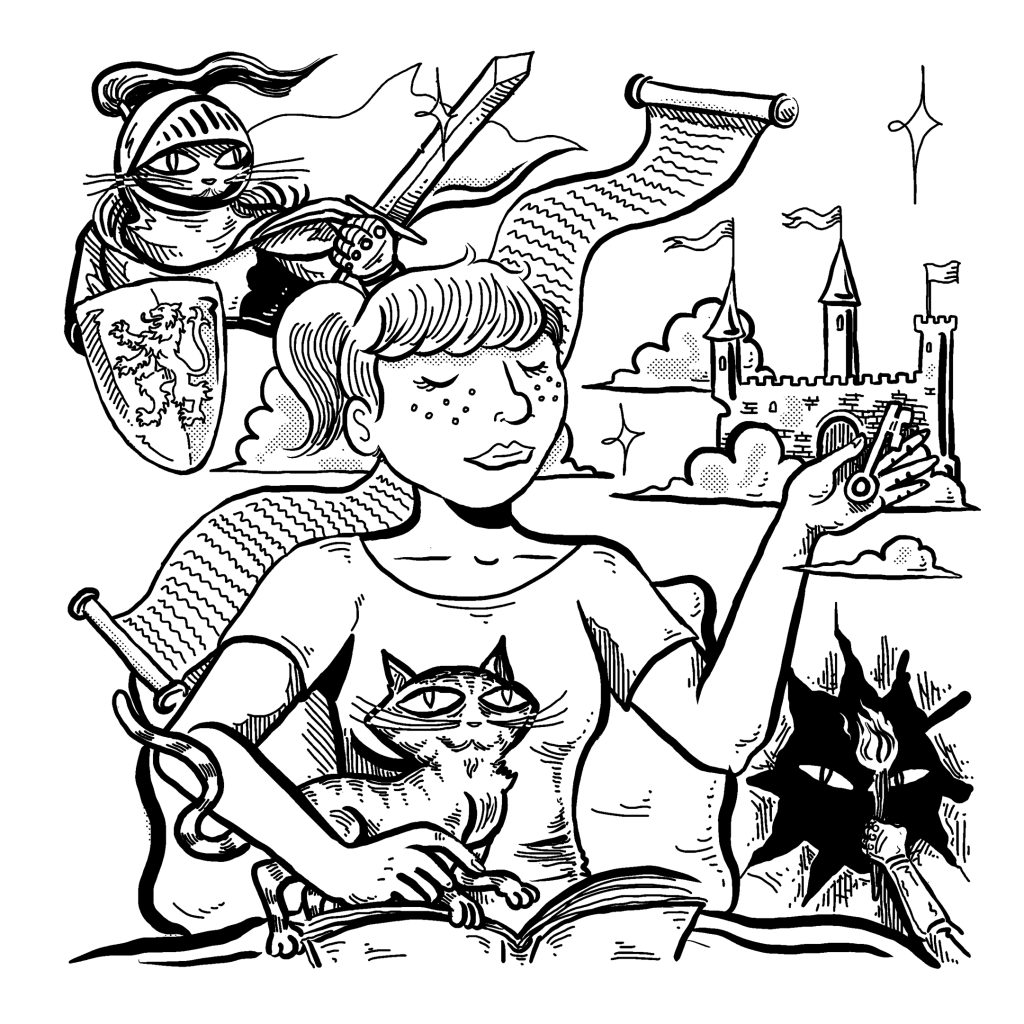
illustrations by Romey Petite
