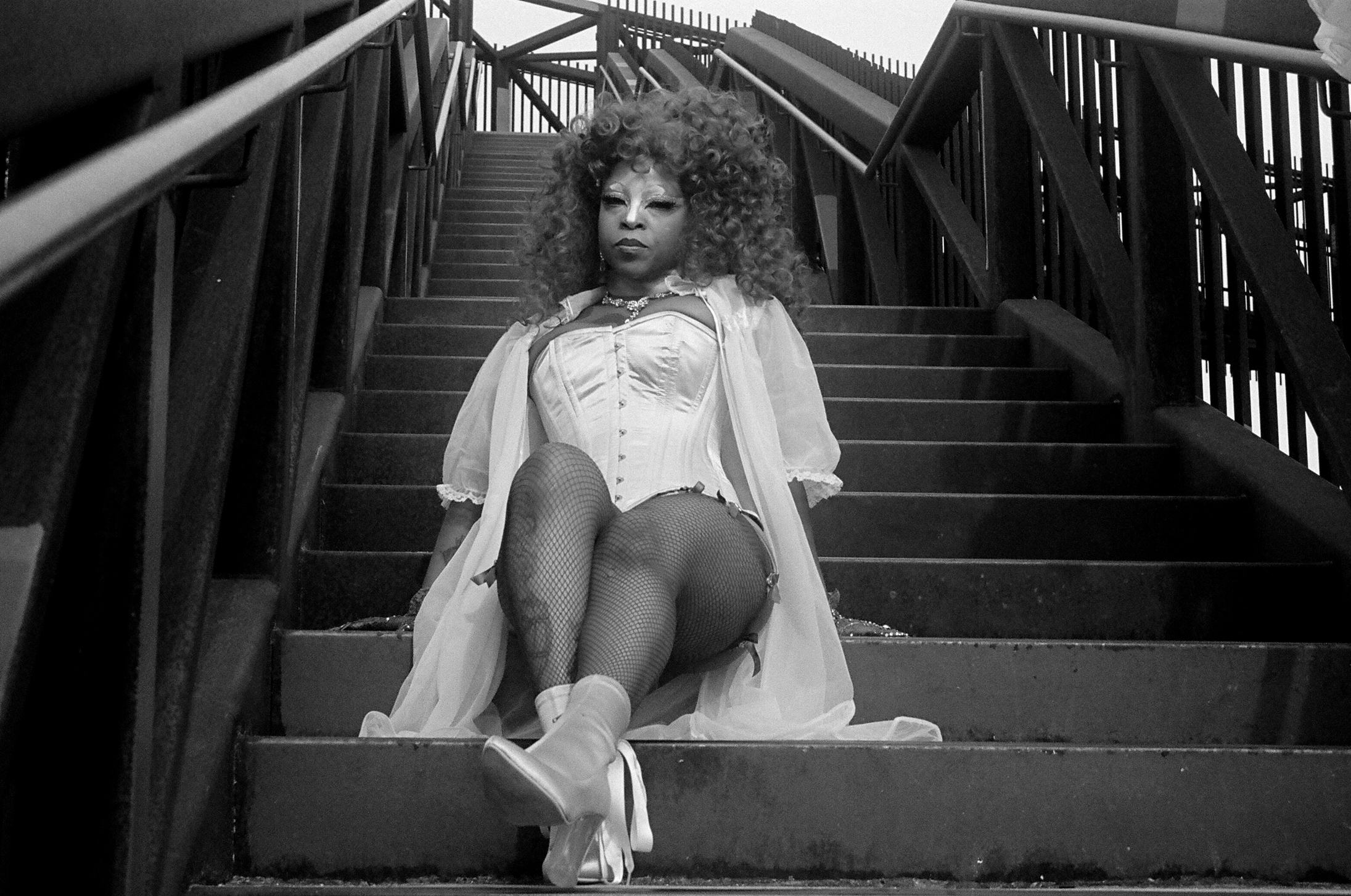
On a sunny day in March, I walked up to the Crescent Park bridge to meet a group of camera-laden strangers. Peppered amongst them were models dressed in pinks, purples, frills, and curls, with makeup just as vibrant and elaborate. I brought with me a Canon EOS Rebel S, a film camera that I knew very little about, ready to figure out what a “photo walk” entailed. This was my first Vantage Point. As I stood there nervously, feeling out of my depth among seasoned career photographers, people began to introduce themselves to me one by one. They asked if I’d been before, about my camera, about myself, intuiting a need for kindness.
Atop the bridge, models draped themselves over the rails, climbing the metal bars in heels to get the risky poses, while passersby ducked under cameras and zoomed through the makeshift shoot to avoid interrupting anyone’s composition. We then meandered through the Quarter, stopping often for models to pose and photographers to snap while bystanders looked on with piqued interest. The final stop of the day was Todd Taylor’s studio, one of the Vantage Point organizers, which had been decorated by Dinah Deville with pastel rocking horses, butterflies, and cotton clouds. The whole day I felt like paparazzi, worming my way into the crowd to find a shot, but mostly waiting until it cleared so I could take my time, as I was shy and shooting on film, on a camera I didn’t much understand. But everyone moved with a fluidity and intuition that awed me—models knowing exactly how long to hold a pose, and photographers graciously stepping aside for others once they got the shots they wanted.
I heard about Vantage Point from Tammie Quintana (ANTIGRAVITY’s newest photo editor) who helps host the photo walk. I had recently worked with her on a piece, and had seen her share information about when the next event would be—it was on a Sunday, my off day, so I had no excuse not to go. I messaged the account asking if there was any sort of cost to attend, and received back “No cost, just come with [a] camera or 7 and fun attitude.” I’ve attended every Vantage Point since.
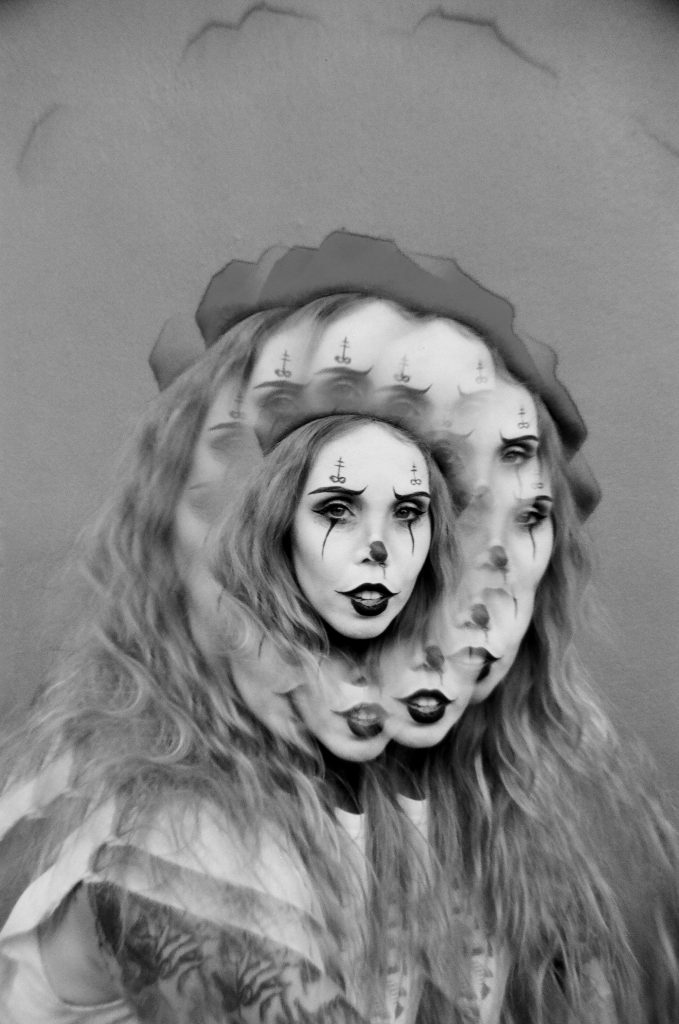
Stilts (Mica Myerscough) making a guest appearance at the clown-themed Halloween Vantage Point photo walk on October 29, 2023. (Photo by Tammie Quintana)
I’ve tried many arts throughout the years. I danced for 10 years, did theatre for five, and have taken printmaking, bookbinding, sewing, and music classes besides. But somehow, photography took its time finding me. There was a period in college that I always had a disposable camera on me, but I wasn’t thinking of it as art, and I never learned how to do it well. I wanted pictures with my friends, and I liked the way that film looked; that was the extent of the thought that went into it.
For my most recent birthday, my friend Alex got me my first film camera—something I’d long talked about but lacked the commitment to research and dig into. It was an SLR (single-lens reflex) camera, and most of its functions were automatic. It loaded the film automatically, had settings for different types of light, environments, and shots, and had an autofocus feature. It was an easy camera for someone with no experience to learn with on their own time.
In the first five months that I had the camera, I only went through one roll. I didn’t have the confidence to know what to point it at. Every time I raised the camera, a voice in the back of my head asked Who cares?—a familiar query for any artist. I wanted to take more pictures, to get better, but felt overwhelmed by my lack of skill, focus, and direction.
This type of blockage is what Quintana hoped to curb when starting Vantage Point. The first one took place in July of 2023 when the owners of Margaret Place Hotel asked if she would host a photo walk there, as a sort of introductory class to film photography. “I wanted to teach people how to make fine art on film and bring it to the next level of photography,” she said.
Each month, photographers and models meet at a different location within the city to take pictures and make art, and it’s entirely free. Since a year ago, the community has expanded substantially, as have the events themselves. They began with one model per shoot, but they now work on recruiting around five, and have also started featuring local brands as a way to both style the shoots and promote local artists. More photographers join each month, and a solid group of volunteers has helped make the events happen: Allen Boudreaux handles the Google forms and Dropbox for sharing pictures between participants afterward; Amy Jo Wisehart is the group’s graphic designer; Denise Lyons helps with social media; and Amy Lopez helps coordinate models for the shoots.
Lopez, a multi-hyphenate artist, has run the gamut of participation. She was asked to be a model at one of the first events, then at the second event she attended, she brought with her a 35mm film camera that she hadn’t used since her high school photography class. Soon after, she asked to coordinate her own month—the theme was Dystopian Glamour. Since then, each Vantage Point has had a theme.
For Quintana, these walks have been all about the power of collaboration. Because the events are free, they exist on a sort of barter system. Photographers barter tricks and skills with their respective cameras amongst themselves, models get pictures taken by a multitude of photographers to add to their portfolios, while the locations and brands receive publicity from the photos that get posted or published.
“I didn’t go to school for photography, but it’s been this ripple effect of meeting people who are already involved in photography and them having the kindness in their heart and the time to stop and show me what they know,” Quintana said.
She took the time to stop and show me how to do a film swap, a ritual in which one photographer shoots on a roll of film and then another photographer shoots over the same roll, double exposing it. It’s a mystery game, as you’re unsure what you’re shooting over, and whether or not the two images will turn into something cool or incomprehensible. At its best, it feels like magic. It ties together not only the images but the photographers as well.
“This creates a loud whisper, a loud vibration—the collaborations do. [Mia] showed me how to shoot film swaps, and somebody else showed her. It’s such an exciting thing, and then you want to experience it with somebody else, too.”
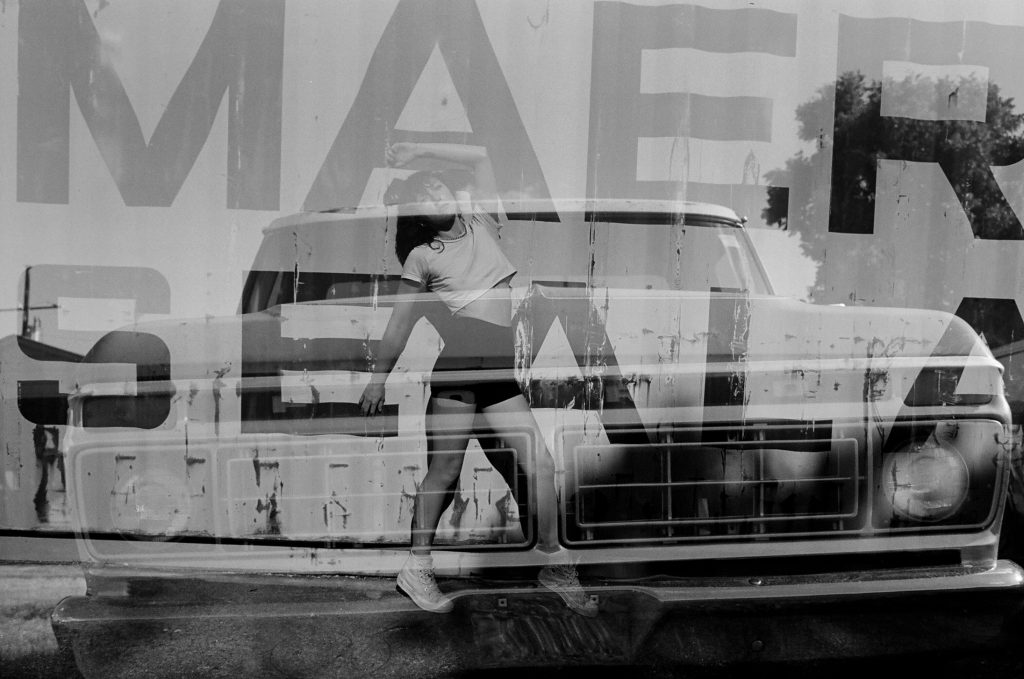
A film swap of Tori Benoit posing in front of a shipping container exposed over an image of a truck from “The Bomb Factory” Vantage Point on May 19, shot on Portra 400 film. (Photo by Marisa Clogher and Tammie Quintana)
I’ve been a writer by vocation for as long as I can remember. I spend hours laboring over verbiage, thwarted constantly by the pursuit of precision, and suffering when I can’t get out of my own way. Writing this, here, has proved arduous. I want what I say to match the wonder in my head, but it often feels like trying to take a picture of the moon. Trying to pin language to abstract thought never becomes easier, and when it’s your job to do so, that wonder of translating the world around you can become lost to resentment. This is the nature of work: When there’s money and obligation embedded in it, it becomes tiresome, even if you love it. My relationship to the written word is not always warm and fuzzy.
Photography offers fewer opportunities to get stuck. If you pause too long figuring out the perfect shot, it disappears. My current aim is speeding up while remaining intentional. Sometimes I’m not fast enough—manually focusing on my subjects, fumbling with the aperture to get the light meter in the right spot, forgetting to advance the film once the shot is ready to go. I’ve missed quite a few shots these ways.
But in accordance with my writing process, film encourages me to not speak until it’s as good as it can be. I do miss some shots, but the deliberation is necessary, as there is a finite amount to be taken. There’s a feeling of real choice, when your camera is loaded up and ready, and your finger hovers above the shutter as you wait for the exact expression, movement, or framing you want.
With film, I can’t edit myself in real time. Once the picture is taken, it’s done, and you have to wait to see if you did a good job telling the story on the other side. It’s a leap of faith, and it’s forced me to act before knowing if it’s going to come out the way I want, especially as I experiment with different film stocks, different cameras, different lighting, different environments. These guesses become more and more educated, but still, nothing is guaranteed.
Vantage Point has become my dedicated monthly slot to make art for the sake of making art, where I take risks yet don’t labor. The gig economy functions as a constant audition, and here I am auditioning for nobody. I don’t have to worry if my art is good enough. I’m not proving my abilities to anyone. There’s no money to be made, and this has been crucial to the mission of the event. “I wanted something that didn’t involve money,” Quintana said. “This was just a creative project, because money can really start ruining things.”
Lopez also expressed the importance of a non-monetized space. “I feel like I’ve turned all of my hobbies into jobs so it’s nice to have a new art form that I don’t plan to make money off of.”
While Vantage Point itself remains free, Quintana has expressed hopes for avenues of expansion that do get artists paid. As the event has grown, she said people have reached out looking for photographers, models, and creatives for unrelated projects. Her hope is to eventually develop a database or website that helps link artists to gigs, as well as offer some intentional education through real photography classes.
“I always wanted this to be an educational thing… I think within this community there’s a handful of people who would like to have more classes.”
In the time that I’ve been working on this draft, my apartment was broken into, and that first camera, my Canon EOS Rebel S, was stolen. Among the things they took, this upset me the most. It was the camera that helped me figure out what I wanted and didn’t want in a camera. It helped me get my footing, and then it made me ask questions that other cameras could better help me answer.
In the mere four months that I’ve been attending Vantage Point, I’ve acquired three new film cameras, which, as I zoomed out, felt astounding. As I became curious about double exposures, I knew that I’d need an older, manual film camera, and bought a Minolta X-370. The more I carried around these bulky cameras, I decided I wanted a lighter, easier point-and-shoot—a waterproof one while I was at it—so I bought a Canon AS-6. And at some point in my digging, I came across the Lomography Oktomat, which captures eight sequential frames in a single shot, which seemed fun to play with, so I got that too. When my apartment was broken into, I was out of town, and two of these cameras were with me and therefore safe because I go few places these days without at least one.
That Canon EOS Rebel S lit a spark, but Vantage Point turned it into a full fire. As I’ve become more comfortable and confident knowing where to point my camera, I see the world differently—not just as a blur that happens around me, but as art worth documenting.
There’s a poem by Ama Codjoe, “Posing Nude,” that has stuck with me since I first read it, where she writes, “This particular ex anticipated / my needs like a photographer considers / sources of light.” It suggests that art is about anticipation, and an artist’s job is to be one step ahead, ready with caring and curious attention. If we’re tapped in often enough, this skill helps us not only when taking a picture, but in understanding the needs of the people and world around us. It makes us better lovers, friends, and neighbors. I’m learning to consider the light in every room I enter.
For more info on upcoming Vantage Point events, follow @vantagepointnola.
Top photo: La Reina poses on the Crescent Park bridge at the “Pastel Pony” Vantage Point on March 24, shot on Kodak Ultra Max 400 film. (Photo by Marisa Clogher)
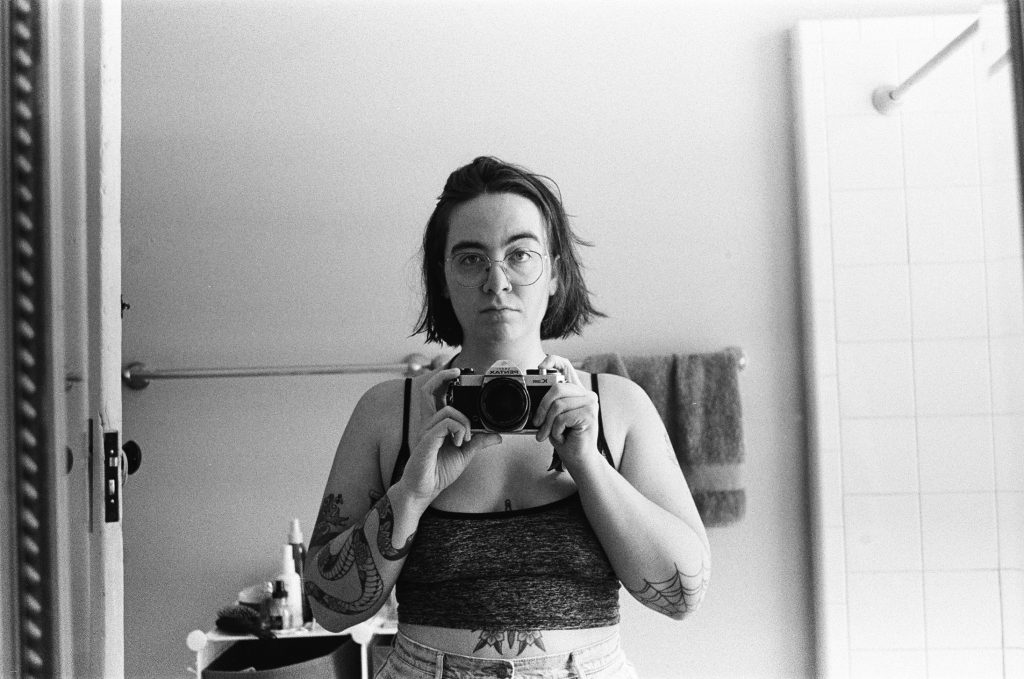
Bottom photo: Self-portrait in June with a Pentax K1000, shot on Ilford HP5 400 film.
