
On a recent Friday morning in New Orleans, while shoppers perused high-end luxury items at stores inside the Canal Place mall like Saks Fifth Avenue and Banana Republic, while workers sipped their coffee and checked their emails in the adjacent office tower, already thinking of the weekend ahead of them, a man disappeared.
He’d arrived, per his summons, on time to the immigration court on the building’s fifth floor, speaking loudly and confidently when his case was called. The middle-aged Guatemalan man spoke K’iche’, an ancient language used by the Mayans native to Central America. But the court didn’t have an interpreter on hand who could translate the proceedings for him.
The judge asked if there was another language he wanted to use. The man said Spanish, a language he’d started learning with his family since he’d arrived in the U.S. a little less than two years ago.
But as the questions became more complicated, the one or two-word answers the man gave made it clear he didn’t possess a strong enough command of the language to fully understand what was being asked of him.
“Criminales,” he said in response to the judge asking why he was seeking asylum. He wasn’t able to explain that he was in fear for his life in Guatemala—that he’d had a close family member killed there.
The judge and the Spanish interpreter appeared to acknowledge the language barrier at one point. But the proceedings continued.
Later, someone interrupted the judge, saying they were a representative of the U.S. Department of Homeland Security. They weren’t interested in pursuing the man’s case for asylum. The judge objected to the disruption, explaining he was still in the process of gathering information in order to make a decision.
Eventually, the judge presented the man with two options: voluntary or expedited departure. Voluntary would have given him 120 days to put his affairs in order, to prepare to return to the country where he was afraid he might be killed, and to potentially come back to the court to appeal the decision. The man declined it.
“My heart sank,” one court watcher said. “I do not believe he understood the difference between the two.”
The man walked out of the courtroom and called his brother. Four men sitting in the courtroom’s observer section, dressed in plainclothes, stood and followed after him.
On the phone, the man recapped in K’iche’ what he thought happened. He told his brother his case had been continued, possibly combining the snippets of Spanish he understood—taking the number of days attached to voluntary departure and the possibility of returning to court to appeal the decision.
Soon after, the four men surrounded him, revealing themselves to be U.S. Immigration and Customs Enforcement (ICE) officers. And then, he was gone.
In Guatemala, they call the more than 40,000 people who went missing during the country’s long civil war Los Desaparecidos—The Disappeared. It’s one of many Latin American countries where U.S. government and corporate interventions created violent political instability. More than 200,000 people were killed in the Guatemalan genocide under dictatorships supported by the United States—83% of those killed were indigenous Mayans. That instability persists today and continues to drive thousands to seek refuge in the U.S., where they can apply for asylum.
The formal asylum process requires convincing an immigration judge that a person is genuinely in fear for their life, and that process has a long history of inequity. Between 1980 and 2021, of the more than 3.7 million refugees from across the world that have been granted asylum since Congress enacted the Refugee Act of 1980, only about 152,000—4.2%—were admitted from Latin America.
Applicants may have more often than not been denied asylum, refugees may have been demonized and told “Do not come” by U.S. politicians, as they were in 2021 by then-Vice President Kamala Harris while she stood alongside former Guatemalan President Alejandro Giammattei, who was later accused and then banned from the U.S. for charges of corruption—but still, there was a process. And people and their families were kept apprised and aware of the procedures.
Under the Trump Administration, they’re simply vanishing. Shortly after the man from Guatemala disappeared, a small crowd of protestors formed outside the Canal Place mall. The court watcher had immediately contacted organizers, horrified by what they’d witnessed.
While they chanted and called for the man’s release, along with demands for the release of people targeted and detained by ICE—like Mahmoud Khalil, who was recently released after being held for 104 days in the ICE Processing Center in Jena, Louisiana—the protestors noticed a small group of people standing nearby.
“I was like, wow, that family must be really intrigued at the protest,” said Rachel Taber, an immigrant rights activist and one of the organizers of the demonstration.
A few hours later, after court adjourned and the protest was ending, one of the protestors who spoke Spanish approached the group to introduce themselves. As they talked, they learned the people were family members and friends of the disappeared man. They’d given him a ride to court that morning and were waiting for him to return.
“If it wouldn’t have been for court watchers, no one would have even known what happened to him,” Taber said. “The fact that we had a person inside and then the fact we had a protest and we just happened to meet, it’s kind of crazy.”
Taber described a “damned if you do, damned if you don’t” situation the Trump Administration has created with immigration court. It goes like this: You receive a court summons in the mail giving you a date and time to appear. If you don’t go, it’s automatic deportation. But if you do appear, you may be detained by ICE. She said that’s what happened with the man from Guatemala.
Others are disappearing, too. Days later, another court watcher, Zach Bishof, witnessed a family of six taken away from inside the mall by unidentified men in plainclothes. “It was two parents and four kids, one of them a two-year-old, and a kid who I think was 11. Young kids,” Bishof said. The family had been in the immigration court earlier that morning. Their hearing was pretty routine, Bishof said, recalling that the judge had given them about a year to get a lawyer and come back for their next hearing.
After court adjourned, Bishof was in the mall downstairs when he spotted the family talking to a man he believed to be an ICE officer. He watched the man escort the family out of the building and into a white van. And then, they were gone.
“There’s no way for me to know what happened. And I think what it illustrates is that this whole ordeal at immigration court is so shadowy, we may never know for sure what’s happening with people,” Bishof said. “We don’t know who is ICE because they’re dressed in plainclothes. We don’t know who’s on the docket until they’re there. We don’t know where they’re going after they pick them up.”
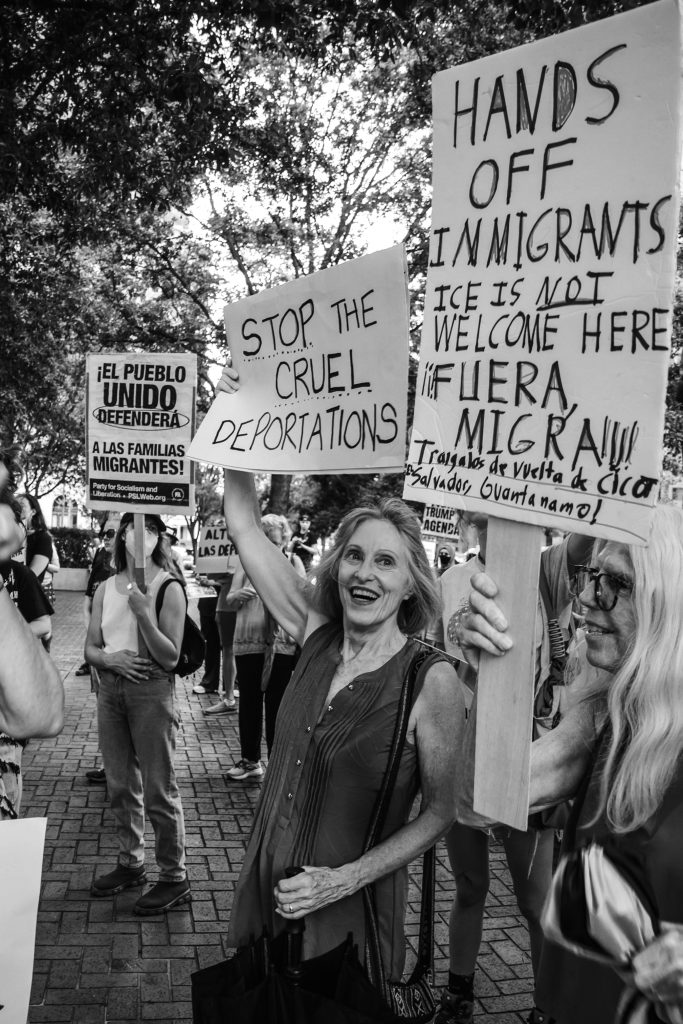
Photo by Steph Tarrant: On June 14, Louisiana organizers and community members protest outside the Hale Boggs Federal Building on Poydras St.
There’s more than cruel irony behind people seeking asylum disappearing from a mall in New Orleans with a Banana Republic inside. The city played a role in the installation of actual banana republics in Latin America. In 1912, mercenaries from New Orleans incited a coup in Honduras—hired by a man named Samuel Zemurray.
Zemurray was one of many “banana men” of the period gobbling up large swaths of land in Latin America to build banana plantations. But the New Orleans native was perhaps the most rotten of the bunch.
After successfully orchestrating the coup in Honduras, Zemurray continued to expand his company in the region, eventually merging with and becoming the owner of the largest, most influential, and most well-connected fruit corporation: United Fruit Company—known today as Chiquita. The merger made him one of the richest men in the world.
While he took a less-overt approach in Honduras, recruiting about 100 hired guns from New Orleans to help install a government more favorable to his company’s interests, in Guatemala, Zemurray had the help of the U.S. government.
With the support of U.S. Secretary of State John Foster Dulles, his brother Allen Dulles, director of the CIA, and President Dwight D. Eisenhower—all stockholders in United Fruit Company—Zemurray launched a propaganda campaign in the early 1950s that convinced the American public that Guatemala’s democratically-elected president, Jacobo Árbenz, was a Communist who wanted to make the country a Soviet satellite.
It was a complete fabrication. Árbenz had been implementing modest social and economic reforms and expropriating unused land owned by the United Fruit Company in Guatemala, distributing it to local farmers. But in the era of McCarthyism, it wasn’t a hard sell.
In what became the first CIA-led intervention in Latin America—and would become the blueprint for future CIA interventions across Latin America—in 1954, Zemurray helped overthrow Árbenz and install a dictator who acted as a puppet for the United Fruit Company, ushering in decades of brutal civil war and mass slaughter in Guatemala.
Zemurray retired from the banana business not long after, turning his attention to local philanthropic causes. His donations benefitted many New Orleans institutions, including Touro Infirmary and Tulane University.
Tulane received not only Zemurray’s money, but also many Mayan artifacts he looted from Guatemala and other countries. In another cruel irony, today an endowment from the Zemurray Foundation supports the study of Latin American indigenous languages and art its founder helped destroy.
And Zemurray’s mansion on St. Charles Avenue now serves as the residence for Tulane University presidents—perhaps a fitting abode for the school’s current president, who ordered the clearing of encampments and the arrest of Tulane students protesting the ongoing, U.S.-supported genocide in Gaza.
Zemurray’s actions in Guatemala were not without protest at the time, either. Across Latin America, people demonstrated against U.S. interventions. In 1954, Mexican muralist Diego Rivera created Gloriosa Victoria—Glorious Victory—a painting that addressed the Guatemalan coup d’état.
In the painting, U.S. Secretary of State John Foster Dulles shakes the hand of the newly-installed dictator, while his brother, CIA director Allen Dulles, whispers in his ear, his hand resting on a chair with freshly-harvested bananas in the seat. President Eisenhower’s smiling face adorns a bomb. In the background, people are locked in a cell, a United Fruit Company worker carries a bundle of bananas on their back while Guatemalan people protest, and bodies, including the bodies of children, lie bloody on the ground.
Frida Kahlo, married to Rivera, attended protests against the U.S. intervention in Guatemala in a wheelchair—her last public appearance before her death. Colombian writer Gabriel García Márquez included a fictionalized version of the “Banana Massacre” in his novel, One Hundred Years of Solitude, where hundreds of striking United Fruit Company workers were slaughtered by government soldiers.
Since that first protest outside the immigration court in the Canal Place mall on May 30, several more have been held. Others have been ongoing on a weekly basis in front of the ICE offices inside the Hale Boggs Federal Building on Poydras Street, with demonstrators calling for an end to ICE raids, an end to the genocide in Gaza, and the release of people held in ICE detention centers—the ones we know about and the ones we don’t.
“We are here today because if the Constitution doesn’t stand for our immigrant neighbors, who does it stand for?” Rachel Taber said at one of the Canal Place protests. “And this is an example of that quote: ‘First they came for the Jews and I said nothing because I wasn’t a Jew. Then they came for the socialists and I said nothing because I was not a socialist. And then they came for me and no one was left to defend me.’”
Outside of New Orleans, protest movements have grown in other cities, like Chicago, Baltimore, and Los Angeles—where Trump sent in the National Guard and active-duty Marines. The “No Kings Day” protests, held the same day as Trump’s military parade in Washington DC, drew over five million people in more than 2,000 cities, including around 6,500 in New Orleans.
Pablo Zavala, a professor of Latin American studies at Loyola University, said he believes it’s “very appropriate” to compare what’s happening now under the Trump Administration in the United States to what happened in Guatemala after Zemurray and the CIA installed a dictator friendly to their interests. In the first few months after the coup, people began to disappear.
“One of the things the United States today shares with what happened back then is the lack of respect for law, not for the people, but for the person and the people in power,” Zavala said. “It’s not supposed to be a king anymore because that was before. Now we have several branches that are supposed to check each other. But the person or the people in power are not following the law. And that’s exactly what happened in Guatemala.”
What is clear is that the U.S. has an outstanding moral, economic, and political debt to Guatemala and other Latin American countries for the role we played in ushering in the conditions that cause people to flee. As Zavala put it, “We owe it to them. We destroyed their country.”
But every presidency since Eisenhower has failed to accept responsibility or take any meaningful steps toward investing in the region—or, as evidenced by asylum rates, provide refuge for those who run for their lives. The Trump Administration has only made the cruelty and hostility more explicit.
The scenes depicted in Gloriosa Victoria are displayed on every screen. Today’s version of the painting hangs from headlines and news clips of people snatched off the streets. It unfurls as we scroll neverending news feeds serving us views of what our bombs are doing to children in other countries.
It is pinned to tweets from the White House gleefully depicting people in chains being deported, posted to a site owned by Elon Musk, who whispered in Trump’s ear as he enriched himself by more than $170 billion while running a governmental department that, among many other things, cut funding for translators in immigration courts.
“Imagine [the] type of reality where we welcome those folks and treat them well,” Zavala said, describing “reparations” that could include health care, education, and the chance to start a new life free from fear created and fostered by this country. Until we reckon with that truth, we remain complicit in their disappearances.
But we also see the protest behind the painting’s intent. We see people chasing off ICE officers. We see people protesting outside of ICE offices, marching in the streets, and volunteering their free time to sit in an immigration court in a mall in downtown New Orleans on a Friday morning, bearing witness to keep the disappeared from being unknown and forgotten.
Top photo courtesy Wikimedia Commons: Diego Rivera, Gloriosa Victoria

