
On April 24, my boyfriend texted me that I needed to go see Sinners in theaters. Seized by desperation, I immediately sent a distress call to my friend asking if we could go to the late show that same night in 70mm at Prytania Theatre [an ANTIGRAVITY advertiser]; if there was good art, I needed it fast. The movie had been out for about a week, and I felt naively confident about my ability to procure day-of tickets. Having worked at the theater for over a decade, I thought I understood their traffic patterns. But to my shock, even the late show on a Thursday was sold out. And it turns out, pretty much every single show that came after it for weeks would do the same.
According to owner Robert Brunet, “The movie didn’t just break the record, it shattered the record.” Sinners grossed around $350,000 at the local theater—more than triple their previous record of a first-run movie (which belonged to Oppenheimer, another 70mm run, at around $110,000). People called and travelled from out of state to see the movie, having been told they needed to see it in “70 em em,” as customers relayed over the phone.
The locally-shot movie tested film stocks and screened daily footage at Prytania, so they secured a spot as one of the five theaters in the country that screened the movie in 70mm upon its initial release. And Brunet confirmed that the 70mm projection is what kept the seats sold out. “Not to take away from how magical Sinners and Ryan Coogler were with that film,” Brunet said. “We recognize that because we were also playing it on digital… it did well on digital but not even close to [70mm].”
70mm prints have always been a specialty medium, typically reserved for epics and large-scale productions. The negatives, which are five perforations tall, have about 3.5 times the negative area as 35mm film. This larger negative is capable of capturing much richer depth and resolution, and it can be blown up big without losing quality. Coogler, ahead of his movie, released a thorough breakdown of film types and aspect ratios, explaining just how large of an image 70mm film is able to capture and project. Its resurgence speaks to a rejection of digital slop that has permeated our media ecosystem, as well as a yearning for something grand.
Prytania is currently the only theater in the city capable of screening movies on film. Two decades ago, film was the only way you screened movies.
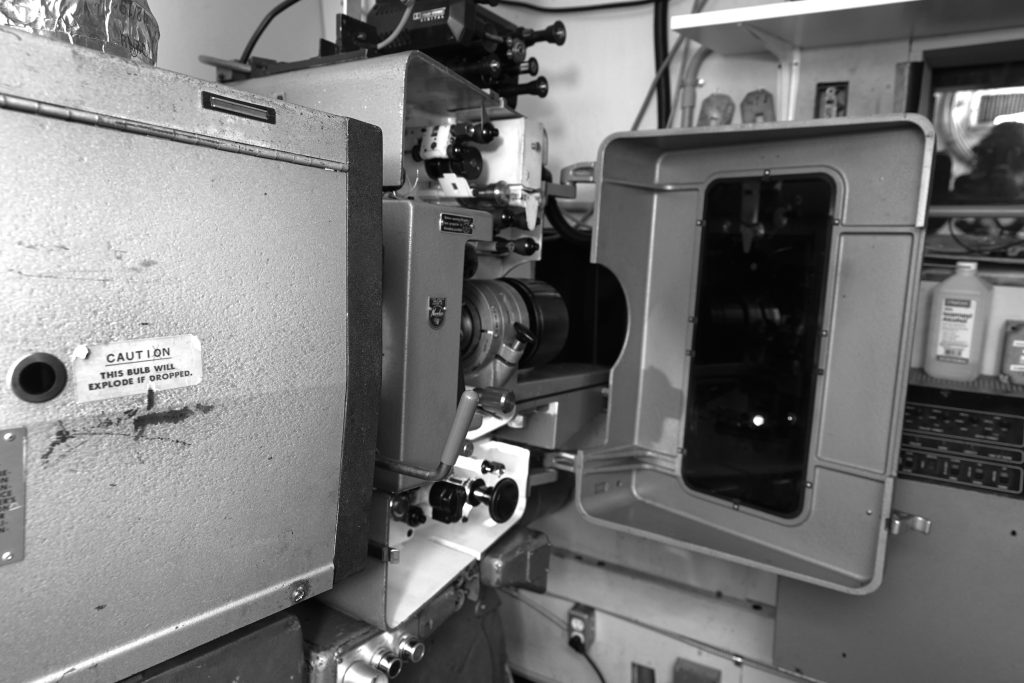
Norelco AAII Universal 70/35mm projector at Prytania Theatre’s Uptown location
In the early 2000s, it was rumored that digital would take over, but nobody really believed it. With such low resolution in its earliest iterations, the switch to digital was expected to be a much longer process. But once 4K projectors hit the scene, the digital takeover began its rapid onset. According to Brunet, projector companies offered rebates and film companies helped finance theaters to aid the switch to digital and alleviate the burden on theater owners. For the film companies, they saw it as a better financial investment than continuing to produce, distribute, and store film. In November 2008, Prytania Theatre installed a 4K projector—among the earliest in the country to do so. By 2016, all major film companies had stopped producing 35mm prints.
“The real reason that digital cinema happened was because of economics,” said Steve Levy, a studio engineer at a major Hollywood studio. “It wasn’t because of quality. It wasn’t because film was inferior to digital or anything like that.” But Levy, who has worked as a projectionist for nearly five decades, believes there is a larger unforeseen cost to digital in the long run. As digital formats are ever-evolving, the expense of continuously transferring and reformatting the files adds up—not to mention the cost artistically. “If at any time any of that data goes bad, you no longer have your entire show. With film, you still have your entire show. All you do is put cans of film in a salt mine in decent storage conditions and you’ll have it a hundred years from now.”
Levy came to projection the way many do—by falling in love with the booth. A cousin of his grandfather’s generation “made the mistake” of taking him into the projection booth, and it was game over. When he got to witness everything that went into making the picture on the screen happen—the mechanical aspects, the electrical and electronic aspects, changing reels, carbon burning in a lamp house, film running at 90 feet a minute through a projector—it fascinated him. “And not unlike Cinema Paradiso, I wanted to learn that.”
For those committed to film, its appeal is apparent. Film captures a moment as if it’s still alive, the light within it glowing eternally. The colors are richer, the grain adds texture, and even its flaws are alluring. I learn, I read, I listen, and I watch, and still I cannot wrap my mind around the way film captures an image. As Steven Spielberg puts it, “digital photography is a science and film photography is a chemical miracle.”
The problem, though, for those committed to film, is that most of the technology for it is old, rare, and the people who truly understand how to work it are few and far between. While new movie film cameras are available through IMAX, and Kodak is still producing film, new film projectors haven’t been manufactured in over a decade, according to Levy, and the people who knew how to work those projectors are getting older. So as projectors and projectionists alike age, the maintenance of the technology becomes more expensive, more time-consuming, and simply less possible.
In 2018, Tulane gave Prytania two 70mm film projectors. The projectors were not in working condition, and it took years to get just one of them running properly. Between finding parts, working on the machine, COVID halting movie-going, and one of the technicians passing away, the first projector didn’t make its debut until the summer of 2023, just in time for Oppenheimer.
“What’s out there is out there of the original parts, and you gotta find them, which is very hard,” said Brunet. “Some of it [is] just sitting in somebody’s back booth and they don’t realize what they have.” In order to keep the craft alive, this has meant getting creative—like taking a working bracket to a machine shop that typically services boats and having them make a mold and duplicate it. “It was like $3,000 to have [that] bracket made,” explained Brunet. It also means collecting parts whenever and wherever they turn up to ensure some sort of backup if a part breaks.
The working 70mm projector at Prytania is currently set up on a platter system, which allows for a film to play continuously without having to change reels. The film starts on one reel and throughout the course of the movie spools itself onto the second reel. For this reason, one working projector is sufficient for newer releases such as Sinners and Oppenheimer, as film companies can print reels that run from beginning to end. But for older movies that are often printed across multiple reels of film, a reel-to-reel system is required. Here, a reel contains a portion of a movie, usually about 20 to 30 minutes, and when that portion is finished an instantaneous switch happens to the second projector which has the next portion of the movie threaded up. For this reason, older prints require two working projectors, full of all the necessary, working parts.
Once you have all of those pieces in place, you need someone to project the movie—someone who understands the machine, and ideally someone who knows how to fix it. “When I started in 1976, I apprenticed for two years before I was allowed to even run a show because when you were training as a projectionist, you were learning how to take the projector apart,” said Levy. What he sees as the connection between the abstract desire for wider scale film projection and the material reality of achieving it is younger film enthusiasts not only looking to thread up the reels but seeking to understand the machinery and how to maintain it. “A projectionist will know how to tear down a machine and work it,” he said. “A film threader-upper will just thread the show and put it on screen.”
Carlos Molina got his master’s in cinema studies at NYU between 2013 and 2015. As his work study job he worked in the archive as a projectionist for classes, essentially getting paid to audit them. “My logic was I’m going to try to learn for free, and then [I] developed this skill that I never thought would come in handy ever again,” he said.
After doing film projection at the Alamo Drafthouse theaters in New York, where “a lot of things were Frankensteined together” he is now one of the rotating projectionists at Prytania. While he freely admits that fixing a projector problem isn’t his strong suit, he notes that’s why he shadows David Sardenga, a projectionist who has worked in New Orleans for 40 years, as much as possible.
“I’ve learned a lot about the different bits and pieces that go into Frankensteining a machine together. I’ve gotten better at identifying things.”
In addition to screening Paul Thomas Anderson’s upcoming movie One Battle After Another on 70mm in late September, Prytania Theatre is currently in the process of getting their second 70mm projector up and running. Brunet is optimistic that it will be very soon, saying it’s in the home stretch of repair. And once they’re able to screen movies reel-to-reel, a whole host of film opportunities opens up for New Orleans.
“Once we get that done, we are going to make a firm commitment to showing film again,” Brunet assures. “A minimum of several film presentations a month.”
Despite the added costs, logistical hiccups, and time that a craft like film projection requires in 2025, it’s encouraging to see widespread excitement about it. Supply and demand follow a fairly basic conceptual balancing act, and demand is currently high. It’s true, what’s old is always new again, but it feels larger than nostalgia. In a post-AI reality, defining reality is particularly nebulous. Art is always a product of its time, whether explicitly or implicitly, not just in its content but in its method, and it seems the tides are turning on the digital age and everything it has wrought. People are longing for art that’s true, and tangible, and alive.
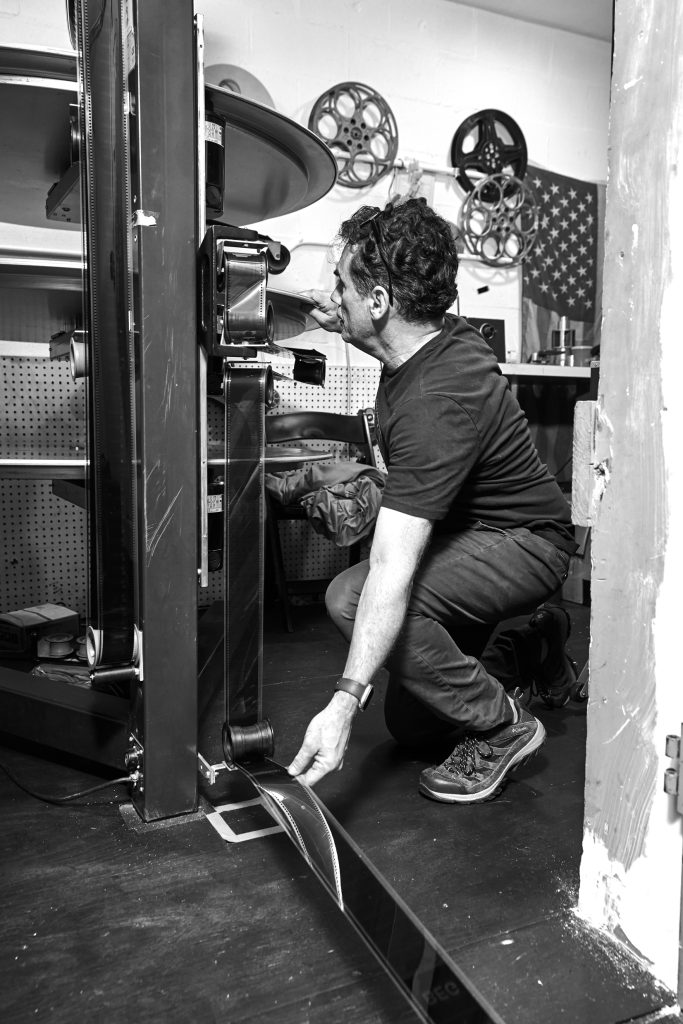
Bottom photo: David Sardenga operating the projector during a screening of Sinners in May
photos by Adrienne Battistella
