Ranging from the “crankwave” scene in the U.K. to the mass success of European bands like Fontaines D.C. and Viagra Boys, as well as Americans like Parquet Courts and Geese, post-punk has seen a surge in popularity over the last decade. The influence of this post-punk trend has not gone unnoticed in New Orleans, with some local bands adopting the style themselves. Coworkers is one of those bands invigorated by the new noise, a local punk and indie all-star group with members from projects like Pudge, Sharks’ Teeth, Pope, and Donovan Wolfington. I met with lead singer-songwriter Jake Silvas in City Park where we talked about shit jobs, class consciousness, Western esotericism, and their debut album Awake In Non-Dreams.
What was the impetus for Coworkers? Did y’all work together?
I had started teaching in California, so there were a number of years where I was just teaching and it gave me some time to think about like, “Alright, I’m just working right now. I’m not doing much creatively.” But I got to think about how I wanted to make music in the future. And so I finally got my chance when I moved back here. Very organically, I met back up with Matt Seferian and Tyler Scurlock, and then brought in Eric [Grimm] and Matt Murray. And we all just started playing together. But to answer your question more directly, it was me wanting to make a post-punk band.
Were you listening to some specific bands at the time or something?
Yeah, I mean, I love Viagra Boys. I was listening to this band Shame a lot. And then from there, Gang of Four, Squid, all that kind of stuff—punk is just so cool. There’s so many things you can do with it. We did hardcore with Pudge and now I want to move on.
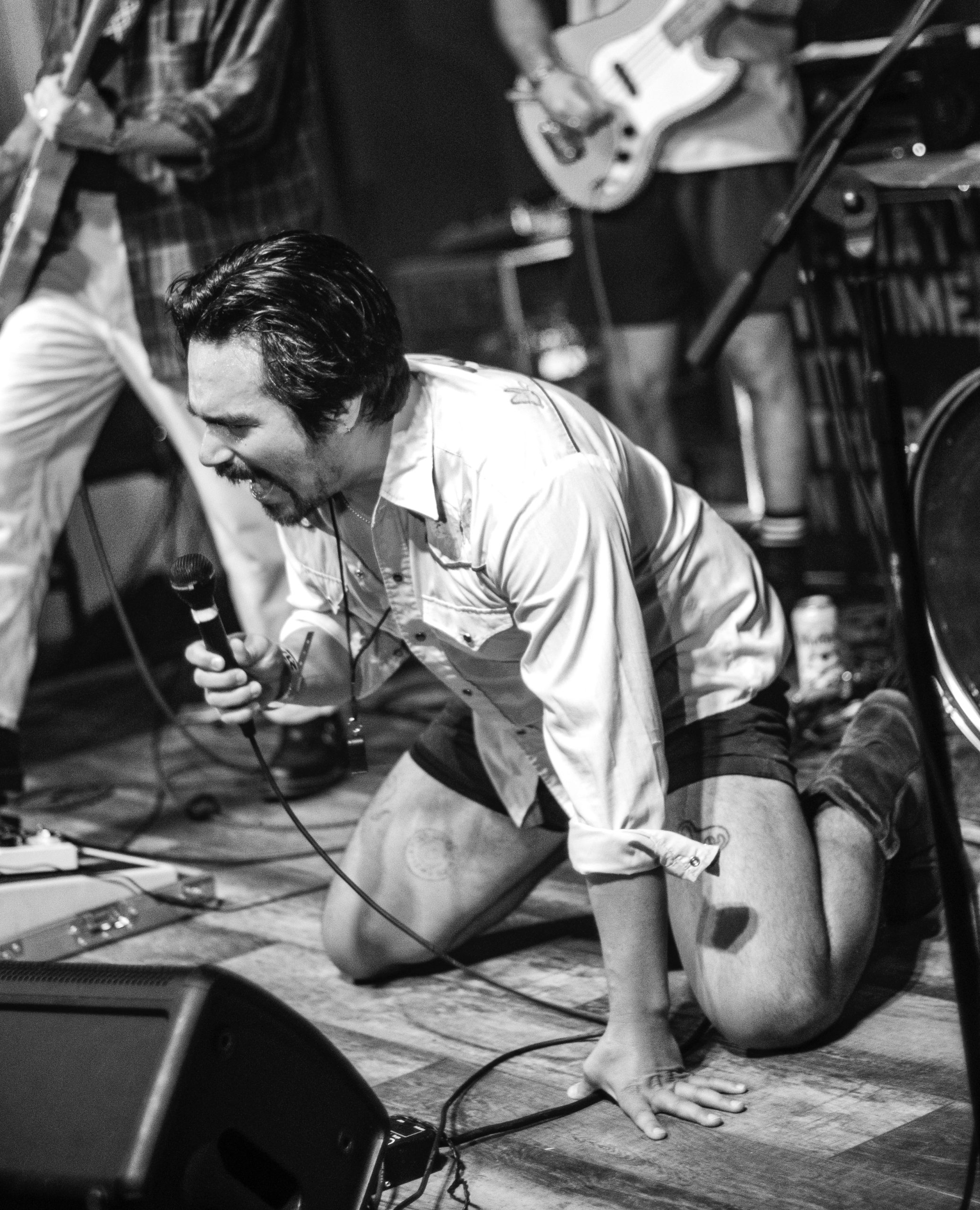
I remember seeing y’all live at a BAD OPERATION show and you had a giant cowboy hat on, looking like Doug Dimmadome and y’all were super energetic. You were on the floor, Tyler was on the floor a little bit. Was that what you envisioned when you were starting the band?
In post-punk, there’s a lot of emphasis on detachment and inhumanity to an extent—like as a commentary on humanity, right? But I don’t know, this sucks right now. Life is pretty shitty. Society’s pretty shitty. And so when I wanted to create this band, I wanted something that was dancey and felt human and alive. And part of that is I feel alive when I’m dancing. And I feel alive when everyone else is feeling it. So if Tyler’s rolling around on the ground, great ’cause I’m gonna be rolling around on the ground. I just want to leave it all out there. I just want to feel. I feel really alive when I’m dancing on a dance floor or dancing in front of a crowd, whatever it is. And I just want people to feel that too. We’re all here, we’re all alive. Let’s celebrate.
Where did the name come from?
That was another one that was years in the making. You know, just like me sitting at my prep table waiting for my next period to start thinking about what I wanted a band to be. I don’t want to think about bosses. I don’t want to think about hierarchies and the people who hold the power in society. I want to think about me and my coworkers. So we are literally working together, co-working in creating this music emphasizing “you” and “me” being the same, all of us working towards something better.
It seems like your lyrics talk a lot about work culture or problems with capitalism. When you were writing this new album were you trying to comment on anything like that?
Yeah, for sure. With a name like Coworkers, there’s a line you have to walk where you can be too on-the-nose, and then on the other side you can get too abstract. And it’s like, “Well, nobody can relate to this and now this actually isn’t dancey and emphasizing community.” It’s just abstraction. Nobody wants just abstraction and nobody wants too on-the-nose. I want to be somewhere in the middle. With “Legwork,” it’s emphasizing this person, this character who’s becoming more productive, becoming a better, a more “productive” member of society.
But it seems like it doesn’t take them anywhere, right?
Yeah, for sure. Do you listen to the Minutemen? There’s a great documentary on YouTube, highly recommend if you get around to it. I think it’s called We Jam Econo, and D. Boon, the lead singer-songwriter and all that, he was very much somebody who was all about making sure that shows were accessible: Free or very cheap shows on weeknights—if they’re on weeknights—no punk time. Like they start when they start and everyone can go to bed at a reasonable time and go back to work the next day. And I can’t think of a better way to energize a populace to get people more socially conscious—to get people more aware of class consciousness—than to try to write songs that address larger issues of hustle culture, capitalism, and hierarchies by taking something that’s relatable… The point is just trying to find inroads for commonalities that we all share that are funny somehow and try to speak to something larger about how we’re all stuck in this grind. This endless cycle of waking up and turning off your brain for several hours while you work, getting home, doing the things you have to do in order to keep yourself alive, and then doing the same thing the next day. And then boom: Your life’s over.
What jobs have you worked in the past? You mentioned you were a teacher, right?
Yeah. I’ve worked pizza delivery, farm delivery, like CSA boxes. I used to work for Hollygrove Farm delivering the produce. I’ve worked as a dishwasher multiple times. Oh my God. I think the worst job I’ve ever had was, I used to work at Audubon Aquarium as a photographer.
Is that the person who takes a picture at the front?
Yes, when you’re at the front with the green screen. So the job posting online was photographer. That’s how they got me in the door and I was so desperate for money, I didn’t realize that’s what would be happening, but yeah. Either I was in the front handing out cards and being like, please stand in front of the green screen while I take this photo. Or I was in the back doing rapid Photoshop edits. It was pretty mindless work, you know? I’ve worked physical labor handyman stuff. I’ve worked a lot of jobs in my life, man.
What made you want to become a teacher?
I was living in L.A. and I was working a dishwashing job. I was desperate to put my English degree to work somehow and found a teaching program. It was like a one-year program that wasn’t TFA that you got to be a teacher by the end. So I moved back up to where I’m from and did it for a year, became a teacher. But yeah, it came out of desperation because I just couldn’t wash dishes anymore. And since then, I have washed dishes again. It always comes back.
With the new album, Awake In Non-Dreams, where did the name for that come from?
Yeah, so I have something for you. I was definitely gonna forget it so I brought this, but this is where I got the title of the album from [William S.] Burroughs [interview] collection called The Job. I can read you the quote if you’d like? It’s like three sentences. It’s from this section, it’s a Q&A, right? And the person asks, “You’ve described America as a nightmare, would you enlarge on this point?” And Burroughs’ response: “America is not so much a nightmare as a non-dream. The American non-dream is precisely a move to wipe the dream out of existence. The dream is a spontaneous happening and therefore dangerous to a control system set up by the non-dreamers.” So, “Awaken the non-dream,” right? Unfortunately, after we decided on the name and all that, I realized Chris Forsyth [Philadelphia-based guitarist], has an album called [Dreaming In] The Non-Dream or something and I figured that out way after. I was like, “Fuck, dude.” It looks like I’m biting Chris Forsyth, but whatever.
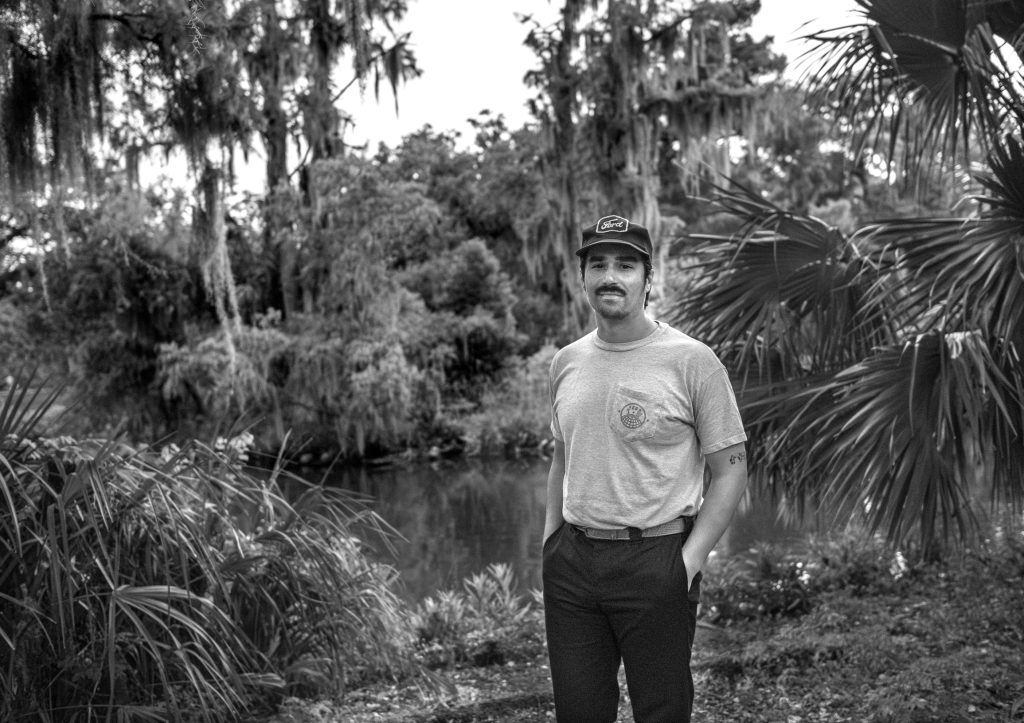
Silvas at City Park
Is that where he got the name for that album also?
I would assume so, yeah. I mean, who else has said non-dream before? But yeah, I was reading that and unfortunately, Burroughs is a misogynist and he veers into unfortunate places but that quote just stuck with me, which was like: America, this system. We are stuck in the endless trudge of capital and white supremacy and the surveillance state that’s all around us. It’s meant to be control. It’s meant to ensure there are no aberrations. There’s nothing wild or different or abnormal. Everything should be heterodox, white supremacy. All those things that we are ensuring are the status quo. That is the non-dream of America.
What led you to be critical of capitalism and drew you to leftist ideas like class consciousness?
I think working service industry instills a certain level of class consciousness in you. It can be latent because there’s a lot of people who are not particularly interested in politics and yet they’re upset, they’re unhappy with their minimum wage or low-wage jobs and they don’t know why. And so for me, I was working a minimum wage job but I didn’t really have a framework for it. It wasn’t until Bernie Sanders in 2016 when I really started to realize, “Oh, this guy is a democratic socialist. Maybe I should look more into what that means?” I mean, Bernie just on the surface was already sort of simpatico with my own politics, but he was the gateway for me to start looking at class consciousness and what it means to actually take these lofty leftist ideals and put them into practice.
You seem like you read a lot. Have you been reading anything lately?
I just finished the biography of Harry Smith. [Anthology of American Folk Music] is this three-volume compilation that this guy Harry Smith made in the ‘50s and bands like the Grateful Dead, Flying Burrito [Brothers] band, Jefferson Airplane, all those like ‘60s, psychedelic rock bands… they all took inspiration from this series of folk records, which kind of recontextualized American folk. Because before that, we had an idea of what WASP-y America as a culture looked like, but when Harry Smith came out with this record of these really obscure tracks all compiled together, it allowed all these folk people to better understand how weird and unique and specific to regions America is and how varied in culture this whole country is.
It’s a big place.
Yeah, it’s huge… but that was one of the many titles he held in his life. He was a painter, an early animator, an experimental filmmaker. He was really incredible and also a mess of a human being. Fascinating book, it’s at the local library if you’re interested.
Back to the band, to clarify, do you play any of the instruments besides doing vocals?
I write the songs.
So you actually write all the parts?
Yeah, I usually demo everything and then I’ll bring the songs to the band. I play things badly and then they, as the people who are good at their instruments, play it better. Like take a riff or whatever I made. And then they say, “Oh yeah, I think we should play it like this.” And so they add to what I’ve written.
How old are all these songs?
We started the band in 2023, so some like “Legwork,” I wrote in 2021 as a one-off song by itself. And then two years later I started this band and we started tracking. It wasn’t until a couple of months ago that we finally finished tracking and mixing and mastering.
How did you record it? Did you do it at home DIY or did you rent a studio?
Tyler is a very generous and beautiful human being, and Tyler allowed us to use his home. So we just leaned into a very DIY lo-fi kind of thing. We used his computer and recording interface and just did it all at his house.
And y’all did all the mixing and mastering yourselves?
Yeah. Matt Seferian has his own studio space. So we mixed at his studio space and then we sent it off to our friend Andy Gross to get it mastered.
It’s cool that Tyler and Matt are well-established in that way and can bring that to the band.
Their contributions, I mean, this band wouldn’t exist without them.
And they both play guitar.
Yeah. When I originally texted Tyler—just as a Hail Mary, like maybe he’ll say yes—I said, “Hey, would you want to join this band? We’re gonna do some stuff.” And he told me later, he almost said no. He was about to text back, “Hey man, sorry. I got a lot of stuff going on.” But then he was like, “Wait a second,” and he checked the area code for the phone number. He thought I was a different Jake. He thought I was some other guy who was trying to get him. So luckily he checked and he was like, “Wait, who is this?” And I said, “It’s Jake Silvas.” And then he was like, “Oh yeah, I’m down. And so that’s how it started.”
I feel bad for the other Jake.
I know! But we had Tyler on synthesizer for a couple practices and then he just switched over to guitar because it just made more sense.
I did notice at the live show there was a sax player. Is he part of the band or was that just for the ska show?
That’s Chris Spies. That would be really funny if we just hired a saxophone player for the ska show, but he is a permanent member. He just currently lives in Mobile. So when he can show up, he can play with us. And when he can’t, he can’t, you know?
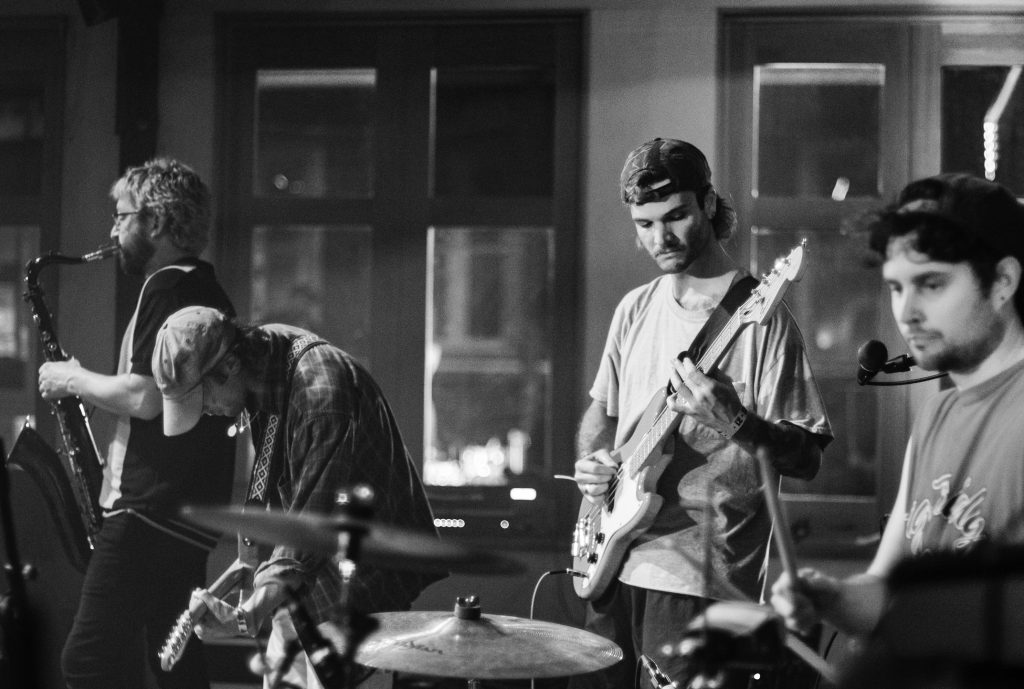
Left to right: Chris Spies, Matt Seferian, Eric Grimm, and Matt Murray, at The Broadside on May 2, 2024
Also on the album, there’s a ton of cowbell on one song and other weird instrumentation going on, especially with the percussion. What’s happening there?
I mean, how many punk songs have you heard with cowbell?
Not many. Post-punk, it feels like a natural place for it. Cow punk, maybe.
Yeah, for sure. So first off, it was the novelty of: This is a punk song with cowbell in it. Or actually, a decent amount of the hits in “Fresh Hell” are—we recorded Matt Murray playing pots and pans, and then affected them to sound closer to cowbells using different tones. So some of them are cowbells and some of them are pots and pans. It was sort of the novelty of having auxiliary percussion in punk songs but also to make things more dancey. Just having things on the offbeats and creating more auxiliary percussion, emphasizing the rhythms and the movement of it.
I notice the music and some of the lyrics have a dream-like or psychedelic quality. Was that intentional? On “Hibernate,” you mention things like “astrally cruising” “leylines,” “frog’s blink.”
I will say, I think we’re a pretty woo-woo band. I’m into magic, esotericism, and the occult. Maybe it doesn’t seem grounded, but it felt grounded for me to put this objectively woo-woo imagery in the song. “Hibernate” itself is a song that, on the surface, sounds like a song about revenge. It’s like, “By tomorrow I’ll be underground repenting for your mistakes.” A lot of the album is not only about trying to create class consciousness, but also on a personal level, going back to Western esotericism, like the internal alchemy, right? How do I further refine this base metal of myself into gold? And so it’s more of a conversation with myself. How do I forgive myself? How do I become a better version of myself? Repenting for your mistakes.
How did that interest in esotericism spark for you? Have you always been into that?
To an extent. In high school, I went on Erowid [Erowid.org] a lot. It’s a website devoted to drug experiences and drug information. So in high school, just like reading descriptions and reading trip experiences, learning about Terence McKenna. He’s an interesting guy from the ‘60s who became a lecturer and talked about DMT a lot, psychedelics, magic and Western esotericism and the sort of Western canon of spirituality, occult stuff. Also learning about Alan Watts, all those things culminating in high school and getting into Buddhism and stuff. And then through college, I didn’t really think about it, but during the pandemic, it got to a point where I was on Twitter and somebody was talking about astral projection. And I was like, that’s interesting. So I DMed them and I asked, “How did you get into this?” And they said, “Look into Chaos Magic. Buy Phil Hine‘s book.” And so I got that book and I started reading about magic and practicing it and just continued to dive and dive and dive in a very casual way up until now.
One last question about the upcoming album—can you tell me a little bit about why you chose the album art and swampy imagery for some of the promo stuff?
I love the swamp. I love living in New Orleans because it feels sometimes like you’re living in a world that is affected by the non-dream, but in some other ways there are very beautiful spontaneous things that can’t be contained, things you just don’t see in other cities, right? And so the swamp is a perfect example of it. We’re living within it, we’re living next to it. I went and ran the other day and I saw a nutria right next to me. Not that there’s not wildlife elsewhere, but if I were to say anything, I’d think it’s just that I love nature and wildlife and the spontaneity that it inspires and embodies.
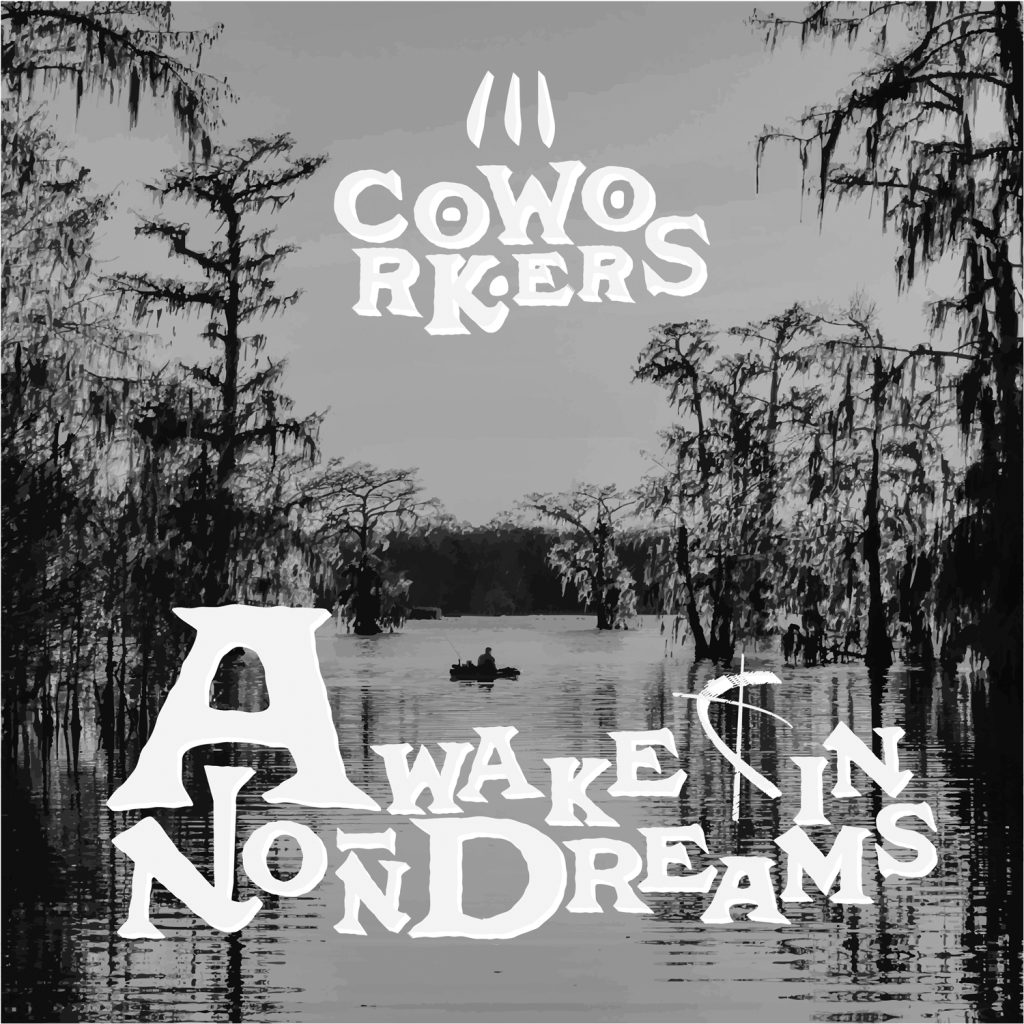
For more info, check out coworkersnola.bandcamp.com and @coworkers_nola on Instagram.
Top photo: Silvas performing with Coworkers at The Broadside on May 2, 2024
All photos by Dalton Spangler
