If you’re a fan of performing arts, you’ve heard of the Edinburgh Festival Fringe, one of the world’s greatest (and largest) performing arts festivals. Every August, performers and creatives of every variety from all corners of the globe descend upon the Scottish city, staging shows at hundreds of venues—“from existing theatres and concert halls to repurposed spaces like bars, parks, buses and shipping containers,” according to their website. For three weeks, famous entertainers and established production companies rub elbows with lesser and unknown up-and-comers to perform live shows that blur genre lines and enthrall audiences. Nothing is off limits, and all the city’s a stage. Other cities across the world have followed suit, exciting audiences regionally through their own Fringe Festivals.
Over a decade ago, New Orleans had its own Fringe Festival: a citywide coalescence of theatrical arts, featuring original acts from creatives and performers of every artistic predilection. Combining New Orleans’ signature je ne sais quoi and a global flair for the dramatic, this theatrical celebration thrived for many years, bringing together audiences and performers in unconventional ways that only Fringe could dream up. It ended in 2014, reorganized into a new format (Faux/Real) under Executive Producer Ben Mintz—but for over a decade, the memory of the original Fringe Festival has persisted.
“For years we’ve been watching the Fringe community create magic in other festivals and spaces,” says Riley Elise, co-producer of the 2026 New Orleans Fringe Festival. “We wanted to bring Fringe back to celebrate that community.” Since 2014, there have been several attempts to revive Fringe, including Faux/Real in 2015 and InFringe in 2017, but this year marks the festival’s long-awaited rebirth. Bringing together “hundreds of avant-garde performers from circus, burlesque, dance, music, spoken word, and more,” according to the website, Fringe will entertain “thousands of audience members over four days.”
“It’s been a lot of dreaming and building,” Elise says. “Personally, I kept hearing people in the theatre community wish for the Fringe back… I wanted to join the project so it could be more than a magical myth I kept hearing about.” That sentiment was echoed by members across the organizing force behind this year’s Fringe Festival rebirth, including (but not limited to) Elise, Grace Batz, J. Roberts, Gia Vaughna, and Monica R. Harris. “New Orleans is such a theatre city, and such a festival city… but there’s no theatre festival?” Batz adds.
Over email and in person, we spoke about how they put the proverbial band back together. About a year ago, co-producers led the charge to bring Fringe back to life. Surveys, community meetings, and planning began in earnest. From there, co-producer Batz signed on to support their vision, then tapped co-producer and grant writer Vaughna to join the revival efforts.
There’s plenty of creative spark in the city these days. Between beloved local theatre companies and the expansive clown, puppet, and burlesque communities, there’s a bit of a theatrical renaissance underway. You can see it everywhere: in theatres, clubs, and on the streets themselves. But it’s expensive to frequent the arts, especially in the traditional sense. With most tickets falling around the $20 to $45 price point, supporting local theatre is no small investment. From the producing artist’s perspective, it’s risky to stage a work without having dedicated financial backing. Ticket pricing is what makes it possible. And obviously, artists, performers, and producers have to be able to afford to live to keep creating. This frustrating economic balancing act is what makes sustaining original art such a challenge. “Like everyone these days, our main challenge has been money,” Roberts says. “Coming back after so long, we’ve been rebuilding our finances from scratch… even with that weighing on us, we’ve had the constant warming support from our community.” What Fringe seeks to do is eliminate barriers between audiences and performers, producers, and venues—a dream that everyone can get behind. “Just because you haven’t had access to a stage doesn’t mean your art isn’t important,” Batz says. So after hosting fundraising events across the city, a grant from the New Orleans Jazz & Heritage Foundation [an ANTIGRAVITY advertiser], and many devoted community efforts to bring the vision to life, the 2026 New Orleans Fringe Festival is slated for November 12 through 15.
This renewed version of Fringe promises to be as unique as the place it was born from. The focus is on showcasing original and authentic productions, “something [we] haven’t seen before,” says Vaughna. But how do you coordinate a festival like Fringe, famously unbound by geography, genre, and convention? With a little advice from Pandora Gastelum of The Mudlark Public Theatre, whose experience putting on The New Orleans Giant Puppet Festival was vital to planning efforts, as well as the support of the rest of the advisory board and participants of the original Fringe.
Selecting the acts themselves also proved challenging, especially when the goal is to blur genre lines, promote artistic cross-pollination, and indulge in experimental play. To that end, this year’s process included a selection panel of nine local artists who evaluated 41 submissions and eventually began whittling down acts using a list of criteria. “It’s interesting to try to fit Fringe artists into a rubric,” Vaughna says. “That was comical of us.”
But putting some guidelines in place ultimately proved helpful: All submissions had to be original, and local and experimental acts (as well as those with completed scripts) were prioritized. “Getting to discover each of the artists and their passion pieces was, in a way, very philosophical,” Roberts says. “It really opened each of our eyes to how we want to reintroduce Fringe to the public.”
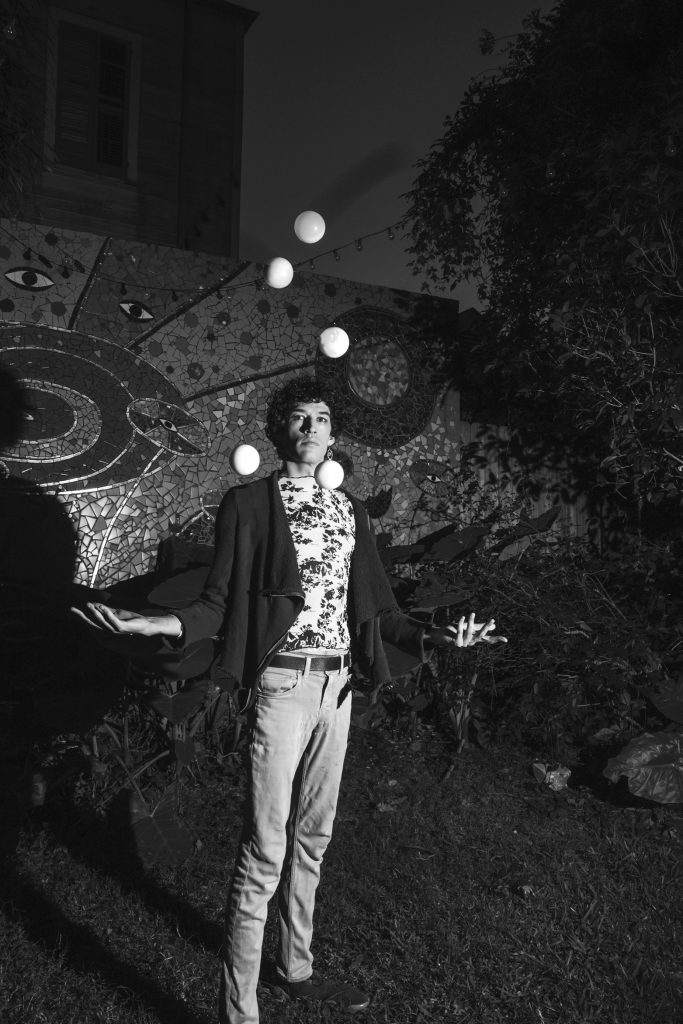
Juggler David Chervony will perform DAM, “a play with water,” at New Marigny Theatre.
Photo by Stephanie Tarrant.
A crucial aspect of Fringe 2026 is highlighting artists of and for New Orleans. “A big part of my selection process was about the person creating the art and their connection to the community,” Batz says. “Who do I see doing good for our community? It’s a group decision, of course, but I want to see those people get paid and have a platform.” The finalized lineup includes seven FMV (Fringe Managed Venue) shows, 35 BYOV (Bring Your Own Venue) shows, 24 venues, and upwards of 13 genres submitted from New Orleans, New York, Appalachia, Portland, Mexico, and beyond.
During the selection process, some of the less developed acts were able to further flesh out their ideas or evolve into new forms entirely. “I plucked some of those experiences for the After Dark show,” Vaughna says. “Pole, drag, burlesque—even puppet burlesque artist Miss Aubrey—acts that aren’t full length, but work together well.” In addition to the adult productions, there are kid-friendly shows like “Goat In The Schools” with Goat in the Road Productions, or “RIPERION: Piano Creatures” by Playdoh Puppet Productions. There will be all-ages programming at New Marigny Theatre, including kids’ karaoke with Rockabye Karaoke, an abbreviated version of “Gumbo Cypher” with a raffle for a class with Artivism Dance Theatre, and family yoga with Clown Yoga Nola. The fest also includes a vendor market, health screenings, sober and ADA-friendly venues, even acts that share food with audiences, feeding more than their hunger for the arts. Some shows, such as “Conditional Love” by Jakki Kalogridis, “SHEEP” by Joey Z, and “The Bacchae” by queer influencer and writer Quinn Bishop feature a bespoke pre- or post-show experience.
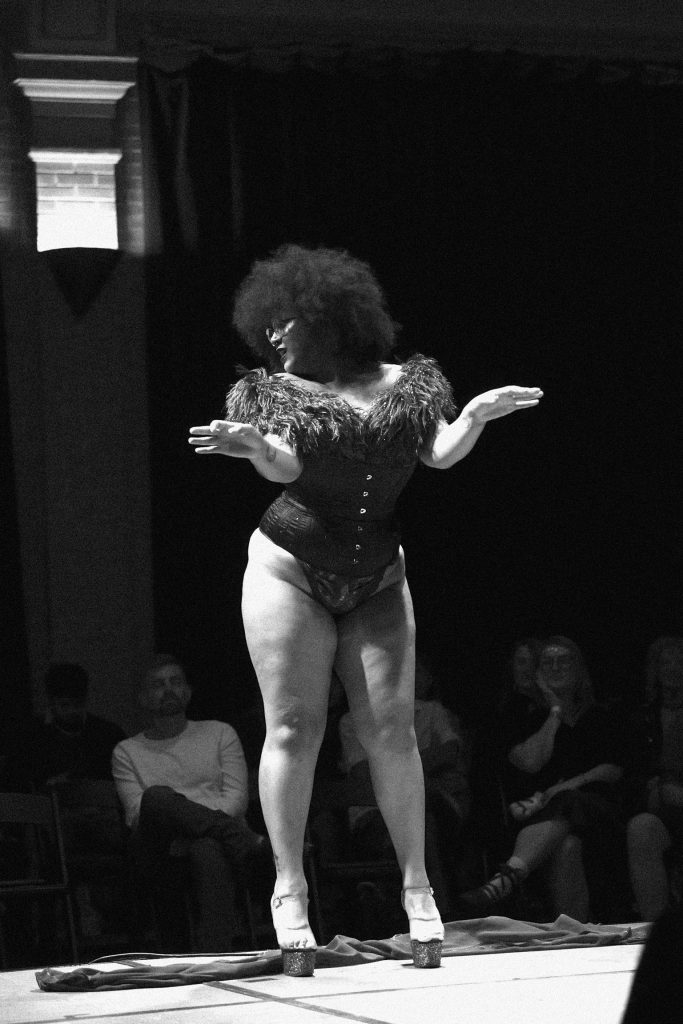
Trombone Squirty performs at Mini Fringe at the New Marigny Theatre
Photo: Peter Phillips / MADBOMB MEDIA
One of the main evolutions of Fringe 2026 from previous iterations is the intentional accessibility. “The old slogan was ‘Fearless audiences, fearless theatre,’” says Elise. “Our board president, Monica Harris, suggested ‘Theatre for all,’ and that fits us better. We now have a lot of language and ways to accommodate people who are differently abled, neurodivergent, immunocompromised, sober, etc. If everyone leaves riding the high of original, experimental art and community and feeling safe, we’ll have done our job right.”
Beyond the three Fringe Managed Venues (The New Marigny Theatre, Siberia, and AllWays Lounge), there’s the “Bring Your Own Venue” (BYOV) program, which allows artists to stage shows in their own unique setting in the city and be included in the Fringe program and map. The potential for unconventional BYOV locations is endless—some of this year’s locations include ArtEgg Studios, McDonogh 35, The End of The World, and Peaches Records.
“Most shows start at odd hours, so there’s an hour between shows to either venue hop, grab food, or dance with your friends in the street,” says Elise. Some acts, like “Life with Yia Yia” by George Trahanis, are full analog—door sales and cash only. Generally, BYOVs will follow the same $10 to $20 sliding scale as FMVs, and most uphold NOTAFLOF (No One Turned Away For Lack of Funds) or Pay-What-You-Can policy.
My approach? Nail down your must-sees and map out your day hopping to venues across the city. “I imagine it like a girls’ night out where you and your friends take a bus, streetcar, or rideshare all over the city to hit all the shows on your list, like a scavenger hunt,” Roberts says. I can attest that the unique BYOV venues are what really Fringes up the city and make it feel different than any other parade or theatre performance. Every time you pass the random building where you saw that one weird show, you’ll recall that spark. Years later, long after the details of the show have faded from memory, that’s what you’ll remember.
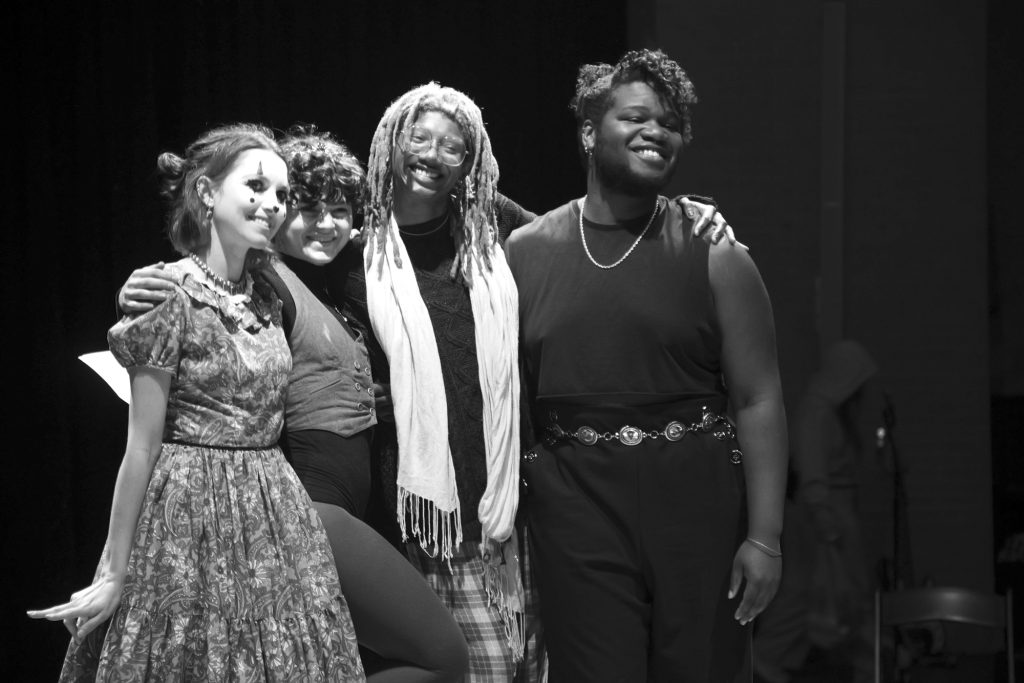
Left to Right: Grace Batz, Riley Elise, J. Roberts, and Rayshaughn Armant at “Mini Fringe” at New Marigny Theatre, December 2025
Photo: Peter Phillips / MADBOMB MEDIA
Some shows outlast Fringe, but others you can only catch during the November weekend. There’s no wrong way to Fringe, but know what you want to get out of your festival experience. And if you can’t make it this year, don’t despair. This time, Fringe Festival isn’t planning on going anywhere. “We still have so many more people in the community we want involved in shaping Fringe, and we hope this first fest back attracts them,” Elise says.
“Everyone always says, ‘Remember when Fringe…?’” Vaughna says, and that’s not at all hard to believe. I find myself repeating that sentiment often these days—about the restaurants, venues, hidden gems, neighborhood landmarks past. After a frustrating summer of NDAs, data centers, spaceports, and yet another heartbreaking wave of “Ain’t dere no more,” so much of what makes our city unique is at risk of disappearing forever. So when a legend like Fringe Festival triumphantly returns, transmuting the city itself into art for the people, by the people, it’s something special. “Lately I’ve been kept afloat by our collective art and power of community in these rising tides of the world,” Elise says. “This Fringe will give us a chance to celebrate that and keep coming together.”
The 2026 New Orleans Fringe Festival will take place November 12 to 15. For more info, check out nolafringe.org and @fringefestneworleans on Instagram.
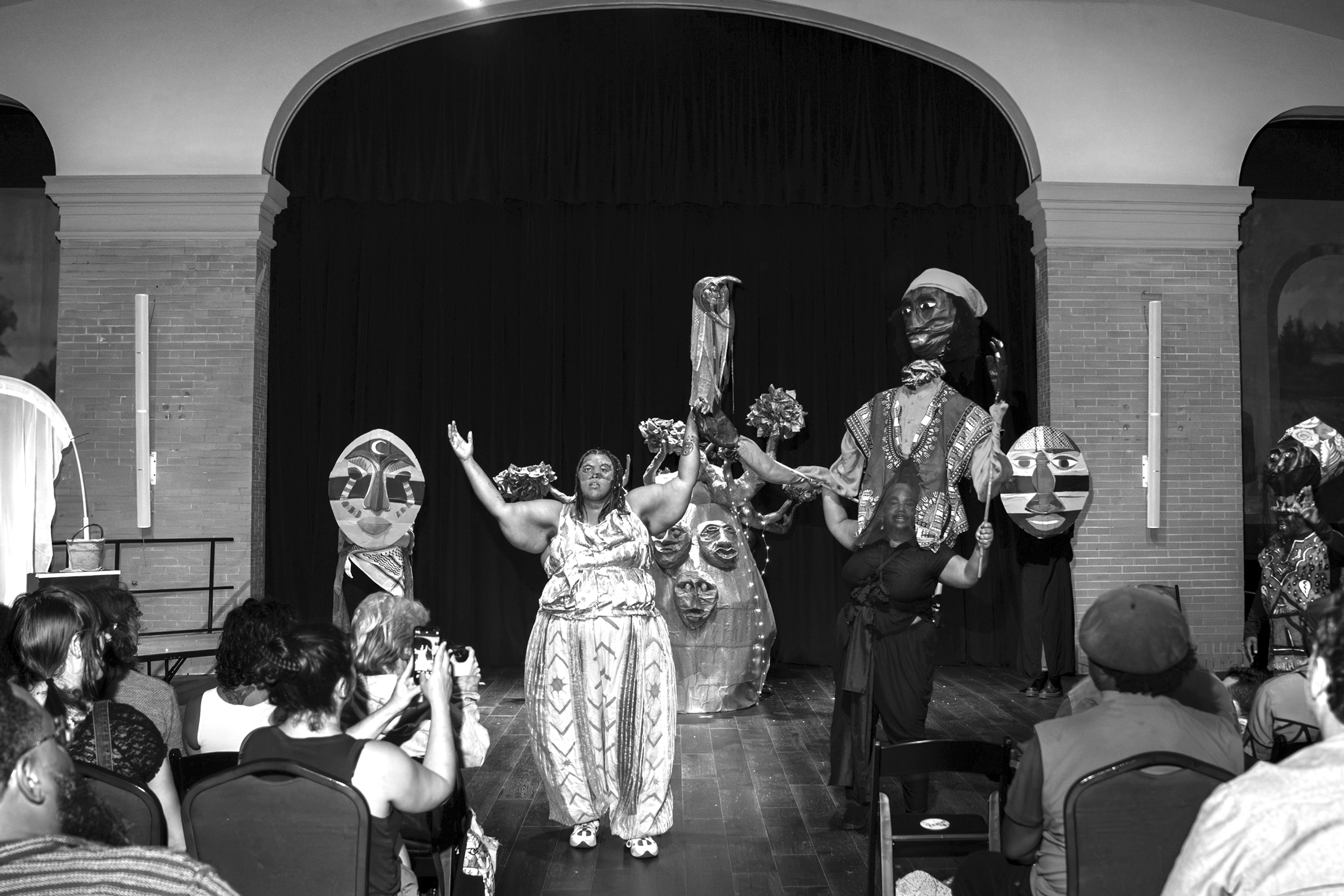
Top photo by Stephanie Tarrant:Butter Woman, “a decolonial, life-sized puppet performance reimagining an African folktale” by Tuere T. S. Ganges and Samille Ganges, to be performed at New Marigny Theatre.
