
“In 2022 / Yeah we’ve got cellular / Yeah, we’ve got driving cars / They move like cartoon vampires,” Nick Corson sings on “2022,” a late-album cut from The Convenience’s second LP, Like Cartoon Vampires. Cue the detuned violins. On the forthcoming record (due out April 18 via Winspear), Corson and the duo’s other half, Duncan Troast, veer hard left from the polished funk-pop fusion of their 2021 debut album, Accelerator, which hewed closely to the feel-good ‘80s vibes they help curate as live members of Video Age. Stripping away the smooth synths and lush arrangements that characterize their early projects, they turned to guitar music, which led them instinctively to Cartoon Vampires’ unsanded post-punk pieces. The spontaneity of these sessions threads its way through the record’s grooves: from its tightly wound opener, “I Got Exactly What I Wanted,” through apocalyptic anthems like “2022” and “Western Pepsi Cola Town,” to its closing track, “Fake The Feeling,” which climaxes with seven minutes of bludgeoning, cathartic drone. In March, Troast and Corson called in from a sunny park in Philly where they’d been enjoying some downtime before a Video Age soundcheck. A nearby little league baseball practice completed the tableau, an oddly idyllic setting for a discussion of an album steeped in millennial ennui.
I know y’all met at Loyola. Are either of you from New Orleans?
Nick Corson: No. I’m from San Francisco and Duncan’s from Jersey.
Tell me about your integration into the very close-knit New Orleans indie rock community.
Duncan Troast: I was always admiring bands like Donovan Wolfington and Pope and Lawn and Nick’s old band Grotto Girl in college, but that was before we really became musical buds.
NC: When I was a freshman or sophomore, I became obsessed with that whole scene. I remember seeing Rui [de Magalhães] from Lawn’s first band called Yo Tambien at a house show, and I thought it was the coolest thing ever. I slowly started meeting people like Matt [Seferian] from Pope, who’d play me records at his house. I got tight with them and started playing in a bunch of different bands.
DT: I joined Fishplate, and then Nick joined too. That’s how we met.
NC: In those days, it was mostly like Circle Bar shows, Saturn Bar shows, and house shows—places like Heaven’s Gate, which was Mac [Folger]’s house. There were so many great punk shows there. That was such an important time for me.
You put out your first EP in 2018, so you’ve been around for a bit. Those early tracks felt really Beatles-indebted. And then the next few releases, up through Accelerator, are in the same ‘80s-pop wheelhouse that Video Age occupies.
NC: When we first started, it was pretty casual.
DT: We were just meeting up at the Video Age practice space. Nick would come with a song fully written, and we’d arrange and record it right then and there.
NC: It was an experiment in back-to-basics recording. We’d been in so many bands and were kind of exhausted with how things would just fizzle out. It was so frustrating dealing with four different personalities. So there wasn’t a vision for The Convenience, just, “Let’s meet up and try some stuff.”
Is that why you called it The Convenience—because it was easy?
NC: It was actually difficult because we didn’t really know how to do it, or what exactly to do. I made a list of so many names, and [The Convenience] was the least offensive to our aesthetic taste, so it was the one that stuck.
DT: [When we were making Accelerator], I became deeply, deeply obsessed with Prince, geeking over unreleased, lo-fi demos I’d find on YouTube before they’d get taken down.
NC: [That album] was a love letter to Prince and that era of music. We were touring a lot with Video Age at the time and being exposed to different stuff [from that time period] and getting inspired by it. The arc of the band is kind of confusing, but because we didn’t start out with strict rules, we felt like we could do whatever we wanted.
DT: We were just making stuff when we had the chance, which was once a week at best.
NC: And we had no plans to release it. We’d finished it and were like, “I guess we’ll just put it on the internet or something.” And then we put one song out, and Jared [Jones] from Winspear—which is the same label that puts out Video Age’s stuff—was like, “Wait, is there a record of this?”
Starting in 2024 with “Routiner,” you turned a corner into the skronky post-punk sound you’re working with now. Tell me about that transition.
DT: A lot of time passed, and I was rediscovering some stuff that I’ve always loved, and Nick was putting me onto a lot of noisier, louder bands like The Fall that I’d never really gotten into. That was another deep well, like with Prince, where there was so much music to geek out on.
NC: [During] the pandemic, I had so much time. It brought me back to my roots in punk, and I fell back in love with the energy of that music, and playing guitar in general. We were both feeling like it was important to make something with little thought, to go from instinct this time.
DT: With Accelerator, we were pulling from the rule book of pop. For this one, we said, “Let’s start over and have fun with guitars.” I play a little guitar, but I don’t think I’m very good at all, so that was super fun.
NC: I think he’s amazing, and he plays guitar on every song [on Like Cartoon Vampires]. We’d just meet up and play guitar together, and that’s how the songs happened. There wasn’t as much planning or conceptualizing or world building. It was very immediate, direct. That felt like the most exciting, honest thing to do.
Nick, tell me about falling back in love with the guitar; Duncan, tell me about rediscovering it.
NC: I’ve just been playing for so long that I go through phases where it’s not the most exciting. I was feeling burnt on it, and I started playing bass in Video Age, which had me thinking about music in a different way. But [during the COVID lockdown], there was nothing to do except sit around and play guitar, and it was so fun. If I actually think about the things that are dearest to my heart, I’m such a rock‘n’roll guy. It turned me on when I was 12, the energy and spirit of it, and that’s shaped my whole life. So I was like, “That’s the energy I need to get through this thing.”
DT: I’ve always loved guitar music. If we go back to being a kid, it was classic rock on [New York radio station] Q104.3 all day. Eventually, I found Elliott Smith and Big Star, and then, in the last couple years, the crossover of post-punk bands doing weirdo funk-disco stuff, like the no wave scene where it’s completely atonal. I was seeking that extreme of Arto Lindsay smashing on the guitar with no notes at all, so [Nick and I] would get together and do stuff like that. Nick was also showing me Captain Beefheart, and my friend Zach [Villere] showed me James Blood Ulmer, who had all these crazy tunings—he’d [make every string] an E, or it’d be two notes across the whole fretboard. Coming from a trained background on piano but not being very good on guitar, I was trying my best to go full Beefheart or Ulmer and record it on a tape machine. It felt very fresh.
NC: Duncan is such an amazing keyboard player, but he was talking for a long time about being jealous of the physicality of the guitar, of being able to stand and lean into something and really whack it in a way you can’t with a piano.
DT: Especially a digital Nord.
Tell me more about the Cartoon Vampires sessions. How did they differ from sessions past?
NC: We just got together and played. We’d be in the practice space, turned up loud, either both playing guitars or one of us on drums, and we’d voice memo those jams. Most of the time, we’d come up with something right on the spot and be like, “That’s the song; let’s do it,” and immediately set up tracking. Or we’d take it home and find the part that was interesting and turn it into a more structured thing. The other thing we did sometimes was hook up our recording rig in the practice space and start something without knowing what it was, and then later chop it up and stitch it together as a song. There was way more improvisation, and it was much faster than anything we’d done before.
DT: We were like, “What if we just finished a song? We could get lazy and be in here for a while messing around, but what [if we] just mustered up the energy to finish it?”
NC: It was important to not let things hang and become question marks because that kills me, emotionally. I don’t want to go back to stuff. I’ll edit lyrics, but I think the best stuff happens really fast, with the least amount of questioning what you’re doing.
DT: We wanted to limit our options, be light on effects, and get to that finish line.
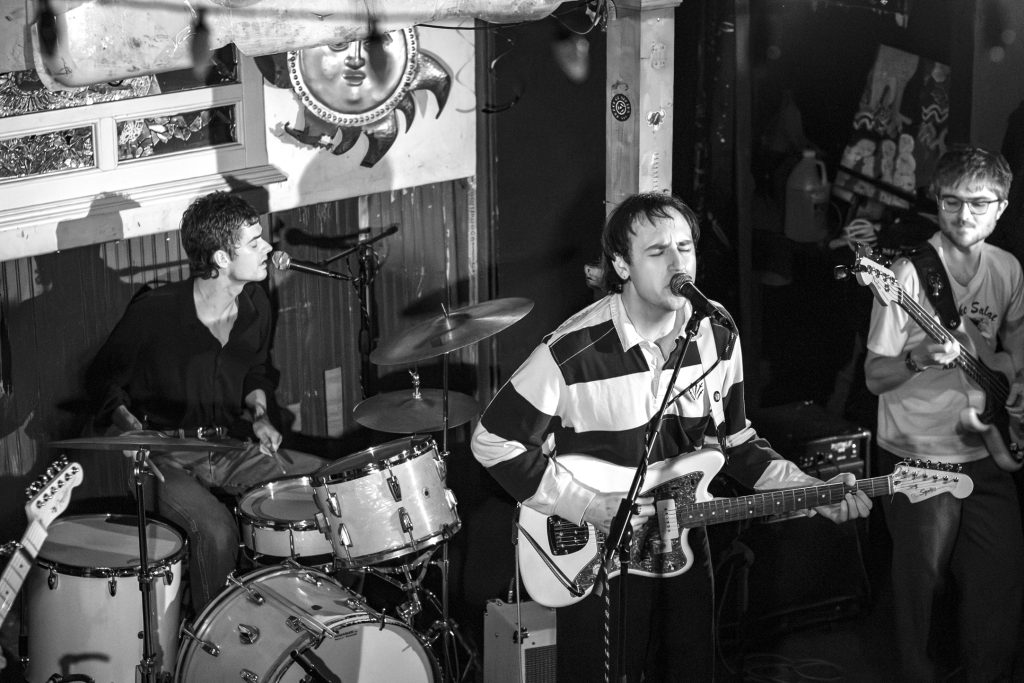
At the Saturn Bar on February 26 (with Alex Szotak on bass)
What was the lyric writing process like? It must’ve been at least a little separate from the jams.
NC: Sometimes words would happen. Sometimes I’d set up a mic and free associate, and a lot of times, those words ended up in the songs. Sometimes we’d have a full instrumental demo where I was just mumbling, and then I’d go through and phonetically pick out the words and try to stitch something together that way. Sometimes I’d have something separate written. I’d started free-writing a lot, so sometimes I’d pull from my notebook.
But the songs were never completely written before the sessions.
NC: Almost never. There were maybe two songs where the lyrics were written before we recorded, but they were written in a similar way [to that] of free-associating on the guitar.
Let’s talk about the album itself: First off, who are your favorite cartoon vampires?
NC: Oh, gosh. Count Chocula probably… a brand ambassador.
DT: I dunno. Who else is there?
NC: Well, there’s The Count. He’s actually my favorite. He’s educational.
So no deep cuts.
NC: No. I could’ve thought about that.
Yeah, come to your next interview with a few in mind.
NC: [The cartoon vampire] was an image I thought of when I was at home in San Francisco visiting my parents. There were so many driverless cars, and there was something so unsettling about the way they moved among normal traffic—undead, floating, like cartoon vampires. I was thinking about the stupid evil of automation. It’s kind of goofy looking, and it doesn’t always work quite right.
DT: I mean, good for them—the smartest people ever who develop this stuff. But then people like us see it, and we’re dying laughing because it looks hilarious.
NC: It has awful consequences, but it’s also stupid, you know?
There’s a lot of dystopian imagery like that on this album. Other than Waymos, what was weighing on you most when you were writing these postmodern, impressionist tracks alluding to the banality of late capitalism?
NC: I wasn’t even trying; it’s just so overwhelming. If you’re looking at your phone every day, it’s bombarding you, all this stuff. I wrote “Western Pepsi Cola Town” after I read an article about developers in, I think, Nigeria building these huge skyscrapers that just sit empty while the general population suffers right next door. It’s bizarre, the way capital sustains itself to no visionary end. It operates in a sphere that has nothing to do with daily life, except creating awful power structures. It’s the same as the driverless car: It’s its own intelligence, operating outside of person-to-person contact.
DT: It’s all about growth. You’d think they’d just stop at a certain point, but they’ve gotta keep going until it’s just a gridlock of driverless cars.
The songs that bookend the record are my favorites. The opener, “I Got Exactly What I Wanted,” feels like a bridge from your Accelerator aesthetic to your current one. It’s tight and catchy, but it’s got a post-punk edge that sets the tone for the rest of the record.
NC: I think that’s just how my brain works: I can’t help but kind of want things to work like a pop song. There’s something so powerful and elemental about the verse-chorus structure that I don’t think you need to switch it up too much, just tweak it a little.
DT: We would send each other [reference] tracks, and for that one, I think I sent [Nick] a tune that had a weird time signature, or a weird measure, as a challenge. So yeah, that song has a pretty straightforward structure, but there are some minor tweaks that get me really excited.
NC: To counter that, the song was written in about two seconds. I had the phrase, so it was a [matter] of fitting it into an odd length of time. That’s just to say, it’s not conscious, but I think we can’t escape “pop,” whatever that means.
Cartoon Vampires’ closer, “Fake The Feeling,” ends with a seven-minute jam. What about the content of the song made you decide it should germinate into this epic improv piece?
NC: The song was a reaction to the [Dutch psychological thriller] Spoorloos, or The Vanishing.
DT: A young married couple is traveling through Europe, and the whole time, you kind of know something sinister is gonna happen. You’re seeing both sides of it—from the couple and from this other guy—and it’s so dry, so real.
NC: It makes you soul-sick in the way that scary movies do sometimes. The song was based on some images from the movie, and the ending was a cathartic way of dealing with that feeling. It was such a physical release, playing so free, fulfilling all the free-improv noise stuff we flirt with on the record.
DT: It was a slightly elevated, controlled version of pure, thrashing harsh noise.
NC: Which is what I love about noise music: It can be dark and crushing, but it can also be ecstatic and joyful the way great free jazz is.
I like the way it spirals from more traditional rock improv into that thrashing drone and then ends on another left turn with what sounds like a tune from a music box.
DT: That was a prepared piano. I make a lot of piano music, and I was looking up what [Fluxus artists like] John Cage did. They’d put a screw in one string and a piece of tape on another, and it would do the most amazing things. You put one little piece of metal between the strings, and the harmonics completely change. It sounds like a fucked up bell.
NC: It felt like a perfect ending. If we’d just ended on a final feedback note, it would’ve been a bit much, but having something that sweeps you out of it at the end wraps things up nicely and maybe takes you back to the beginning.
Like Cartoon Vampires is due out April 18 via Winspear. Its release show is set for May 2 at No Dice. For more info, check out the convenience.bandcamp.com.
Top photo: Left to right: Corson, Troast
photos by Dalton Spangler
