
We’ve all experienced it: a sea of upturned faces packed along St. Charles Avenue, thousands of arms outstretched against a backdrop of ancient live oaks and glittering floats. Between the masked riders above and the longing hands below, a dense volley of throws hangs suspended in the air. As the riders taunt the crowd with these apparent treasures glimmering against the sky, it’s easy to forget about what’s left behind when the floats pass.
In the fleeting adrenaline rush of the catch, nearly every object seems like a prize. Disposable throws, however, are actually the centerpiece of an often-overlooked facet of the local economy—one that’s found itself in the crosshairs of environmental and budgetary challenges influenced by unpredictable changes in national trade policies.
In preparation for this year’s Carnival, local revelers and business owners have been grappling with the economic uncertainty stemming from President Trump’s erratic tariff implementation in 2025. Within weeks of his inauguration, the president imposed tariffs on the three largest U.S. trading partners—China, Mexico, and Canada—and followed up with a series of trade policy changes broadly impacting foreign imports to the country. The tariffs contributed to inflation, impacting the daily lives of individual consumers and businesses and undermining domestic manufacturing by driving up the cost of a wide array of goods and materials. The City’s current budget crisis, including a $222 million budget deficit inherited by Mayor Moreno, compounds unpredictability around how this year’s Carnival season will impact New Orleans’ quality of life and economy. While reduced consumption necessitated by these economic challenges might seem to lead the city toward more sustainable practices—reduced reliance on disposable imported throws, less garbage, and responsible stewardship of tax resources—local experts don’t bet on it.
Brett Davis, Grounds Krewe founding director, is among the skeptics. A local nonprofit, Grounds Krewe [an ANTIGRAVITY advertiser] has been implementing programs to reduce Carnival waste by increasing the availability of sustainably-produced throws that support the local economy and offering recycling on the parade route. In addition to their sustainable throw catalog that gives krewes the option to purchase packages featuring eco-friendly parade throws, the organization has initiatives to recycle beads, bottles, and cans at parades and offers waste prevention and recycling services for festivals and events. When asked whether he’s observed a shift away from imports towards more sustainable throw options as a direct result of tariff changes, Davis replied, “I don’t think it’s changing anyone’s minds on whether or not sustainable throws are a good idea.” Instead, he explains, tariffs reduce the gap between the cost of sustainable throws and cheap imported ones, but the profitability of imports is something that Carnival krewes have come to depend on. Davis describes a climate in which New Orleans’ bead habit, and comparatively modest interest in sustainability, is motivated by a for-profit business model that externalizes its environmental cost onto taxpayers and foreign producers of imported throws. With limited options for income, parades are mostly funded by the markup on imports that are sold to krewe members.
Throw packages are marked up from their import price to provide revenue to both the supplier and the krewe. This money is essential to the parades, which generate no revenue from attendees and are restricted by a City policy that makes securing alternative parade funding difficult. The City of New Orleans’ Municipal Code includes an ordinance (Sec. 34-7.) that prohibits commercial advertising during parades. Without sponsorship or ticketing revenue, the parade krewes rely on membership support and fundraising to operate. Where membership dues and fundraisers fall short of generating the money necessary to support these sometimes massive operations, revenue from the markup on imported throws that are sold to krewe members helps to make up the difference.
“Riders pay a membership fee (dues) and then they have a package you can buy for beads, and I’m sure the organization makes money off of that. They also sell t-shirts, coffee mugs, and sweatshirts to riders, and have a few events for krewe members each season,” Julie Ann Connick, a long-time member of Iris—a parade offering some sustainable options—explains. Annual membership dues for large krewes range from several hundred to several thousand dollars (approximately $1,200 for Iris in 2026), with the cost of beads and other throws potentially doubling that expense. And while riders may have the option of purchasing the beads outside of the package approved by the krewes, beads purchased through krewe packages are pre-loaded onto floats for riders, and those purchased independently must be loaded by the riders themselves. In 2026, Iris has over 3,600 riders and a waitlist to join, making it one of the largest parading organizations in New Orleans.

Reddit posts from the New Orleans community page during Carnival 2025 include numerous threads about the aftermath of parades: garbage in the streets and the problem of disposing of hoards of novelty throws that cease being useful as quickly as the adrenaline rush from catching them fades. Reddit posters lament about Carnival debris that plugs storm drains, accounts for millions of pounds of (often toxic) landfill waste, and results in millions of dollars in tax-funded annual sanitation costs.
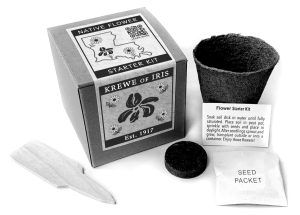
Davis has seen a growing demand for the work of Grounds Krewe among some of the larger parade krewes, which he attributes to the organization’s community engagement and its focus on providing high-quality throws that are sourced to support the state’s economy. While he is confident in the public’s interest in Grounds Krewe’s offerings—such as biodegradable glitter packets, local jambalaya mix, and soap from Port Allen—he sees the comparatively limited profitability of these throws as a barrier to their widespread use.
“The most challenging aspect is that a lot of these krewes, even though they might want to fully cut down on imported disposable plastic offerings and go sustainable, are financially reliant on the economics of importing, branding, packaging, and selling these really cheap items in high quantities.”
Side by side, the unit cost of many of Grounds Krewe’s sustainable throws is higher than that of certain imported items. According to Julie Ann Connick, Iris’ customized float beads for 2026 will be imported through a local Mardi Gras supply business for a quoted price of approximately $1.34 per unit. In comparison, a beignet mix throw from Grounds Krewe starts at $1.72 per unit with an additional cost for customization. The most significant difference lies in the products’ potential for markup.
In the example of imported float beads, the price charged to krewe members already includes markups to pay the local supply company, the parade krewe for operations costs, and in some cases, direct payments to members of krewe leadership. Grounds Krewe isn’t competitive in this profit model, even with volunteer labor and grant funding subsidizing their products.
While there are several factors impeding the widespread adoption of sustainable throwing, the difference in krewe profit between locally-sourced and imported throws is the most consequential. According to Davis, much of the public—including most parade riders—seems to have no idea that this is the case.

The question remains: How have tariffs affected these economics, and what does it mean for Carnival 2026? The answer is still being determined.
Connick, the 35-year Iris veteran, provided float bead price comparisons for the last four years to demonstrate that, as of now, quoted bead prices for 2026 are on par with what Iris paid in 2023. At the bottom of the invoice, however, is a disclaimer that the prices could change based on tariff rates at the time of import. She is uncertain about how major changes in rates might impact the cost to krewe members, and how the parade will handle unexpected price increases when the throws, usually ordered almost a year in advance, are delivered in the weeks before the parade.
In 2025, throw orders that would have been placed in April were delayed several months when a series of rapid reciprocal tariffs on China peaked at a whopping 145%. Dan Kelly, owner of Mardi Gras supply company Beads by the Dozen and Krewe Captain of the superkrewe Endymion, corroborated that the initial flurry of tariff activity delayed throw orders which would normally be placed in the spring and created unanticipated financial burdens on his business.
“It has been a hardship because we had to come up with that money. And we’re not getting any revenue to compensate for the 30% extra that we put out until we’re able to sell,” Kelly explains about retail imports from China, tariffed at the current rate, which accounts for an upfront cost to his business of approximately $18,000 per container of goods.
As for parade orders from Beads by the Dozen, Kelly said that initial ordering delays that occurred when the tariffs reached their high last spring temporarily halted his business and created challenges for overseas manufacturers who count on exports to New Orleans. Despite the current uncertainty, Kelly remains optimistic that krewes will continue to buy throws at the present volume—which amounts to over 125 containers to his business from China and India annually—at least for a while.
“All of our krewes are selling all of their products and they’ve asked us to get more… Now, if this carries on for another year or two, it may very well affect everybody’s business.”
With tariffs, at least immediately, being an insufficient force to reduce the city’s consumption of imported throws, Carnival 2026 is unlikely to usher in a new era of sustainability for revelers in New Orleans. And while significant profit is generated by krewe members throwin’ till it hurts—as the Endymion slogan goes—almost none of that revenue is passed on to the City, which is responsible for the cleanup after most of the large parades.
The City of New Orleans pays for the majority of sanitation costs only for krewes that parade two Fridays before Mardi Gras through Fat Tuesday, dubbed the “legislative parade season” by Councilmember JP Morrell. These costs can account for tens of thousands of dollars per event, yet permitting expenses paid to the City remain relatively low—less than $2,000 per parade, in most cases. Parades that fall outside of this window, many of which are walking parades with handmade throws that produce little waste, are generally responsible for funding their own sanitation.
The new mayoral administration answered the City’s financial crisis with a 2026-approved budget that pauses City support for many services, including grants to organizations like Grounds Krewe, which was previously promised increased municipal support for its parade recycling initiative, “Recycle Dat!” Funding that was approved in early 2025 through the Mayor’s Office of Resilience and Sustainability (ORS)—which focuses on environmental stewardship and climate resilience—was canceled during budget revisions later that year. In January, ORS faced a significant staffing reduction, with nearly half of their staff laid off with less than a week’s notice as part of a wave of City Hall personnel cuts under then-Mayor-Elect Moreno’s spending plan.
Meanwhile, despite the local budget emergency and tariffs impacting the national economy, large krewes will continue to generate revenue from the import of post-industrial plastic throws, delivered from the streets to the landfill at the taxpayer’s expense.
Given this financial discrepancy, Davis hopes that the City will review its current permitting practices and the degree of responsibility that is placed on krewes for dealing with the waste generated by their throws. He remembers a time when throws were fewer, of higher quality, and more highly prized, and is hopeful that growing public interest in sustainability will create a new mechanism for parade funding that discourages an excess of cheap imports.
“We’re basically trying to shift the economics of Mardi Gras that has accidentally backed itself into being reliant on [revenue from throws] towards something that is different. But we’re never gonna have ticket sales to Mardi Gras or sponsors that can provide better options. So we have to figure it out, and it’s a very tough thing to do.”
The best Mardi Gras traditions are built on community and sharing, not industrial supply chains. The current economics, only made more volatile by global tariffs, have cornered large krewes into measuring their success by container volume rather than by the quality or meaning of each throw. The path forward is not about finding cheaper imports, but rather restoring the true value of the catch. This might depend on behavior shifts at every level—from parade revelers demanding more sustainable options, to responsiveness from the krewes, to City policy that encourages less waste by making the amount of garbage produced by a parade commensurate with the amount of sanitation costs it is responsible for. Given the tremendous presence of high-capacity corporations in this region, perhaps a review of the municipal code barring commercial activity at parades could provide for novel mechanisms for sponsorship and funder recognition without compromising parade aesthetics. This could create opportunities to financially engage businesses that generate immense wealth through their local presence in the preservation of New Orleans’ unique cultural heritage. By aligning parade funding with sustainable, locally-sourced goods, New Orleans can move away from the current wasteful cycle and reclaim a Carnival where every throw is a treasure, not just a trinket waiting for the landfill.

Top photo: Adrienne Battistella
Other photos: Grounds Krewe “sustainable throw package” options for the Krewe of Iris, including a jambalaya mix throw, bamboo toothbrush set, and native flower starter kit. Courtesy GroundsKrewe.org.
illustration by Maegen Guidroz
