
Mary Beth Campbell is a trained public health professional, but this feature is not a substitute for advice or care provided by a licensed medical or health care professional. All information provided is current at the time of publication, but new information may arise.
In late January, a measles outbreak was identified in West Texas; at the time of this publication, there have been over 300 known cases identified in Texas and neighboring New Mexico and Oklahoma, most of which are people who are unvaccinated. There has also been one child fatality, the first measles-related death in the United States in a decade. This outbreak, and this tragedy, arises alongside the dismantling of public health, science, education, and social infrastructure by the Trump Administration and the confirmation of noted anti-vaccine advocate and purveyor of misinformation Robert F. Kennedy Jr. as Secretary of the U.S Department of Health and Human Services (HHS). As with so many things, the measles outbreak is not just about measles: It is a result of decades of misinformation, weakening of systems, and corruption, and a reminder of what we need to do to keep our communities safe.
Measles, also known as rubeola, is caused by the measles virus (MV) and transmitted via the respiratory system (direct contact or via aerosol). Infectious droplets can remain in the air for about an hour and can also survive and spread on surfaces for several hours. A person can also become infected with MV by touching their eyes, mouth, or nose after coming into contact with an infected surface. Since this is an airborne pathogen, wearing well-fitting masks (preferably N95 or better), washing your hands, and sanitizing surfaces is always a good move. The measles virus is highly infectious, with a basic reproduction number (R0 or R nought) of 12 to 18. This means that, on average, a person infected with the measles virus will infect between 12 and 18 people who do not have immunity to the virus. As a comparison, the R0 of SARS-CoV-2, the respiratory virus that causes COVID-19, has a median value of 5.7. At least 95% of the population needs to be vaccinated against measles in order for herd immunity (the threshold of people protected against the virus to prevent transmission to susceptible people) to be achieved. Approximately 90% of people without immunity to the measles virus—either through previous infection or vaccination—will become infected when exposed.
There is currently no antiviral treatment for measles. There is, however, an effective vaccine. The measles, mumps, and rubella vaccine (MMR), which also protects against the serious childhood illnesses mumps and rubella, is given to children as a two-dose series, with the first dose typically given at 12 to 15 months of age and the second dose given when the child is between four and six years old. One dose of MMR vaccine is 93% effective in preventing infection with measles, and this increases to 97% after two doses. There is also a measles, mumps, rubella, and varicella (MMRV) vaccine, which also protects against chickenpox, though there is currently no data on its long-term effectiveness. Side effects don’t occur in most people and, if they do, they are mild. The MMR is not recommended for immunocompromised people, which is all the more reason for people who are not immunocompromised to get vaccinated: You will be protecting more vulnerable community members. While the MMR vaccine, in some cases, offers life-long immunity, there is also evidence that immunity wanes over time, but MMR boosters are available and are something to discuss with your health care provider. “Getting revaccinated doesn’t [cause any harm], especially if you have young children in your household or in your family that you care about,” advises Dr. Susan Hassig, infectious disease epidemiologist and associate professor emerita at Tulane School of Public Health and Tropical Medicine’s Department of Epidemiology. “All of the vaccine preventable diseases are vaccine preventable for a reason… It’s like going out on the [Gulf of Mexico] to go fishing without having a life jacket on… you don’t know if a storm could blow up and toss you into the water… vaccines are like a life preserver and that’s what I think people just don’t understand.”
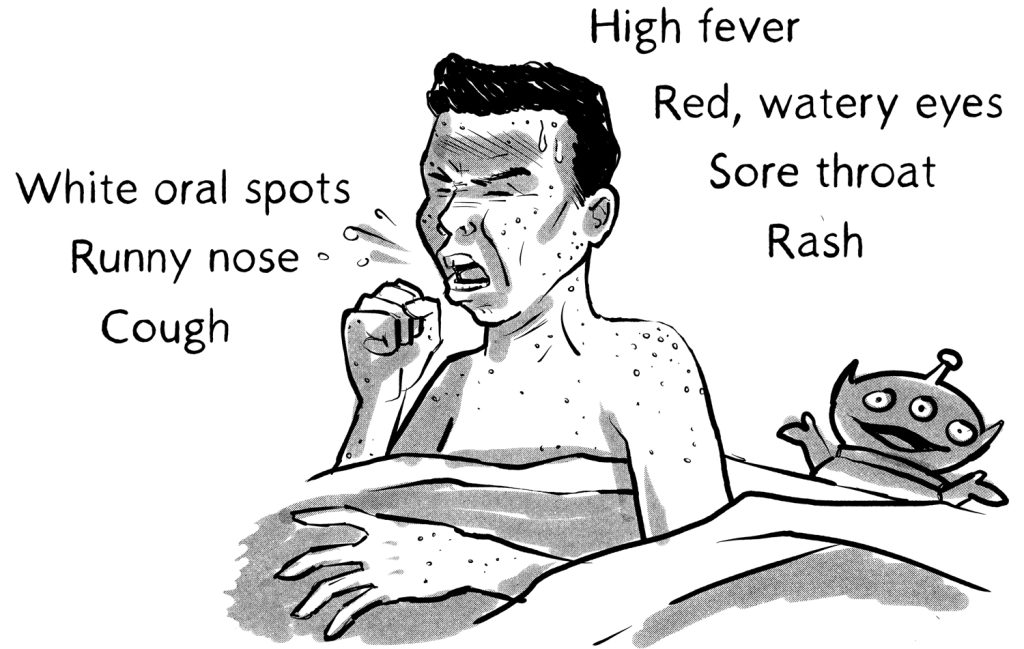
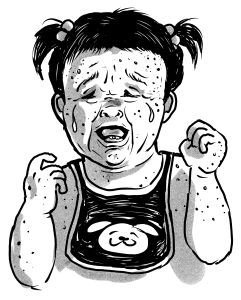
Measles symptoms typically appear between 7 to 14 days after exposure to the virus, typically starting with high fever, sore throat, cough, runny nose, and conjunctivitis (red, watery eyes). In some cases, tiny white spots known as Koplik spots may appear inside the mouth two to three days after the initial symptoms begin. Within three to five days after the onset of the initial symptoms, the classic measles rash forms: flat red spots that start near a person’s hairline and spread down the body and limbs. As the rash progresses, small white bumps sometimes form on the flat red spots. A high fever often accompanies the spread of the rash, with fevers spiking to 104° Fahrenheit or higher in some cases. Approximately one in 10 people (usually children) with a measles infection will develop ear infections, and some people also develop diarrhea. People who are infected with measles virus can also develop bronchitis (inflammation of the lungs), laryngitis (inflammation of the voice box), and/or croup (inflammation and swelling of the airways).
Pregnant people who are unvaccinated and infected with measles may experience pregnancy complications in addition to adverse health outcomes for themselves. These pregnancy complications include premature birth, low birth weight, miscarriage, and neonatal death.
In some individuals, measles infection may lead to more serious complications, including pneumonia, encephalitis (swelling of the brain), loss of vision, loss of hearing, brain damage, long-term neurological issues, and death. The most severe complications are often observed in the following groups of people: children five years of age or younger, adults older than 20 years, pregnant people, and individuals with weakened immune systems. In the United States, approximately one in five unvaccinated people who are infected with measles end up being hospitalized, and between one and three children out of every 1,000 who are infected with measles die from respiratory and neurologic complications related to the disease.
Another layer to all of this is that the measles virus has the unique ability to erase immune history (immune amnesia). It does this by binding to and infecting immune cells, including memory T- and B-cells that are primed to identify pathogens from previous infections. These infected immune cells are then destroyed by the body’s immune response. Without these memory T- and B-cells, people are more susceptible to future infections, and it can take between two and three years for a person’s immune memory to be restored.
In the United States, the measles vaccine rate dropped below 93% during the COVID-19 pandemic and—with the rise of anti-vaccine rhetoric, increases in vaccine exemptions, and dismantling of public health infrastructure—has not increased. According to the most recent data, nationally, about 92% of children in kindergarten have completed the MMR series; only 11 states have met or surpassed 95% MMR coverage in kindergarten-aged children. In Louisiana, about 92% of kindergartners have completed the two-dose series and in Texas, where this most recent outbreak originated, about 94% have been fully vaccinated. This is a stark reminder of how infectious the virus is and how important it is to maintain the 95% vaccine coverage. Vaccine uptake also varies in different communities. The current West Texas outbreak originated in a Mennonite community, where, due to religious beliefs, the vaccination rate among children is low. At the time of publication, there were 309 identified cases across 14 counties in Texas, the majority of which were unvaccinated individuals, with 232 confirmed cases in children who were unvaccinated or of unknown vaccination status, 40 hospitalizations, and one death of an unvaccinated child. Anti-vaccine group Children’s Health Defense—which was founded and, until recently, run by Secretary Kennedy—has been using this tragedy to downplay the severity of measles and to spread vaccine misinformation.
The majority of cases in the West Texas outbreak have been observed in Gaines County, which has a kindergarten measles vaccination rate of only 82%. However, with vaccine rates low in this area, and with the measles virus being so infectious, this places the broader community at risk. Remember, viruses do not care about borders. There is a concurrent measles outbreak in neighboring New Mexico, with most of the 42 reported cases occurring in Lea County, which is just across the state border from Gaines County. Four additional measles cases have been identified in Oklahoma, all of which are associated with the Texas outbreak. There have also been measles cases confirmed in 15 other states this year to date; there is no evidence that these cases are linked to the outbreaks in Texas and New Mexico. According to Dr. Jennifer Avegno, the director of the City of New Orleans Health Department (NOHD), “Unfortunately, in America, due to all of the weakening and erosion of trust in public health and vaccinations, there aren’t a lot of places where that protection is above 95%, so we are quite vulnerable, and our youngest among us are the most vulnerable. I don’t truly believe that anyone wants to return to a time when we don’t care about children dying, because I just don’t want to live in that kind of world.”
Perhaps the most frustrating and tragic aspect of this outbreak is that it was preventable. Contrary to claims by Secretary Kennedy, the MMR vaccine does not cause deaths every year, and any claims that infection with measles offers protection later in life are unsubstantiated and dangerous. As Dr. Avegno reminds us, “Measles is a serious disease that causes real disability and even death, and I think many of us have the luxury of never having to think about that, because of measles vaccination efforts in the 1950s and 1960s on to present day.” In Dr. Hassig’s expert opinion, “[Kennedy’s position] is a really unfortunate position, to put it mildly. Frankly, [it’s] stupid. Because no one should be getting a disease just because you think it’s going to be better. I would like to hear him explain that when an infant dies of it and there’s nothing that can be done medically to prevent that fatal outcome. Or when a child is brain damaged from encephalitis secondary to measles.”
Prior to the development of a vaccine, it is estimated that there were between three and four million measles cases in the United States every year. Of these cases, there were an estimated 400 to 500 measles-related deaths and 48,000 measles-related hospitalizations annually. Concerted measles outreach efforts in the United States and the rest of the Region of the Americas led to the disease being declared eliminated in the U.S. in the year 2000.
Unfortunately, this did not last long. In 1998, British physician Andrew Wakefield published his infamous paper, which falsely linked the MMR vaccine to the development of autism in children. This paper was bolstered by anti-vaccine groups—which have existed since the first smallpox vaccination efforts began in the 1800s—and has led to a decrease in MMR vaccination uptake and the resurgence of measles in the decades since its publication. Despite the paper being retracted in 2010, and despite the evidence of numerous studies around the world involving hundreds of thousands of children—all of which dispel the link between autism and vaccines—this harmful myth persists.
Approximately 25% of U.S. adults still believe that the MMR vaccine causes autism. And this anti-vaccination sentiment also extends to other vaccines. The vaccination rates for childhood diseases—along with uptake of vaccination against respiratory viruses (influenza, COVID-19, RSV) across the population—continue to decline. Unsurprisingly, this has not only led to the resurgence of measles but other infectious diseases. Influenza-related deaths in the United States hit a seven-year high in the first two months of 2025. Other childhood diseases such as pertussis (whooping cough) are also resurging. According to Dr. Avegno, “We have the worst pertussis outbreak nationally that we’ve seen in many years, and that’s something that kills. We’ve had two infants die in Louisiana of pertussis this year; [pertussis] kills babies and old people.” The simple solution, of course, is to take preventive measures such as vaccination. Adds Dr. Avegno, “The pertussis vaccine is… in the Tdap [vaccine, which also protects against tetanus and diphtheria]. So we need to start talking about ‘Are you up to date on your tetanus?’ because it actually covers you for this one, too.” Declining vaccine rates are also a concern as the H5N1 avian influenza continues to spread among mammalian species. Though human-to-human transmission still has not been observed, the more transmission that occurs between different species, the higher the risk. If the virus does evolve to be transmitted between humans, vaccine misinformation could hinder control efforts. Among other concerns, co-infection with seasonal influenza and H5N1 could lead to more human-adapted H5N1 strains.
As so many issues are connected to the measles outbreak, we cannot ignore the ableism inherent to the anti-vaccine movement. The myth that vaccines cause autism implies that autism is a disease instead of a developmental disability, which is, as autism advocates emphasize, “a natural part of human diversity.” Part of the Trump Administration’s Make America Healthy Again (MAHA) commission’s focus is to decrease autism spectrum disorder and chronic diseases in the U.S. It is worth mentioning that the push to eliminate disability is rooted in fascism. There are many different causes of autism, which, historically, has been misunderstood and underdiagnosed. Rising diagnoses of autism could be attributed to improved methods of diagnosis. While children are typically diagnosed with autism around age three, some signs may appear between ages 12 and 18 months—which coincides with the recommended vaccine schedule for children—leading many to incorrectly link vaccines with autism. Dr. Avegno, whose son is autistic, emphasizes that: “To say that one particular treatment [or] medication causes autism, it doesn’t hold up and it’s insulting. Many of us with children on the spectrum, we knew in infancy that there was something a little bit different about them and that was long before they got their one year MMR. It just doesn’t jive, and it isn’t fair to kids like my son.”
The rise of health misinformation and anti-vaccine beliefs also coincides with an increase in the supplement industry, which has an annual revenue of $70 billion. There are certainly many reasons to criticize the pharmaceutical industry. However, unlike with vaccines or other lab-made pharmaceuticals, the U.S. Food and Drug Administration (FDA) cannot require that supplements be shown to be safe and effective before they hit the market. It shouldn’t be ignored that many top players in the supplement industry celebrated Kennedy’s confirmation as HHS secretary. As a practicing attorney, Kennedy earned substantial legal fees from personal injury firm Wisner Baum in their case against vaccine manufacturer Merck regarding the Gardasil vaccine, as well as from Children’s Health Defense for lawsuits over federal vaccine approvals. “I think, as in most things, you need to follow the money and understand what the connections are between whoever is providing information and what they’re getting out of it,” Dr. Hassig cautions.
This is not to shame people for choosing to use supplements. It is, however, important to understand what is and is not actually beneficial, and what is harmful. Secretary Kennedy has recently been on record touting the benefits of cod liver oil (which is high in vitamin A), steroids, antibiotics, and vitamin A as treatment and prevention for measles. There is no evidence that cod liver oil, steroids, or antibiotics offer any benefits for measles. It should also be noted that antibiotics may be used to treat bacterial infections, but not a viral infection like measles. Measles-related complications can arise in people with vitamin A deficiency, and the virus itself is known to deplete vitamin A levels, so, in some cases, vitamin A is given to measles patients. The dosages need to be carefully managed, however, as vitamin A can easily be toxic. The side effects of vitamin A toxicity are numerous and include birth defects, changes in vision, and liver and kidney damage. “It’s one thing to peddle snake oil that isn’t going to hurt you,” states Dr. Avegno, “but when you are advocating for treatments that are harmful… if I, as a medical physician, started doing that, my license would likely be taken away, so I’m not clear why non-doctors can do that and get away with it.”
Amidst all this, the work has not stopped; it is just getting started. Within hours of the Louisiana Department of Health’s (LDH) statement that the state will no longer be promoting vaccination, the New Orleans Health Department issued its own statement that underscored their commitment to providing access to vaccines and protecting public health, with the City of New Orleans also passing a resolution to support ongoing vaccine efforts. “[I]f we’re not talking about [vaccines], then it’s just not going to make it up to anybody’s priority list, right? So it’s not just that the state pulled back on the mass vaccination events, it’s that they said we’re not going to promote this. That’s the more damaging part,” says Dr. Avegno. The NOHD communications team has created social media campaigns (@nolahealthdept on Instagram) on topics including misinformation, the measles outbreak, seasonal influenza, and childhood vaccines. Efforts are also underway to identify new resources, since the state and federal governments can no longer be relied upon, and to strengthen the existing public health relationships and coalitions that already exist. “My team is working on [a] strategy,” says Dr. Avegno. “My hope is that we’re going to convene all the partners in this space and just lay it out, who has people to put shots in arms, who has messaging [and] reach, who has the data? You’re gonna see us. We’ve always done events, but I think we’re just going to have to double, triple, what we’re doing.” In the meantime, she wants people to remember that “you can still go to most pharmacies and get seasonal vaccines. [For] some of your childhood vaccines you can go to your provider, go to your pediatrician, go to your internist, and get caught up on your vaccines. So they’re still out there.”
Current measles outbreak is not just about measles, it is a result of the dismantling of our education, public health, and education systems. It is a reminder that there are those in power who would promote anti- and pseudo-scientific misinformation for their own personal gain, despite the consequences. And it is a reminder that we need to take care of our communities, using the best knowledge and resources at hand. As Dr. Avegno reminds us, “There’s millions of people we have to love and support and just show that we have their best interests, that we’re not trying to control them or take away freedom, that we really do care about them.”
For more information about measles and vaccine access, check out the following resources:
- New Orleans Health Department: nola.gov/next/health
- New Orleans Health Department social media: @nolahealthdept
- Vaccine availability in your area: vaccines.gov
Post-Print Edition Update
Since the April issue went to print, there are currently five measles outbreaks in the U.S., with over 600 confirmed cases in 21 states, a number that continues to increase as new diagnoses are made and transmission continues. A second child has also died in Texas of measles-related complications. The majority of the cases are associated with the West Texas outbreak. Unsurprisingly, approximately 97% of current reported measles cases are people who were either not vaccinated with the MMR vaccine or were of unknown vaccine status. Despite this, HHS leadership recently prevented the publication of a CDC measles risk assessment. Dr. Peter Marks, the FDA’s top vaccine official, also resigned due to Secretary Kennedy’s “misinformation and lies.” We continue to see the negative effects of the misinformation and lies: several children in Lubbock, Texas were recently hospitalized and treated for Vitamin A toxicity, and yet recommendations for Vitamin A treatment were added to the CDC’s measles website. However, there are reports of increasing interest in vaccines due to the measles outbreak, some needed good news. Kennedy has also finally publicly acknowledged that the MMR vaccine is the most effective way to prevent measles. At the time of this writing, there have been no confirmed cases in Louisiana.
State and local health departments, especially in more progressive jurisdictions (including NOHD):
- Kaiser Family Foundation: kff.org
- The World Health Organization: who.int
- Public Health Agency of Canada: canada.ca/en/public-health.html
- European Centre for Disease Prevention and Control: ecdc.europa.eu/en
- Science-Based Medicine: sciencebasedmedicine.org
Illustrations by Kate Lacour
