
Laura Fisher
Laura Fisher’s apartment is filled with artwork and instruments. Every square inch displays a keyboard or a watercolor. Even the backyard lizards consistently come to the window to admire her gallery. She is the sort of artist who supports other artists on a deep level by co-producing and helping them arrange their solo projects, playing in their live bands, going to shows, and commissioning paintings. The bands that Fisher currently performs with, in addition to her own, are Avery Island BCE, jess joy, loucey, D. Sablu, Lyla George, (until recently) Matron, and occasionally Chloé Marie, Amelia Neville, and People Museum. Not surprisingly, she also has a few projects in the works. We had to cut this interview down from five hours, much of which was just spent listing how many people Fisher has played with and admires. We narrowed it down to stories about Fisher’s formative years, bonding with sound engineers, and becoming an unintentional ambassador for KORG.
Let’s dive right into your love affair with synths.
The first time I ever bought a synth, I was like 20. I bought a basic microKORG to play in my first band. I think I got it in a music shop [in NYC] on West 30th Street where there’s definitely no music shop anymore. I picked it because it was cheap and small and I could carry it around town really easily. It was my introduction to synths.
I was at Saturn Bar for the Matron gig in May and noticed that you still play a microKORG.
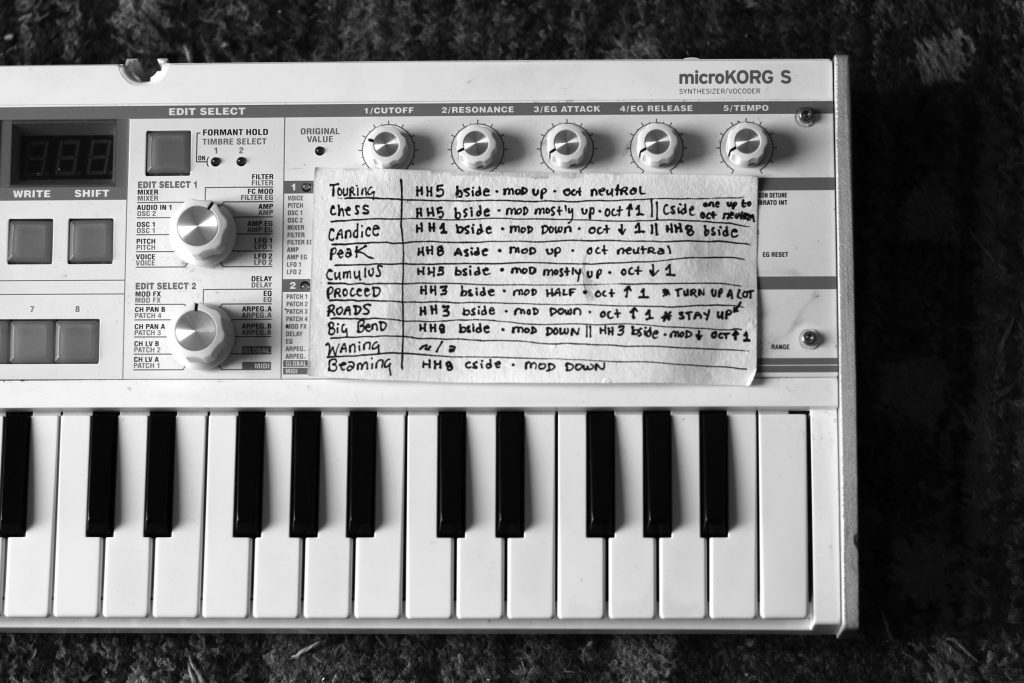
I do, but it’s a different one. Years back, I was on a road trip with Jon[athan Arceneaux]. We were trapped in a hotel room in what seemed like a kinda shitty town, so we were like, “Maybe we should buy a couple of instruments to have while we’re there.” Jon bought this acoustic guitar and I bought this synth. The microKORG S is upgraded. What’s cool about it is, obviously it looks really good ‘cause it’s white with wood on both sides, but it also has twice as many sounds. It has A, B, C, D for patches (the standard one is just A, B). My favorite feature though, and why I bought it for this trip, is that it has an internal speaker. It’s taken me a long time to unlearn how I played the piano and understand that synth is almost an entirely different instrument but, for me, the limitations are almost like a game.
And you’re actually really into games, so that must flow with how your brain works.
Yeah. A lot of the inspiration for my music is video games, specifically Zelda. I have a seizure disorder, so growing up, I was in and out of childrens’ hospitals and sometimes I’d have to stay up all night to get the EKG the next day or whatever, and I have really strong memories of, “Oh I have to stay up all night!” Which is fun as a kid but then at a point it becomes kinda hellish. So I’d be playing Nintendo 64, and music in the Zelda game and GoldenEye and Mario, that shit inspired me so much. It’s why I gravitate towards sounds that are kinda mystical. If I had a religion, it would be Zelda.
We have to talk about that Matron reunion show. It was wild that it was both a record release party and a final performance.
That was our first one in five years. Matron was a band back in the day, 2017 to 2020. We met doing those Print Shop cover bands. Our first one, we put together a seven-piece and did a King Crimson cover band that I fronted. When we did Tom Waits the next year, our old bass player sounded just like him. For King Crimson, we had to practice so much but for Tom Waits, we were like, “We’re only practicing twice, and we’re getting drunk.” [As Matron] we got to open for a lot of bands we loved and toured a bunch. Speedy Ortiz, Tera Melos, Piehole, SPIRIT OF THE BEEHIVE, Guerilla Toss… We weren’t even trying to be a real band. We were just having fun. We were all coming out of some heartbreak from other bands and it took on a life of its own. But COVID fucked some shit up. When you have time, you change, and everything happened so fast for us in those years. It was so nonstop that we never had time to slow down and check in and decide creatively where we were at or where we wanted to go next.
I see that your two microKORGs are part of a whole KORG collection.
It’s not like I’m trying to be a KORG ambassador, I did just end up with a lot of KORGs. I used to think of the microKORG as an introductory synth (it’s very niche) but now I feel like so many people, when I play this thing, are shocked at how much I can do with it and that’s kind of the fun. It’s not necessarily the easiest instrument to put into an emo-tinged indie rock band, which is what I play with Amelia Neville, but I play these lines that she wrote and it makes sense. And to play this in a band like Matron, that’s a math rock prog-y band, and I’m one of the only two melody-leading instruments, is almost just a sport at this point. I don’t need to make it this limited but sometimes, with too many options, our brains shut down. That’s why I love improv and intuitive living. I’ve already overthought plenty of stuff in my life. Now I just want to flow.
Show me your KORG prologue! What is that bright blue patent leather, yellow silk case about?
It’s ridiculous. Aaron [Boudreaux] calls it the Limited Too case. When I first played with People Museum, we were trying to see if I could become the backing tracks that they use, so I had stacked synths: I was borrowing Aaron’s [KORG] prologue and Claire [Givens’ KORG] minilogue (now I own both) because they created some of these songs on those specific keyboards, so they had some of the patches already programmed. We did a two-hour show at the Marigny Opera House around January 2020, with no tracks. I played real piano, stacked synths, I sang… it was a lot. It was really amazing, though. Then it shifted to where, when they got really cool, really artsy gigs, they would bring me in, so I played when they got the grant through NOMA to write a full EP about Louise Bourgeois and the ballet they did a couple of months ago.
You have some Casios and a Yamaha too?
Oh, this one’s really cool. Claire and I were working on her solo record and right before she moved to L.A. last year, she gifted me this [Yamaha] DX7. The lore is that Jeremy [Phipps] gifted it to her, Ben Lorio gifted it to him, Eric Heigle gifted it to Ben, and it was originally procured from Nothing Studios because it was Trent Reznor’s. Nine Inch Nails was a huge influence on me growing up and also a huge influence on Claire and I feel like you don’t always hear that in our music. But then if you know that, you’re like, “Oh, I totally hear it.” So, she wanted to keep it in the fam of someone who would use it. There was actually a shortage of DX7s in the ‘90s, because he would buy them all and break them on stage every time they played a show.
Let’s dive into your solo career.
Putting out solo music only happened for me during the pandemic. It was a focus when I was a lot younger and then it just wasn’t for, like, 15 years. I really intentionally wanted to grow as a songwriter, a producer, an arranger, and even a keyboard player in that time. When COVID happened, I was immediately aware of all this solo music I’d made over the years and never released or focused on, so I put out my first solo record [Tracing Our Veins in Spherical Time] within weeks. I pulled from different things I’d already made, a lot of it I mixed myself and recorded back in the day. A lot is electronic instrumental stuff, some with vocals. It’s Bandcamp only. I was hardcore Bandcamp-only during COVID because my hustle, non-music job was non-existent and everyone was at home on their devices, so they were actually buying music.
We both started performing classical piano very young. And I love that, for you, it developed into a lifetime of playing keys.
I owe it to this woman, Meral [Guneyman] who went to Juilliard and is a world-renowned pianist and just such a special human. She started a little school at the end of my street, very short-lived, called Kindermusik. My mom put me there when I was six—she did a good job pushing me towards important things. When the school shut down, we couldn’t really afford her, but she’d teach me for cheap, if not free. And then when she moved three hours up into North Jersey, she continued to drive down to see me or we’d drive up there. She became a second mother to me and she was so connected in these worlds to all these boards and organizations. Judges would come from London to her house. I was rigorously tested. My childhood best friend, Trevor, my duet partner, the first song either of us ever wrote, we wrote for four hands, one piano and we dedicated it to her. We entered it into this competition and we won and got to perform it at Lincoln Center. We were, like, 10 years old—that level of things. I was getting hired to play solo piano when I was 11. We’re still in touch. Meral came down for Jazz Fest this year and got to see me perform for the first time as an adult ever… The reason I’m gassing myself up as a kid pianist is because I only know it’s for sure because I saw a video of one of these orchestra performances, maybe six or seven years ago, and I was like, “Holy Shit!” It was way more impressive than I am or will ever be because I was just drillin’. I was in that world. I was on the fast track to Julliard. And then I woke up one day when I was 12 or 13 and I was like, “Do I really want to play dead white guys’ music for the rest of my life?” and I quit and it was devastating.
I have a copy of your double EP Rose-Coloured Dream / In Name Only, For It Is Neither and, before I go, I wanted to talk about your collaborators on that.
The A-side of the record [Rose-Coloured Dream] came out spring of 2023. It’s almost all songs I wrote when I was 19. The B-side [In Name Only, For It Is Neither], the musicians wrote all their parts and sent them to me. Everything was like, “Hey, I trust you.” Cassie [Watson Francillon], who I’ve collaborated with many times, wrote her harp part, Theresa [Romero] wrote multiple layers of viola parts, Jeremy [Phipps] and I collaboratively wrote his trombone parts, my friend Sam [Hollier] wrote his cello parts, and Adam [Keil] engineered and played guitar on a track. [Adam]’s my number-one stunner, my co-producer extraordinaire, my bandmate extraordinaire, one of my best friends, and my most trusted musical companion. I feel like I can be the artist I want to be if I have a soul bond with an engineer that’s a consistent figure in my life. Rose-Coloured Dream was me and Adam being like, “What if we just make this into the synth record of our dreams that we want to listen to and that sounds like everything we love?”
With all of the bands you’re already in, I know you still have at least one more that’s in the works.
It doesn’t exist yet, but we’ve had two improvisational performances and some of it sounds like it’s fully composed. We’re on that level. It’s a project with Jon[athan Arceneaux] and Rex [Gregory]. They’re routine collaborators who are in my seven-piece band. I’ve been in a million projects with Jon; Rex too, honestly. Jon wrote the drums to my A-side [Rose-Coloured Dream], Rex was in the live band. We’re huge influences on each other. The first band I was ever in with Jon—Tranche—Rex subbed on synth and is also on that recording, which is wild, ‘cause we got heavy. We exist through threads of each other’s musical journey over the past many years. Everyone who knows us will be like, “It’s about time.”
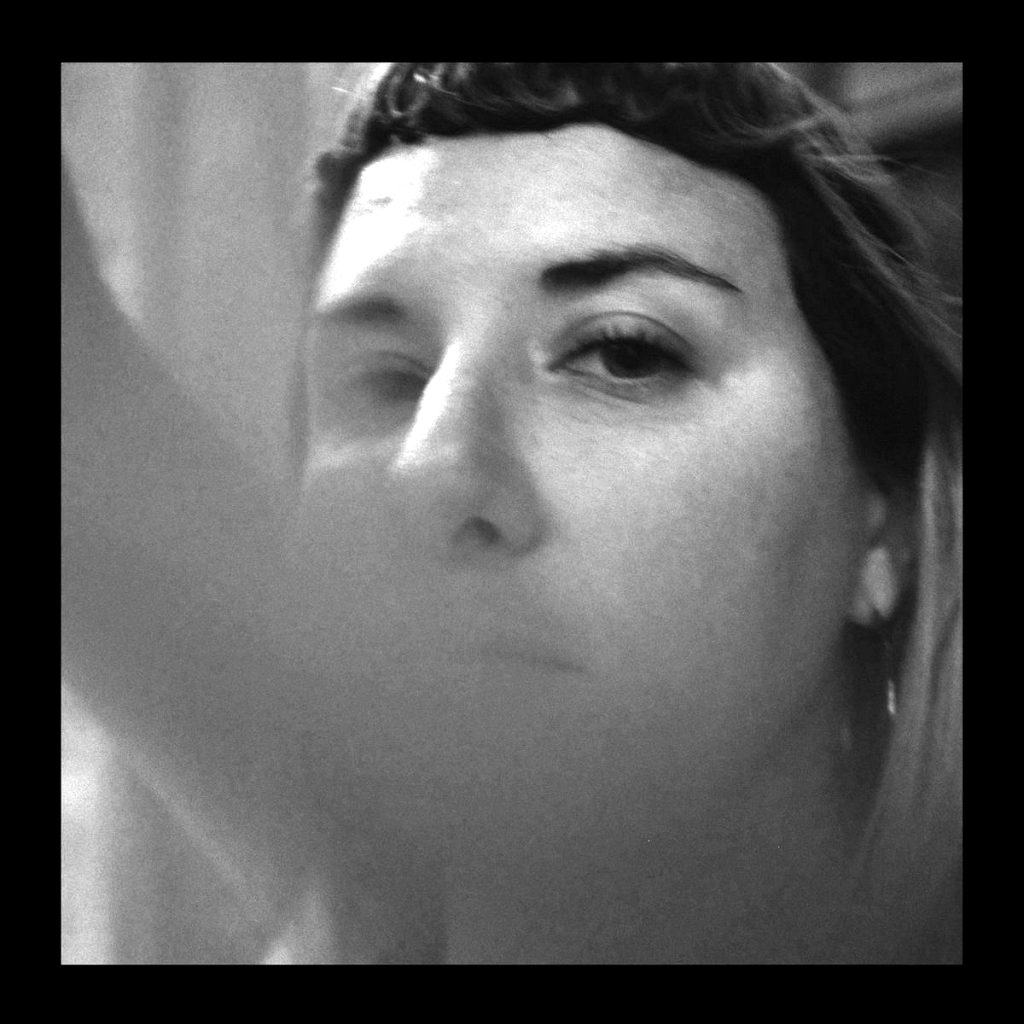
For Laura Fisher’s solo work, check out laurakfisher.bandcamp.com.
All photos by Sabrina Stone except bottom image: Rose-Coloured Dream album cover
